New Glock 19 and 23 RTF2

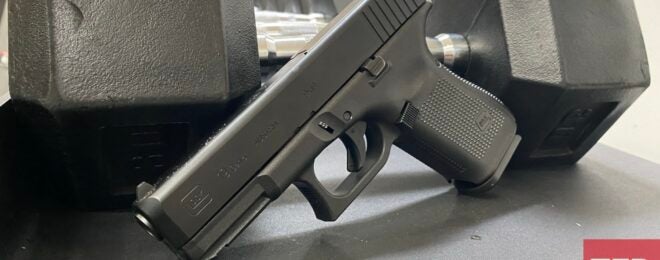
The 9mm compact Glock 19 and .40 S&W compact Glock 23 will both be offered with the Rough Textured Frame (RTF2). This frame does not replace the standard Glock frame, better known as the 3rd Gen Frame, on the G19 and G23, but will be available as an option.

From the press release:

The G19 and G23 are two of the most popular GLOCK models. The G19 9x19 compact is widely used all over the world. In addition, the G23 in .40 caliber is quite popular with both law enforcement and private individuals as a back up or concealed carry firearm. Adding the RTF2 finish to these compact models increases the options for law abiding

individuals and organizations. Along with the new RTF2 finish, each of these GLOCK pistols have the same time tested "Safe Action" system, durable exterior finish, cold hammer forged barrel, durability, reliability, and light weight that GLOCK is famous for.

2009shotshow day1 2009shotshow 01152009 041 tm New Glock 19 and 23 RTF2 photo
Glock G22 .40 S&W with RTF2 frame. © Ken Lunde. Used with permission.

The first RTF2 pistol, the G22 RTF2, was unveiled in January after much speculation. This was followed a few months later by the G17 RTF2.

Related Posts

Posted by Steve on Nov 7th 2009 | Filed in handguns | Comments (5)
Tags: , , , , , , ,

[Guest Post] Visit to Atlanta Arms and Ammo

[ I am pleased to present this guest post written by Ken Nelson, who blogs at his self-title blog Ken Nelson ]

My 12 year old son and I are in Georgia this week to attend the Army Marksmanship Unit Junior Shooter Camp.

Today, he and I visited Atlanta Arms & Ammo in Social Circle, GA. I needed .40 ammo for a training class I’m having on Friday, and they graciously agreed to show Brian & I around their plant.

If you reload then you know how frustrating and fussy reloading machines can be. Just imagine a shop filled with these:

image 16 tfb [Guest Post] Visit to Atlanta Arms and Ammo photo

Note that these are inline not rotary. Also everything is automatic. The only thing the operator needs to do is keep the primer rod full. They have a machine which fills the rod, the operator has to switch in a new one over every few hundred rounds.

Each of these machines makes about 60 rounds a minute, there were about 15 stations. So you do the math :)

Each machine, which they generally buy used, costs $10,000 to $12,000. They then add customized switches and electronics to test that the machines are operating correctly. For instance the case sizer has an air line to it, if air slips out there is no seal and a switch goes off and drops out the bad round. Pretty slick!

As you can imagine they use a lot of bullets. And primers, which they also buy in 5 gallon buckets. They buy new brass, but also get a lot of once fired brass that they prepare in a whole another assembly line, including a system of brass sorters they designed themselves and that are quite clever.

Here is a front on view of an ammo making station:

To the left is a bucket of bullets, at top are brass and bullet feeders. The slender metal tube in the middle is the primer feeder. The machine at far right is a primer filler tube filler. Moving that filled tube to the machine is the only manual step and is done every few hundred shells. The black box with switches is the custom QA monitor they have tied to checks they’ve built in the machine.

After the ammo is made it goes in for polishing and then into a vibrator that gets them heavy (bullet) end up:

and are then hand packaged using a series of steps that flip them in a special die until all are facing the right way:

image 20 tfb [Guest Post] Visit to Atlanta Arms and Ammo photo

The elite shooters of the United States use their ammunition, including the Army Marksmanship Unit.

If you are looking for excellent ammo, made by a group of top notch and friendly people then Atlanta Arms & Ammo is for you. As we left our guide stressed that today, in these high reloading component cost times, in many cases they can get ammo to competitive shooters for about the same as reloading. Similar price… and I don’t have to spend hours running a reloader? Or pull my hair out when it doesn’t work? Sign me up!

Many thanks to Danny at Atlanta Arms & Ammo for setting up our tour. And to Kim for being such an agreeable and friendly host.

Related Posts

Posted by Steve on Nov 6th 2009 | Filed in ammunition | Comments (2)
Tags: ,

[Guest Post] The Williamson Derringer

[ I am pleased to present this guest post written by James A. Zachary Jr. James blogs at The Next Chapter ]

Norm Flayderman’s Guide says that Williamson Derringers have serial numbers running into the 20,000 range but speculates that the Moore Patent Firearms Company / National Arms Company produced fewer than 10,000 of these pistols from 1866 – 1870. The subject of this post has serial number 10621. Perhaps unique to this Williamson are the decorative rhinestones, the heart inlays, and an Ace of Hearts playing card engraved on the backstrap. Further, there is a treaded-plug in the butt of the grip; I have not seen this on any other Williamson Derringer. I would be interested to hear any ideas on what its purpose may be. Someone suggested that it might be for mounting the derringer as a “burglar trap” with the trigger wired to a doorknob.

David Williamson’s design adhered to the aesthetic lines of the original Henry Deringer pistols but he decided to fill a niche market created during the period of transition from ball and percussion cap pistols to those designed to fire metallic cartridges; his derringer would be able to function with both. If .41 rimfire cartridges were not readily available, a reusable metal cartridge adapter allowed the use of loose black powder with a lead ball and a percussion cap.

The pistol requires no adjustments to switch between the ball-and-cap adapter and the .41 rimfire cartridge. During rimfire cartridge ignition, as you would expect, the extended blade firing pin on the hammer strikes the rim of a chambered .41 cartridge. When using the cap-and-ball adapter, the flat of the hammer whacks the percussion cap that is on the nipple of the adapter. The cap nipple, which extends into a hole in the breach when the barrel is closed, keeps the hammer from going forward far enough to damage the extended blade firing pin which otherwise would slam against the adapter’s rim.

To load the Williamson Derringer, first pull the hammer back about one quarter of the way until it clicks into its safety position, then push up on the barrel release lever that is on the underside of the pistol (just in front of the trigger guard) and slide the barrel forward. Insert either a .41 rimfire cartridge or the cap-and-ball adapter (after first charging it with ball and powder; it is probably best not to cap the nipple until after the load is in the barrel chamber). Slide the barrel back to the closed position and you are then ready for an 1866 night out on the town.

Related Posts

Posted by Steve on Nov 6th 2009 | Filed in blackpowder, handguns | Comments (3)
Tags: , , ,

Kari from Mythbusters with .50 BMG

Grant Imahara posted this photo on twitter of Mythbusters co-host Kari Byron.

kari mythbusters sniper rifle tfb Kari from Mythbusters with .50 BMG photo
Looking hot (in both meanings of the word)

I really hope this means the mythbusters are going to prove that .50 BMG rifles cannot shoot down a Boeing 747 cruising at 35,000 feet at a speed of 555 mph :)

Can anyone identify the bullpup, possibly single action and probably .50 BMG rifle? The first thing that popped into my mind was "Steyr" but the only similar looking gun that Steyr ever made was the Steyr AMR / IWS 2000 prototype. Maybe it is a custom stock?

UPDATE: Daniel points out that Kari's rifle seems to be a Maadi-Griffin single shot - I agree.

Hat Tip: Crunchgear

Thanks to mrsatyre for the link.

UPDATE: More pics from the show. Thanks to James for the links.

From Left: Sako TRG-48 in .338 Laupa Magnum, Maadi-Griffin .50 BMG, Barrett 99

Myth: Are phone books good for vehicle armor??!?! Seriously?

UPDATE: As HeartlessLibertarian pointed out that the rifle in the second picture is a Barrett 99, chambered in .416 Barrett.

Related Posts

Posted by Steve on Nov 6th 2009 | Filed in photos, rifles | Comments (15)
Tags: ,

[Guest Post] Bea, the 78 year old grandmother and handgunner!

[ I am pleased to present this guest post written by David. David blogs at True Blue Sam the Travelin' man. ]

There is nothing unusual going on at Bea's loading bench, except this 78 year old grandmother has been a handgunner for just over a year, and now she is loading her own .45 ammo! Her journey as a shooter has been rather remarkable, but she has always had lots of pioneer moxie, and she is still an active person who wants to be able to defend herself and her home.

Dwain, Bea's husband, passed away in 2005, and owned several guns. One was his 'house gun,' a Smith and Wesson Model 36 snubbie. She realized that the little .38 would be difficult for her to master, so she had one of her sons help her pick out a new pistol for her to build her shooting skills. Her first purchase was a Walther P-22, and on her 77th birthday she went to the local range for the first time. The little Walther was easy for her to handle and to shoot; the only problem she had was stripping and reassembling after her range trips. As long as it was fed plated .22's, this gun never failed to function. Bea was now a handgunner, and a pretty good shot, too. Check out the target with thirty offhand shots at thirty feet with her little auto.

img 9537jpg tfb [Guest Post] Bea, the 78 year old grandmother and handgunner! photo
P-22 target with thirty shots at thirty feet.

Bea shooting her Walther P-22.

Bea next learned to handle revolvers by starting with her son's Ruger Single-Six, and she found that she could shoot it more accurately than she could with the little Walther. She got lucky and found a used Single-Six in excellent condition at her local Scheel's store, and soon she was shooting the revolver more than the auto. Her son then introduced her to centerfire with a Ruger Blackhawk, and she found that shooting .38's was easy for her. She looked at the options with Ruger Blackhawks, and when the Scheel's store got a .45 convertible, she bought it. The big slow bullets are easy for her to handle, even though she weighs less than 110. At the range she will shoot several cylinders through the Single-Six, and then one or two through the Blackhawk, then switch back to the .22. Careful practice has kept her from developing flinch problems.

Bea buying her Blackhawk

img 0919 1b tfb [Guest Post] Bea, the 78 year old grandmother and handgunner! photo
Shooting the Blackhawk for the first time.

Her son has been reloading for many years, and he set her up to reload for her .45. A surprise benefit of the convertible Blackhawk is the free once fired brass other shooters leave behind at the range. Every range trip begins with policing for new brass before setting up to shoot.

Bea at loading bench

In September Engineering Johnson, her grandson, took her along to the Gun Blogger Rendezvous, and she was thrilled to meet Mr. Completely, KeeWee, and the other bloggers she has been reading. She says it was the most fun she has ever had. Mr. C even let her shoot his long barrelled High Standard, and Bea had some respectable times hitting the steel plates on the second range day. She is planning to go again next year.

Bea with her .45 at the GBR Show and Tell

She has several range friends in her hometown, and she is spreading the joy of shooting by teaching the basics of gun safety and pistols with new shooters. One of her new found friends is a nine year old boy who is regularly beating his dad at hitting the bullseye with her Single-Six.

Bea would like for more women to realize that they do not have to be defenseless, and that even a small framed womam can shoot a gun that is powerful enough to stop an attacker. Thank you for setting such a great example for all of us, Bea.

Gun bloggers KeeWee and Molly with Bea.

[ GBR photos were taken by The Packing Rat ]

Related Posts

Posted by Steve on Nov 5th 2009 | Filed in handguns, video | Comments (13)
Tags: , , , ,

[Guest Post] Sig Academy Bullets and Vehicles Course

[ I am pleased to present this guest post written by Jonathan Sun. ]

A couple weekends ago, I participated in the Bullets and Vehicles course at Sig Sauer Academy in Epping, NH. I wanted to share my experiences during this course for those who might be interested in training there, or firearms training in general.

3976950619 f8270e5eb7 [Guest Post] Sig Academy Bullets and Vehicles Course photo

My Background

I’ve had an interest in firearms since my teenage years, thanks to my father. Only more recently, I would say the last 4-5 years did my interest in training or competing grow. Training began with Sig Sauer Academy (formerly SigArms Academy). The impetus was that my first handgun was a Sig P229R and the facility was close enough where I thought trying out some of their training wouldn’t cost an arm and a leg. I’m not LE/MIL or a HSLD type, so this type of training is more academic in the sense that it would be something nice to know in case stuff hits the proverbial fan. Previous classes I had taken were:

This path was recommended to me, while not being a new shooter, it definitely did help fine tune existing fundamentals and reinforce training techniques that they use at Sig. The Bullets and Vehicles course was designed to help expose myths surrounding how bullets behave around vehicles and to help give you a better chance at surviving a confrontation at or around a vehicle.

Morning Drills

This was an 8 hour 1 day course that started at 8:30A. It began with an in classroom meeting to go over the safety guidelines and introduce ourselves to the instructors. There were approximately 8 of us plus 3 visitors from South Korea. Two of the visitors worked for a South Korean gun magazine and the third was a South Korean SWAT member. From there we moved to the indoor range staging area and prepared to gear up. Those who did not have equipment were issued equipment from the armory. After equipping we proceeded to the outdoor range.

The drills began dry and as always the emphasis was on safety. The main thing we had to consider while doing these drills was drawing and not lasering ourselves and our neighbor ahead/behind/or to either side of us. The instructors had us run it dry from seated positions while simulating being seated in a vehicle. After they were confident that we moved on to live shooting drills.

Afternoon Drills

When we returned to class, the instructor, I’ll as SK, showed us a diagram explaining the tendency a bullet will have when shot into or out of a windshield. I say tendency because they emphasized that bullets around vehicles are extremely unpredictable and that the best chance you have is to understand how they tend to behave around them. Essentially when the bullet impacts the windshield, the portion of the bullet that impacts the windshield first, that is the direction the bullet will tend to travel. In the case of shooting outwards the bullet will tend to deflect upward and shooting into a vehicle it will tend to deflect downward. After class we moved to the donor Taurus sitting on the far right of the range. SK demonstrated a way to use the car antenna, assuming the older style wire antenna, as an improvised glass breaker and several dedicated pocket knife like breakers/seatbelt cutters.

3976959859 0dae8c0e1a [Guest Post] Sig Academy Bullets and Vehicles Course photo

Fighting from the Vehicle

We took turns taking shots through the windshield from the front passenger seat into a target downrange. The goal of this exercise was to show the angle and degree of deflection once the bullet impacts the windshield. Basically, the amount of deflection in this case, with 9mm and the Taurus windshield, was approximately 7-8 inches. The target we were shooting at was about 5 feet away from the front of the vehicle. About 50-60% of the 9mm rounds exited and struck the target, the other 40-50% of the time, the bullet fragmented before exiting, with small pieces striking the target unpredictably.

The second drill during this phase, they had is sit in the driver’s seat, drawing without lasering ourselves and engage targets from the driver’s side window. Simulating or enhancing stress they had an instructor jumping up and down in the door jamb of the rear passenger side to make aiming more difficult. The big thing they wanted us to take away from shooting within the vehicle was that it was not a great place to be if you needed to engage a threat, and you should make your way out of the vehicle to better cover.

Vehicle as Cover

When using the vehicle for cover, they wanted to emphasize not crowding the vehicle. Crowding the vehicle can make you more likely to get hit from ricochets over the top of the hood or trunk. They had us attempt it, and quite to my surprise it was not difficult to get skipped bullets on target within 1-2 shots. The amount of deflection from the skipped bullets was such that, if you were using a hood/trunk for cover and were sucked up against it, you would very likely get hit if you took a peek. If you were farther away from the vehicle the chance the bullets would deflect over your head increases. The other suggestion besides the obvious engine block was to use the wheels/wheel wells. The thought process behind this being that you had a steel or aluminum wheel and behind that the disc brakes as some intermediate cover. To simulate this, they had us take turns engaging a steel target, while laying prone from underneath the vehicle.

3977716364 d2d308aacf [Guest Post] Sig Academy Bullets and Vehicles Course photo

From a Moving Vehicle

We then proceeded to engage multiple targets while in a moving vehicle. SK drove his Tundra diagonally across the outdoor range and had students take turns sitting in the passenger seat engaging multiple stationary targets while the vehicle was in motion. The point of these exercises was that it is not a great situation to be in and that the best case scenario is that any amount of ammo you’re sending downrange will at least keep heads down if you’re unable to neutralize the threat.

Various Calibers

For the last part of the range exercise, they had us engage the vehicle with various calibers to see how effective/ineffective each round was. We tried .22, 9mm, .40S&W, .45ACP,.357Mag,.44Mag,.223,.308,.338Lapua and finally .50cal. The results were such that someone reasonably armed for CCW, 9mm appeared to be the most well rounded for usage around a vehicle. The interesting to note, the .40S&W (what I shoot) and .45ACP were poor at traveling through the windshield, they tended to fragment catastrophically. They also tended not to travel through the vehicle, when shot door to door. The lack of over travel may or may not be something you may want depending on whether the threat is inside/outside of the vehicle.

3977717636 b638752251 [Guest Post] Sig Academy Bullets and Vehicles Course photo

Concluding

This class was as engaging as any other of their classes, possibly more so due to the amount of myths and conjecture about how bullets will behave around vehicles. The instructors are extremely attentive and knowledgeable. While being experienced, they have a demeanor that makes it easy to ask questions and they invite it. The facilities have reactive plates so you’ll get immediate feedback when you’re on target or not, which is great for tuning or fine tuning your training. The round count for the class was just under 300, which is about average for a one day class. I highly recommend professional firearms training for anyone, regardless of where it may be, as there are a lot of things to consider that you might not realize if you plan on CCW.

If you have any questions for me or about any of the courses above, please feel free to email me, or ask in the comments below.

Alt text

Contact Info for:

SIG SAUER Academy
233 Exeter Road
Epping, NH 03042
Phone: 603-679-2003
Fax: 603-679-1639
Email: sigsaueracademy@sigsauer.com
Web: www.sigsaueracademy.com

Related Posts

Posted by Steve on Nov 4th 2009 | Filed in handguns | Comments (19)
Tags: , ,

[Guest Post] Matt’s Ruger Blackhawk .45

[ I am pleased to present this guest post written by Matt Green ]

This Ruger .45 my Dad left me is one of the first weapons I ever fired.

My grandparents had a farm in central Minnesota, near St. Cloud, and we would drive the two hours to visit every month or six weeks or so. Nearby was an old iron bridge, crosshatched with braces, bedded with wood that beginning to rot as the bridge neared the end of its first century of usefulness. The newer highway bridge went over the slow moving creek a couple of hundred yards upstream, so the metal bridge on the dirt road was relegated to cars and small trucks. It was too small for any modern farm machinery to pass across it.

But it was a great place to learn how to shoot. Dad would bring out his Ruger Mk1 .22 and this Blackhawk, and my three brothers and I would take turns shooting pop cans and empty ammo boxes floating in the river, tossed in on the upstream side of the bridge. Dad would occasionally take a turn with the .22, but he mainly used his .45, usually stoked with ACP ammo, since it was less expensive than Long Colt. It was also a way for him to see if we’d been fooling with his pistols in his absence, as he caught my younger brother once when he hadn’t put the ACP cylinder back in. Dad loaded a .45 ACP round, and it dropped deep into the LC cylinder. One look at the bunch of us, and he knew which brother was guilty.

When we exhausted the .22 ammo, we’d each get a cylinder full of .45 to shoot, or most of one, since five rounds each made the box come out even. It was harder to shoot well than the .22, and much louder (I don’t remember that we bothered with ear protection back then), but it was very satisfying to shoot it well and have Dad comment as much.

I miss him, and think of him whenever I shoot the old Ruger, or really, whenever I handle firearms in general. The interest I have in firearms now was sparked long ago by shooting with him.

Related Posts

Posted by Steve on Nov 4th 2009 | Filed in handguns | Comments (7)
Tags: , , ,

[Guest Post] Antelope hunt in Wyoming

[ I am pleased to present this guest post written by Ed Friedman. Ed is the Associate Editor at the NRA's Shooting Illustrated magazine and blogs at Tell Me Why?. ]

First off, thanks to Steve for letting me guest blog. It's an honor to be here.

I just got back from an antelope hunt in Wyoming with Barnes, Weatherby and Zeiss (the best perk of working for an NRA publication). Weatherby supplied a very nice shooting Vanguard in .257 Wby. and ammo topped with 80-grain Barnes Tipped TSX bullets. As you might imagine, these lead-free projectiles simply scream out of the barrel-with a muzzle velocity of 3,870 fps.

Photo Credit: Kyle Wintersteen of the NRA's American Hunter.

Fortunately, Wyoming is overflowing with pronghorn, and finding one was not a problem. We also had a guide who knew how to judge wind, though he wasn't 100 percent certain how the little 80-grain bullet would handle the roughly 25 mph gusting winds accompanying the lovely sleety snow falling as we came up on my goat. I ended up holding about 2 feet behind the vitals to compensate for the wind. At 230 yards with a .257 Wby., I didn't need to worry about bullet drop. A single shot dropped the antelope, though the wind pushed the TTSX bullet to the critter's neck. Still, it was about as humane a kill as possible-essentially koshering the animal.

We couldn't find the bullet, which obviously passed through the animal, what with its solid-copper construction and a velocity of more than 3,000 fps at 230 yards, but I'd say it performed as advertised. The TTSX is hyper-accurate and even a lightweight model can do a ton of damage when you push it so darn fast.

We spent the next day of the hunt shooting prairie dogs to see if the TTSX would have a chance to expand in tiny varmints. I don't recommend trying this with .257 Wby. simply because it's on the expensive side, but when the ammo is free, knock yourself out. The velocity causes the TTSX to expand even in prairie dogs, which vaporized into a fine red mist to the delight of all spectators.

With the growing restrictions on lead ammo, Barnes has a bunch of all-copper bullets that perform as well or better than traditional lead. They tend to be a bit pricey, but the accuracy and terminal performance make them well worth the cost.

Related Posts

Posted by Steve on Nov 3rd 2009 | Filed in hunting, rifles | Comments (7)
Tags: , , ,

[Guest Post] The Australian Army’s Weapons Training Simulation System

[ I am pleased to present this guest post written by Brendan Leo, an Australian Army Cadet corporal. ]

As a corporal with the Australian Army Cadets, I recently had the opportunity to play with the Weapons Training Simulation System. As the name suggests, this is a fully featured simulation system. Trainees fire modified weapons at a cinema sized projection on a wall 10 meters away. Between the wall and the shooters are rocks, obstacles, and anything else you might find on a battlefield. Wind machines and lights provide for weather effects.

Army Cadets using the WTSS range.

The trainees usually fire modified F88 Austeyr rifles and F89 Minimi machine guns at the screen, but any weapon currently used by the Australian Army, as well as several of those used by an opposing force can be simulated. The scenario is controlled by a technician at a console behind the firing line, who sets the wind speed and direction, the weather, and even the number of round through each barrel. The weapon recoil is provided by a tethering line connected to a tank of CO2, and speakers in the butt replicate the sound. Everything down to magazine changes, and jams are simulated, and the weight of the weapon is almost identical to the real thing.

Reservists using a machine gun with the WTSS system next to 2 F88s.

The main utility in the WTSS system is in the many different scenarios that can be replicated, such as defending a position, quick reaction, and even the sudden appearance of a helicopter. The idea behind the system is that soldiers can be placed outside of their comfort zone, using their weapons against a range of targets in different conditions. Different accessories can also be used with the weapons, including but not limited to Ninox (night vision goggles), grenade launchers and reflex sights, in addition to the standard 1.5x scope on the Steyr.

Open day. Civilians loading the F88s.

At the end of the simulation, the simulated weapon is cleared in exactly the same way as the real thing; by locking back the bolt, removing and clearing the barrel, then replacing it and rendering the weapon safe. Scores are usually calculated by grouping, at the standard target range, the PASS mark for the Australian Army is a grouping of 200mm at 100m. A grading of sniper is achieved when a group of < 40mm is achieved with 4 groups of 5 shots.

Upon completion, a standard range declaration is carried out, and the trainees receive a printout of their score. The next detail then moves in to shoot. The convenience of having no brass to clean up and no targets to patch out is shadowed by the $15 million AUD price tag for each range.

Related Posts

Posted by Steve on Nov 3rd 2009 | Filed in military, rifles | Comments (19)
Tags: , , , , , ,

[Guest Post] You Don’t Say?

[ I am pleased to present this guest post written by Matt Groom.]

For many of us, our window to the world of guns is books, magazines, and the internet. Unfortunately, when you see a word or a name that you aren’t familiar with, you tend to do what you learned to do in school, sound it out in your head. This has lead to a plethora of often mispronounced words and names in the firearms community, and it makes us all look like rubes. I would like to point out some often heard examples along with the proper enunciation of each. Please note that I am neither German nor Scandinavian and I speak no languages other than American English, but I have asked and been corrected by people who do speak these languages.

hk tfb [Guest Post] You Don’t Say? photo
Heckler & Koch

Probably one of the most well-know arms companies in the world is known by its initials because nobody seems to know how to pronounce the last names of its founders. And everybody says their marketing department is SO great...

How most people say it: Heck-ler and C-au-k like “Cock”, or Coach, or KA-t-ch (?)

How it’s actually pronounced: “Heck-ler and Coke” Example: “Well, I’ll have a coke, then.”

Why is it mispronounced? “Cock” would be a very appropriate name for a gun company “Cock your hammer!” or “Those guys at H&K are a bunch of… Germans.”

Krag-Jorgensen

America’s first military repeater is also the most mispronounced of all service rifle names. No less and authority than the late great Col. Jeff Cooper corrected me on the proper way to say this name, and ultimately, he was incorrect.

How most people say it: Ker-Ag ,or Ker-egg Jor-gen-son

How it’s actually pronounced: Kr-Ah-g (like “Frog”) Yor-gen-sen.

Why is it mispronounced? A popular ballad during the Spanish-American War and the Pilipino Insurrection had a refrain that went “Underneath our starry flag, civilize ‘em with a Krag!” which certainly had a better ring to it than “If you want to eat a frog, do not shoot him with a Krag”. The proper enunciation may have been intentionally bastardized for pop-culture.

hus tfb [Guest Post] You Don’t Say? photo

Makers of everything from Weed whackers to Motorcycles to full-auto military rifles, this name seems to dumbfound even the people who sell them. A Swede who was a former employee of the firm in the 1960’s told me how to say it.

How most people say it: Husk-a-varn-a, Husk-Q-var-na

How you’re supposed to say it: Who-sk-Var-na

Why is it mispronounced? It’s Swedish.

prvi tfb [Guest Post] You Don’t Say? photo

These Serbian makers of high quality ammunition available at bargain basement prices have rapidly earned popularity in the US. After being sold for a number of years under different names by different distributors, they are now selling ammo under their own name and confusing many people with their Balkan-esque spelling.

How most people say it: Pervy Party-san

How you’re supposed to say it: PR-iv-A Part-iZ-on

Why is it mispronounced? Triple Consonants don’t make a whole hell of a lot of sense to most English speakers.

I have it on good authority that these are correct, but nobody’s perfect. There are lots more of these, but we’ll save those for another post. Let’s hear some suggestions for gun related names and words that are often mispronounced or which are confusing in the comments!

UPDATE:

Roy recorded himself pronouncing Heckler & Koch, Walther, Sauer, Luger, Mauser, Blaser, Weihrauch and Schmeisser.

Stefan recorded himself saying Anschütz, Heckler & Koch, Mauser, Sauer, Steyr Mannlicher, Walther and Weihrauch.

Related Posts

Posted by Steve on Nov 2nd 2009 | Filed in culture, howto, misc, rifles | Comments (51)
Tags: , ,

Remington is NOT developing a 6.5mm round

A few days ago Confederate Yankee wrote that Remington were not developing a 6.5mm cartridge. This contradicted what Adam Heggenstaller reported a couple of weeks ago. I checked with Jessica Kallam (Freedom Group - Remington's parent company), and the statement Confederate Yankee posted on his blog is the official statement regarding the ACR and 6.5mm round ...

We are not currently in the process of developing our own 6.5mm round for the AR platform. We have mentioned the 6.5 in our communications on the ACR simply because that platform is capable of handling the Grendel or something like it. At this point, there are no plans to chamber the ACR for the Grendel. However, that may change if we receive enough input from the marketplace to make it seem necessary.

Remington Military Products Division still list it as a caliber on their ACR webpage.

acr tfb Remington is NOT developing a 6.5mm round photo
Screenshot of the Remington ACR webpage.

I expect this has generated much confusion as the company now has an official statement regarding the issue. For now the only 6.5mm cartridge in the Remington stable is the .260 Remington1

Many thanks to rootman for sending me the top link.


  1. The .260 is a necked down .308. It is comparable to the 6.5x55 Swede, a full power cartridge, not an intermediate such as the 6.5mm Grendel. 

Related Posts

Posted by Steve on Nov 1st 2009 | Filed in ammunition, news | Comments (11)
Tags: , , , ,

Beretta Xplor

Beretta have been very tight lipped about the new Beretta Xplor shotgun. A well placed source provided me with some new information on the shotgun:

  • The receiver is green in color. The photo I posted previously is the real deal.

  • Despite being chambered for 3.5" shells, the receiver is small and light - comparable to a shotgun designed for 3" shells. As far as I know it is the lightest shotgun of its class.

  • The smaller action, combined with the new gas system, helps with the fast cycling of the action. Firing four rounds before the first ejected shell hits the ground can easily be done.

  • The gas system works well in keeping the action clean.

This photo is legit although bolt will be black in color (and, of course, will have a charging handle attached)

Related Posts

Posted by Steve on Nov 1st 2009 | Filed in shotguns | Comments (0)
Tags: , ,

[Guest Post] Tom’s Black Rifle

[ I am pleased to present this guest post written by David Gomez (aka. redmanlaw). The photo was by his 7th grade son Joaquin. ]

The term “Black Rifle” has become synonymous with the AR-15. My Black Rifle is a 1942 Remington M1903A3.

The rifle came into the family when my late father in law Tom Ansley, a union electrician who worked in West Texas and eastern New Mexico, ordered it for $14.50 around 1961 from the Pueblo Ordnance Depot. After I married Tom’s daughter Inez I would bump into the action and barrel in the closet of his wife Emerita’s sewing room at their ranch in Mora County, New Mexico, put aside and forgotten, but not by me.

Feeling the burden of his 90-some years, Tom and Emerita had me bundle up his rifles – a pair of Savage 99s in .308 and .250-3000, a pre- 1964 Model 70 .243, a 1943 M1903A3 and an old Savage 28 12 ga shotgun - and other shooting and reloading gear one day and take them back to Santa Fe. I pledged to care for them and cherish them just as I did several years earlier with their daughter.

The unstocked M1903A3 intrigued me with “SA 4-42” stamped above and below the Flaming Onion cartouche. It had been drilled and tapped for a scope mount, its dark finish was mostly unmarred, except for some wear and tear. Wanting to shoot it, I ordered an inexpensive black synthetic stock from Cabela’s and dropped in the action and barrel. A gunsmith cut a notch in the stock for the bolt handle and checked the headspace.

I wanted to make my version of a post-war sporterized rifle, something a guy would put together for hunting deer and elk. I found a vintage Weaver K4 scope in Tom’s stuff and mounted it on the rifle. The scope was high enough so that the safety worked. I laser bore sighted it and headed to the range, actually just a berm bulldozed into some BLM land west of town.

Once sighted in, my black rifle easily shot groups of two inches or so at a hundred yards with ammo it liked. The old scope with a dot reticule was sharp despite its age. I’ve been shooting it weekly recently as I’m taking it hunting this fall as my backup to Tom’s .308 Savage 99.

Tom died two years ago this winter. I’ll be in the woods every year as long as I can, carrying one of Tom’s guns or a Marlin .30-30 I got from my dad.

[ Steve says: One of the attributes I love most about firearms is the very personal history each one carries with it. A gun will easily outlive its owner and, if well cared for, outlive generations. ]

Related Posts

Posted by Steve on Oct 29th 2009 | Filed in rifles | Comments (13)
Tags: , ,

British soldiers also complaining about 5.56mm NATO

The British troops are also calling for a switch to something better than the 5.56x45mm NATO. The Telegraph reports ...

A survey of more than 50 servicemen who have fought in Iraq and Afghanistan concluded that the 5.56mm calibre rounds used by British soldiers 'tailed off' after 300 metres yet half of all Helmand firefights are fought between 300 and 900 metres.

...

The study, co-written by Nicholas Drummond, a strategy consultant and ex-Welsh Guards officer, described British soldiers' rifles as "not much more useful than a peashooter".

...

The Ministry of Defence told the newspaper the 5.56mm calibre rounds used by United States and other Nato allies are "proven to be both accurate and powerful."

Typical government response.

Many thanks to RootMan for the link.

Related Posts

Posted by Steve on Oct 29th 2009 | Filed in ammunition, news | Comments (69)
Tags: , , ,

Next »