You are currently browsing the archives of The Firearm Blog .

Hornady Superformance Ammunition

I have been remiss in not discussing Hornady's new Superformance Ammunition before now. The Superformance loads attain a 100-200 fps increase in muzzle velocity at standard SAAMI pressures (ie. they are not hot loads). Hornady’s chief ballistics scientist told American Hunter ...

“Until now, center-fire ammunition performance has been based on the IMR-series propellants developed in the 1930s and ’40s,” he said.

They achieve this by developing a set of new powders and blending these powders specifically for each cartridge so that all the powders burns completely inside the barrel. This allows maximum power transferred to the cartridge but also lower muzzle blast, thereby reducing recoil.

Graphs from the Superformance White Paper ...

So why have handloaders not attempted this before? I am sure some have, but blending powders is dangerous because the pressure curve cannot be predicted. You cannot create a load made up of 50% of Powder A and 50% of Powder B and assume max pressure will equal (Amax+Bmax)/2 or when the maximum pressure will occur.

Currently Hornady is offering Superformance loads in .243 Win, .257 Roberts, .25-06 Rem., 6.5mm Creedmoor, , 7mm Rem Mag, .270 Win., 7mm-08 Rem., .300 Win. Mag, .300 RCM, .308 Win. .308 Win., 30-06 Springfield, .338 Win Mag, .338 RCM, .375 H&H , .375 Ruger and .458 Win.

It is interesting to note that Hornady is not offering any intermediate/varmint cartridges. A Superformance 5.56mm round tuned for the M4 (but fully compatible with other 5.56mm systems) would be very useful.

Posted by Steve on Mar 16th 2010 | Filed in ammunition, rifles | Comments (15)

5.56×45mm Timeline

There has been a lot of discussion about the 5.56mm cartridge recently. I highly recommend reading Daniel Watters's history of the development of the 5.56x45mm cartridge. It is incredibly detailed and continuously updated.

Posted by Steve on Mar 8th 2010 | Filed in ammunition | Comments (5)

Breast Implants Stop Bullet

NBC LA reports ...

Carranza was just a few feet away. She survived a gunshot to the chest, but the the bullet left a scar and deflated the implant.

"She's just one lucky woman," Dr. Ashkan Ghavami told the LA Times. "I saw the CT scan. The bullet fragments were millimeters from her heart and her vital organs. Had she not had the implant, she might not be alive today."

Something does not seem right about this story. I wonder if she hit by just a fragment. I would imagine that the hydrostatic shock from a bullet ripping through a gel implant would have a devastating impact on the surrounding tissue.

800px ruptured implant tfb Breast Implants Stop Bullet photo
A ruptured Silicon gel implant. Photo from Wikipedia.

Gentlemen: please be considerate and don't drive away my female readers away with jokes at their expense!

[ Many thanks to jdun1911 for emailing me the link. ]

Posted by Steve on Feb 26th 2010 | Filed in ammunition, news | Comments (25)

USMC adopt new 5.56mm MK318 MOD 0 ammunition

The Marine Times reports that the USMC have adopted the new SOST (Special Operations Science and Technology) 5.56mm ammunition ...

The open-tipped rounds until now have been available only to Special Operations Command troops. The first 200,000 5.56mm Special Operations Science and Technology rounds are already downrange with Marine Expeditionary Brigade-Afghanistan, said Brig. Gen. Michael Brogan, commander of Marine Corps Systems Command. Commonly known as “SOST” rounds, they were legally cleared for Marine use by the Pentagon in late January, according to Navy Department documents obtained by Marine Corps Times.

SOCom developed the new rounds for use with the Special Operations Force Combat Assault Rifle, or SCAR, which needed a more accurate bullet because its short barrel, at 13.8 inches, is less than an inch shorter than the M4 carbine’s. Using an open-tip match round design common with some sniper ammunition, SOST rounds are designed to be “barrier blind,” meaning they stay on target better than existing M855 rounds after penetrating windshields, car doors and other objects.

sost round tfb USMC adopt new 5.56mm MK318 MOD 0 ammunition photo

The full name and designation of the round is the MK 318 MOD 0 "Cartridge, Caliber 5.56mm Ball, Carbine, Barrier". The 62 grain bullet was designed by Federal / ATK. It features an open tip with lead at the front and a thick copper base. The lead is designed to defeat barriers and the copper to penetrate the barrier.

tbbear claw big tfb1 USMC adopt new 5.56mm MK318 MOD 0 ammunition photo
Trophy Bonded Bear Claw

Many have said that it closely resembles the Federal Trophy Bonded Bearclaw bullet. Personally I think the similarities are superficial.

It should be noted that the bullet is open tip, not hollow point. Bartholomew Roberts explains ...

It isn't a hollow point. It is an Open-Tip Match round much like the M118LR. The jacket is drawn from the base (instead of the cheaper method of jacket drawn from the nose and an exposed lead base) to the tip of the bullet. The tiny little hole there is just a remnant from jacketing the bullet that way. It isn't designed for expansion or calculated to cause unnecessary suffering, so it doesn't violate the Hague conventions

The load has been optimized for ballistic performance and reduced muzzle flash from short barrels. From a 14" barrel is achieves 2925 fps.

A 7.62mm version of this round, the MK 319 MOD 0, has also been developed. It also has been optimized for short barrels (16") but also for reduced recoil. I have not heard of any adoption outside the special forces.

[ Many thanks to Matt Groom and Stu C. for the info. ]

UPDATE: The Marines are not dumping the standard M855 round, but will be the SOST alongside it in situations where the SOST will be more effective.

Posted by Steve on Feb 17th 2010 | Filed in ammunition, rifles | Comments (37)

Berry’s Manufacturing tour

Brian Nelson, the youngest male gun blogger, has written about a tour he took of Berry’s Manufacturing in St. George, Utah.

After the bullets are meticulously cleaned and inspected, they are put into 55 gallon barrels and poured into a vat containing a cyanide and water rinse. Also inside the vat is a device to keep the bullets tumbling. The rinse is charged with electricity, and a copper ingot is inserted. The bullets are left to tumble overnight.

I always wondered how bullets were copper washed/plated (not to be confused with copper jacketing).

Posted by Steve on Feb 11th 2010 | Filed in ammunition | Comments (2)

Cerberus gobbles up Barnes Bullets

Barnes Bullets have been bought by an unnamed subsidiary of the Freedom Group (itself a subsidiary of Cerberus Capital Management). Ammunition is one of the last areas of the firearms industry in which, until today, Cerberus was not represented (Remington manufactures ammunition, how did I forget that?!?). From the press release ...

“We welcome Randy and his team to the Freedom Group family,” commented Ted Torbeck, CEO of the Freedom Group, Inc. “With the acquisition of Barnes; the Freedom Group continues to demonstrate our commitment to the ammunition business. Barnes offers a premium line of high performance bullets for the hunting and shooting communities; and for law enforcement, military and commercial consumers around the world. We are excited about their research and development capabilities and the breadth of the products they bring to our portfolio.”

800px cerberus blake 1 tfb Cerberus gobbles up Barnes Bullets  photo
Cerberus. A Watercolour by William Blake (and modified slightly by myself)

About Freedom Group, Inc.

Freedom Group is the world’s leading innovator, designer, manufacturer, and marketer of firearms, ammunition, and related products for the hunting, shooting sports, law enforcement, and military markets. As one of the largest manufacturers in the world of firearms and ammunition, we have some of the most globally recognized brands including Remington, Bushmaster, DPMS/Panther Arms, Marlin, H&R, NEF, LC Smith, Parker, EOTAC, AAC, Dakota and INTC. The Company distributes its products throughout the U.S. and in over 80 foreign countries. More information about the Company can be found at www.freedom-group.com.

Posted by Steve on Jan 5th 2010 | Filed in news | Comments (6)

Rounds of Authority: Shotgun Ammunition

This video, produced by the Federal Law Enforcement Training Center, shows how different shotgun rounds impact ballistic gel. They show standard rounds as well as specialty flare and breaching rounds and the exotic bolo, flatteche and dragons breath shell.

Flare rounds look nasty. They do not look like they would kill, but they have enough energy to embed themselves in soft tissue and burn inside the body.

Hat Tip: Migs at MP.net

Posted by Steve on Dec 8th 2009 | Filed in ammunition, shotguns | Comments (21)

New .308 Lapua Palma

Accurate Shooter reports that Lapua will soon introduce a .308 Winchester case that uses small primers instead of large rifle primers.

Adam Braverman of Nammo-Lapua just confirmed that Lapua, at the behest of the U.S. Palma team, has been quietly developing a NEW version of the .308 Winchester cartridge that has a small BR-style primer pocket. That’s right, this is no joke. Lapua has crafted small primer pocket .308 Winchester brass that will be introduced at SHOT Show in Las Vegas (Jan. 19-22).

Apparently small primers are more consistent than large primers and therefor more accurate. It won't be long till we see wildcats based on this case.

More info at Accurate Shooter.

Posted by Steve on Dec 8th 2009 | Filed in ammunition, rifles | Comments (3)

Winchester PDX1 Self Defense Shotshell ammo

Next year Winchester Ammunition will introduce a line of self defense shotshell ammunition called Supreme Elite PDX1.

pdx1 410pack shells tfb Winchester PDX1 Self Defense Shotshell ammo photo
.410 Gauge Bonded PDX1

The PDX1 2.5" .410 gauge round is optimized for use with the Taurus Judge revolver. The reduced recoil round is loaded with three 000 Buckshot sized discs backed by 12 BB sized pellets.

A buckshot / slug combo is utilized in the 2.75" PDX1 12 gauge round. A 1 oz. Targeting Ranger Slug is pushed at 1200 fps and is backed by three 00 buckshot pellets. It too uses a reduced recoil load.

The .410 and 12 gauge rounds will be available in February and March respectively.

It is good to see more self defense specific shotgun ammunition being developed. I wonder if the ammunition being developed in response to more Americans choosing shotguns for defense, or is being developed in the hope that people will see the ammunition and buy a shotgun to use it ... a chicken and egg problem.

Posted by Steve on Dec 3rd 2009 | Filed in ammunition, shotguns | Comments (26)

Family run business competes in global ammo industry

DefenseNews has published an interesting article about a small family owned business in New Zealand that manufactures and exports military ammunition using modified vintage machinery from the 1920s. From DefenseNews ...

How can a small, family-owned firm, with a core staff of 12 (which swells to about 20 when necessary) compete in such a vast industry?

"It is very much quality, and the niche that we work in," Quigley said. "We know what we are doing with training ammunition. We are reliable, on time and on budget."

...

Cole particularly admires the design of one of ODL's older pieces of equipment. "It's a .50-cal loading machine from the 1920s," he said. "It is absolutely brilliant."

Posted by Steve on Dec 2nd 2009 | Filed in ammunition, military | Comments (4)

Where is the range of 60 grain .22 LR ammunition and guns?

EmptorMaven asks why is range of 60 gr. ammunition so limited and where are the guns and barrels with the 1:12 rate of twist required to accuracy shoot these long 60 gr. bullets. From EmptorMaven's blog ...

.22LR is by far the most popular consumer cartridge. Every .22LR shooter with a silencer, and many without, would love to be able to buy reliable and accurate 60gr+ bullets, as well as threaded barrels with sufficient twist rates to stabilize them.

So my open question to the firearms industry is: Where are the reputable bullet manufacturers selling cases of plinking, varmint, and match-grade 60gr .22LR ammunition? And where in the vast marketplace of .22LR guns and parts are the 1:12 twist .22LR barrels with threaded muzzles to shoot those bullets?

aguila sss sniper subsonic ammunition 60 grain tfb Where is the range of 60 grain .22 LR ammunition and guns? photo
Aguila 60 grain SSS Sniper Subsonic. Image from MidwayUSA

I think your only options right now are the Aguila 60 grain SSS Sniper Subsonic and, if you want anything resembling accuracy, a Volquartsen barrel for the Ruger 10/22. I imagine a lot of work would needed to be done on the 10/22 action to ensure if would cycle.

Posted by Steve on Nov 30th 2009 | Filed in Suppressors, ammunition, rifles | Comments (19)

Myth Busting: .22 Magnum vs. 5.7×28mm

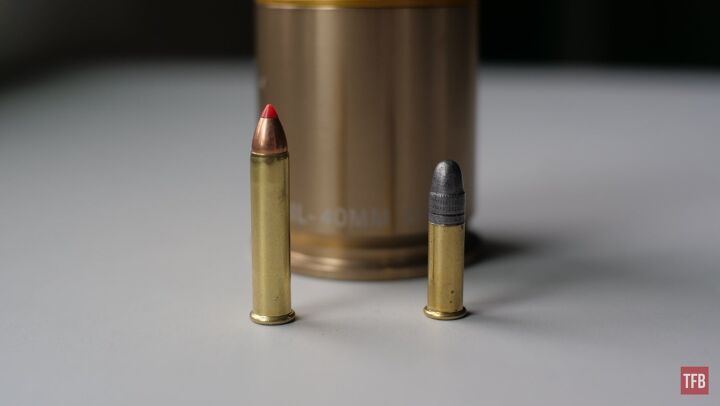
Inevitably, Kel-Tec's new .22 Magnum (WMR) chambered PMR-30 pistol will be compared to the FN Five-seveN pistol which fires the ballistically similar 5.7x28mm cartridge. If people are not saying it now, they will be soon saying that the .22 Magnum is the same as the 5.7x28mm. I used to say the same thing. It turns out that this is far from the truth.

pmr30 8297 2 tfb Myth Busting: .22 Magnum vs. 5.7x28mm  photo
Kel-Tec PMR-30 pistol. Photo by Oleg Volk.

fnm0004mb tfb Myth Busting: .22 Magnum vs. 5.7x28mm  photo
FN Five-seveN USG

Kel-Tec have stated [PDF Link] that a 40 grain .22 WMR round should reach a velocity of 1230 fps from the 4.3" barrel of their PMR-30 pistol. This works out to 134.40 ft/lbs of energy.

This is a significantly less than the FN Five-seveN USG (4.75" barrel), which can push a 40 grain bullet at 2009 fps. This works out to 358.57 ft/lbs! Nearly three times as powerful as the .22 WMR! 1

This does not mean that the .22 WMR is not a good cartridge. It simply means that the 5.7mm is optimized to be fired from a pistol, rather than the slower burning .22 WMR loads which are designed to be fired from a rifle.

300px 57lineup tfb Myth Busting: .22 Magnum vs. 5.7x28mm  photo
5.7x28mm. Image from Wikipedia.

150px 22wmr tfb Myth Busting: .22 Magnum vs. 5.7x28mm  photo
.22 Magnum / WMR. Image from Wikipedia.

UPDATE: Added correct link to specs on Kel-Tec's website : http://www.kel-tec-cnc.com/downloads/SHOT2010_preview_keltec_PMR-30.pdf [PDF Link]


  1. I assume that the 5.8mm load mentioned above it a hot load. I also assume that Kel-Tec will be publishing the results of the best performing ammunition they could find 

Posted by Steve on Nov 23rd 2009 | Filed in ammunition, handguns | Comments (55)

[Guest Post] Visit to Atlanta Arms and Ammo

[ I am pleased to present this guest post written by Ken Nelson, who blogs at his self-title blog Ken Nelson ]

My 12 year old son and I are in Georgia this week to attend the Army Marksmanship Unit Junior Shooter Camp.

Today, he and I visited Atlanta Arms & Ammo in Social Circle, GA. I needed .40 ammo for a training class I’m having on Friday, and they graciously agreed to show Brian & I around their plant.

If you reload then you know how frustrating and fussy reloading machines can be. Just imagine a shop filled with these:

image 16 tfb [Guest Post] Visit to Atlanta Arms and Ammo photo

Note that these are inline not rotary. Also everything is automatic. The only thing the operator needs to do is keep the primer rod full. They have a machine which fills the rod, the operator has to switch in a new one over every few hundred rounds.

Each of these machines makes about 60 rounds a minute, there were about 15 stations. So you do the math :)

Each machine, which they generally buy used, costs $10,000 to $12,000. They then add customized switches and electronics to test that the machines are operating correctly. For instance the case sizer has an air line to it, if air slips out there is no seal and a switch goes off and drops out the bad round. Pretty slick!

As you can imagine they use a lot of bullets. And primers, which they also buy in 5 gallon buckets. They buy new brass, but also get a lot of once fired brass that they prepare in a whole another assembly line, including a system of brass sorters they designed themselves and that are quite clever.

Here is a front on view of an ammo making station:

To the left is a bucket of bullets, at top are brass and bullet feeders. The slender metal tube in the middle is the primer feeder. The machine at far right is a primer filler tube filler. Moving that filled tube to the machine is the only manual step and is done every few hundred shells. The black box with switches is the custom QA monitor they have tied to checks they’ve built in the machine.

After the ammo is made it goes in for polishing and then into a vibrator that gets them heavy (bullet) end up:

and are then hand packaged using a series of steps that flip them in a special die until all are facing the right way:

image 20 tfb [Guest Post] Visit to Atlanta Arms and Ammo photo

The elite shooters of the United States use their ammunition, including the Army Marksmanship Unit.

If you are looking for excellent ammo, made by a group of top notch and friendly people then Atlanta Arms & Ammo is for you. As we left our guide stressed that today, in these high reloading component cost times, in many cases they can get ammo to competitive shooters for about the same as reloading. Similar price… and I don’t have to spend hours running a reloader? Or pull my hair out when it doesn’t work? Sign me up!

Many thanks to Danny at Atlanta Arms & Ammo for setting up our tour. And to Kim for being such an agreeable and friendly host.

Posted by Steve on Nov 6th 2009 | Filed in ammunition | Comments (5)

Remington is NOT developing a 6.5mm round

A few days ago Confederate Yankee wrote that Remington were not developing a 6.5mm cartridge. This contradicted what Adam Heggenstaller reported a couple of weeks ago. I checked with Jessica Kallam (Freedom Group - Remington's parent company), and the statement Confederate Yankee posted on his blog is the official statement regarding the ACR and 6.5mm round ...

We are not currently in the process of developing our own 6.5mm round for the AR platform. We have mentioned the 6.5 in our communications on the ACR simply because that platform is capable of handling the Grendel or something like it. At this point, there are no plans to chamber the ACR for the Grendel. However, that may change if we receive enough input from the marketplace to make it seem necessary.

Remington Military Products Division still list it as a caliber on their ACR webpage.

acr tfb Remington is NOT developing a 6.5mm round photo
Screenshot of the Remington ACR webpage.

I expect this has generated much confusion as the company now has an official statement regarding the issue. For now the only 6.5mm cartridge in the Remington stable is the .260 Remington1

Many thanks to rootman for sending me the top link.


  1. The .260 is a necked down .308. It is comparable to the 6.5x55 Swede, a full power cartridge, not an intermediate such as the 6.5mm Grendel. 

Posted by Steve on Nov 1st 2009 | Filed in ammunition, news | Comments (12)

Next »