#SubmachineGun
A Trip to the Bundeswehr's Fantastic Defense Technology Museum in Koblenz, Part 4: Submachine Guns, Cont'd [GUEST POST]
![A Trip to the Bundeswehr's Fantastic <i>Defense Technology Museum</i> in Koblenz, Part 4: Submachine Guns, Cont'd [GUEST POST]](https://cdn-fastly.thefirearmblog.com/media/2024/05/15/14172451/a-trip-to-the-bundeswehr-s-fantastic-i-defense-technology-museum-i-in-koblenz.jpg?size=720x845&nocrop=1)
The history of modern small arms is in part so fascinating because of how many firearms have been developed even in obscure circumstances, and how many of those obscure small arms still exist in museums and private collections around the world. Even though I make learning about obscure modern small arms my hobby, I am continually surprised by the new and unique weapons I uncover both on the Internet and in real-life excursions to some of the aforementioned collections.

A Trip to the Bundeswehr's Fantastic Defense Technology Museum in Koblenz, Part 3: Submachine Guns [GUEST POST]
![A Trip to the Bundeswehr's Fantastic <i>Defense Technology Museum</i> in Koblenz, Part 3: Submachine Guns [GUEST POST]](https://cdn-fastly.thefirearmblog.com/media/2024/05/15/14172385/a-trip-to-the-bundeswehr-s-fantastic-i-defense-technology-museum-i-in-koblenz.jpg?size=720x845&nocrop=1)
The history of modern small arms is in part so fascinating because of how many firearms have been developed even in obscure circumstances, and how many of those obscure small arms still exist in museums and private collections around the world. Even though I make learning about obscure modern small arms my hobby, I am continually surprised by the new and unique weapons I uncover both on the Internet and in real-life excursions to some of the aforementioned collections.
Full Auto Controllability, Continued: How Do We Define Useful Fully Automatic Fire?
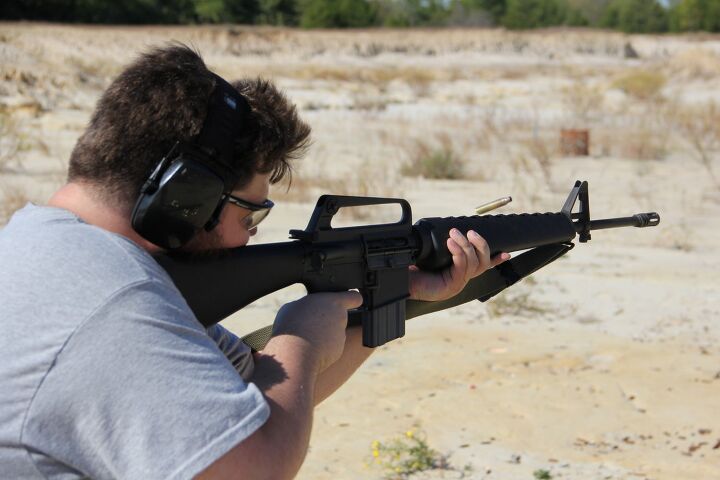
Previously, we talked about the word “controllability”, and what it means in relation to the recoil and ergonomic characteristics of a firearm. If you haven’t already read that article, I recommend you click the link here and do so first, as this post will assume that you have. We discussed how a rifle – due to its ergonomic design and the skill of its shooter – may seem to be “controllable”, even if it produces recoil to an extreme degree and rate. What we didn’t talk about is the effect that terrain, fatigue, and other secondary factors have on rifle controllability, and how those factors fit in to a broader calculus on controllability thresholds for military automatic individual weapons.
"Why Didn't He Design Anything Else?" Looking at Mikhail Kalashnikov's Forgotten Firearms Portfolio

Last weekend, I took the major arguments of Kalashnikov conspiracy theorists head on, and one of those – which I hear rather frequently – is why he did not design any other weapons besides the AK-47.
Modern Personal Defense Weapon Calibers 001: Introduction, and the 5.7x28mm FN

At this point, we’ve talked about 25 different intermediate and full power calibers as part of a series comparing different types of modern small arms ammunition. However, one subject not yet thoroughly covered is rounds for personal defense weapons (PDWs). These weapons are designed to be smaller and less obtrusive than full size rifles, while being more capable than pistols or submachine guns, particularly with respect to armor penetration.
Firearm Showcase: The Heckler & Koch MP5 PIP, Improving Greatness - HIGH RES PICS!

In May of this year, I got the rare opportunity to travel to Heckler & Koch’s headquarters in Ashburn, VA, to take a look at some of the experimental and prototype firearms they have located there in their famous “Grey Room”. It wouldn’t be worth as much for me to just tell you about it and to snap a few foggy cell phone pictures, though, so I brought along Othais of C&Rsenal to help me take high resolution light box photos of these unique and rare firearms.
Firearm Showcase: The Heckler & Koch SMG II, 1980s Would-Be Successor to the MP5 - HIGH RES PICS!

In May of this year, I got the rare opportunity to travel to Heckler & Koch’s headquarters in Ashburn, VA, to take a look at some of the experimental and prototype firearms they have located there in their famous “Grey Room”. It wouldn’t be worth as much for me to just tell you about it and to snap a few foggy cell phone pictures, though, so I brought along Othais of C&Rsenal to help me take high resolution light box photos of these unique and rare firearms.
BREAKING: Kalashnikov Concern Releases New Micro Assault Rifle to Replace AKS-74U – 21st Century Krinkov!
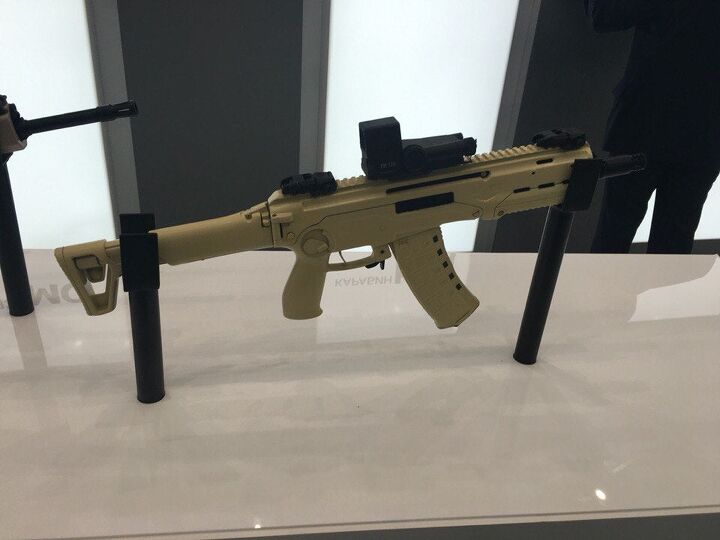
The Russian small arms firm Kalashnikov Concern has announced several new weapons during the International Military-Technical Forum “ARMY 2016” held by the Russian government in Moscow, the first of which is a new take on a promising 20th Century experimental design. The new Kalashnikov MA (Малогабаритный автомат, loosely translated to “Micro Assault Rifle”) is based on a 1970s-era design by Yevgeny Dragunov, which was also called “MA”. The original MA competed against designs from the Soviet Union’s best small arms engineers and showed substantial promise, but was passed over in favor of the AKS-74U, which shared much of its design with the already-in-service AK-74. Now, the MA is getting a makeover, and another shot – Kalashnikov Concern has adapted the basic design for 21st Century requirements and manufacturing techniques, resulting in a very modern-looking weapon.
Business Insider's Terrible, Horrible, No Good, Very Bad List of Weapons the Military "Should" Bring Back

Earlier this week, Business Insider released an article written by Christian Lowe entitled “ 6 weapons the US military should bring back from the dead“ with a very self-evident, but interesting premise. However, the weapons (all firearms, oddly) that the article outlines are very poor choices, so today I want to talk about why these choices are so poor, and maybe suggest some better alternatives of my own. Let’s take it point by point, quoting his text and following that with my responses:
Reising: the wannabe Thompson

This post is part of two others, about a recent range outing with some very historically interesting small arms, the DeLisle commando carbine, the M50 Reising submachine gun, and the Russian PM1910 Maxim heavy machine gun. All of these are NFA items (either Class III or suppressed) and the owner was extremely kind enough to take me out and blow over a thousand rounds through his small arms.

Caracal Introduces New CMP9 Submachine Gun

Gone is the Caracal CC10 pistol caliber carbine from the UAE-owned company’s website, but in its place is a new, modern-looking submachine gun called the CMP9. This new weapon features integral 1913 rail mounting points on its aircraft-grade aluminum receiver, and a wraparound telescoping bolt system using the blowback principle. From Aftermath Gun Club:
Be Ready for the Western Front Offensive of 1919 with the WWI Pedersen Device

In the early winter of 1918, it seemed as though the Boche wouldn’t stop, and the war was sure to continue on into 1919. New, secret weapons were needed to complete the victory over Germany, and one of these was John Pedersen’s “device”, officially called “Cal. 30 Automatic Pistol Model of 1918”, a drop-in replacement for a standard (but modified) Model of 1903 Springfield rifle that would give every American infantryman autoloading firepower for close range engagements in the expected 1919 offensives.
Innovative Arms 9mm submachine gun

Here is a 9mm SMG made by Innovative Arms which was built primarily for testing the effectiveness of their suppressor designs on this type of weapon. Like many utilitarian tubeguns It fires from an open-bolt with a fairly high cyclic rate and also accepts 9mm British STEN magazines. It features a sturdy fixed skeleton stock, reminiscent of the folding stock of the Walther MPK. A pistol grip originally for the HK G3 has also been utilized.

Cracking the Machine Pistol's Code: Is a Useful Fully Automatic Handgun Possible?

In a previous article on TFB, we compared a Mauser 712 Schnellfeuer to a Glock 17 with an auto sear, and along the way discussed how very limited the usefulness of the modern machine pistol is. Fully automatic pistol-sized weapons have been around for over a hundred years, but they’ve only ever seen limited use in specialist roles, with their adoption and then subsequent abandonment coming seemingly in waves as departments and forces pick up the concept and then discard it upon learning how impractical the weapons are in actual use. The history of machine pistols is fascinating, and those who are interested can follow the link to a podcast I participated in on the subject to learn more.
Operating Systems 201: Telescoping Bolts

Previously in TFB’s series on weapon operating mechanisms, we examined both the closed-bolt blowback system and the open-bolt API blowback system, two very close relatives that share a common feature: Closure of the breech through the inertia of the breechblock mass alone. What this means for small arms designers is that they must engineer a system where the breechblock is large enough to have sufficient mass, while having enough room to reciprocate the distance necessary for reliable ejection and feeding. In a standard submachine gun design using the API blowback system, for example, the breechblock is configured behind the breech end of the barrel, so that it can reciprocate. This is an easy design to engineer, and can be made simply and easily.