#Cartridge
Modern Historical Intermediate Calibers 017: The 7.92x33mm Kurz

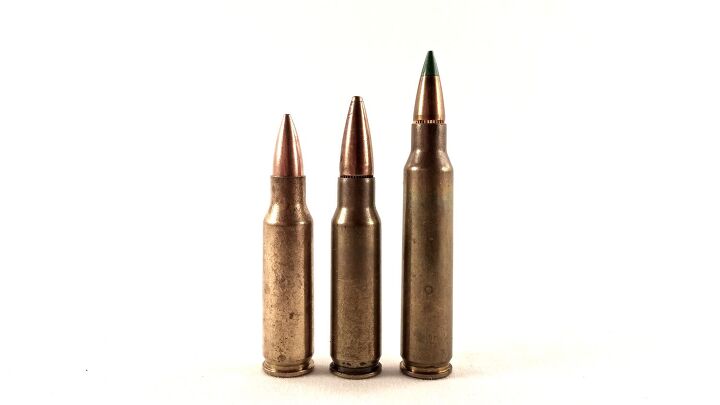
Many would consider this next round to be the first intermediate cartridge ever, and while that isn’t really true, it is one of the most influential rounds of all time, and perhaps the most influential intermediate round ever developed. I am talking of course about the Nazi-era Kurzpatrone 43 Spitzgeschoß mit Eisenkern, or as it is more commonly called, the 7.92×33 Kurz. This round became the model – in one fashion or another – for numerous intermediate rounds developed all around the globe after World War II, including the promising .280 British, and ubiquitous 7.62x39mm Soviet, as well as several others we’ll discuss in later installments.

Modern Intermediate Calibers 016: The 5.8x42mm Chinese

In the mid-1950s, the People’s Republic of China followed the Soviet Union’s example and adopted the intermediate 7.62x39mm round. This decision substantially helped to promote that cartridge’s ubiquity throughout the world, as millions of cheap Chinese-made SKS and AK rifles were exported to every corner of the globe. However, at the very end of Chairman Mao Zedong’s regime, an effort was started to develop a new, modernized caliber that would improve performance and conserve materials versus the 7.62×39. That program resulted in the 5.8x42mm caliber, standardized in the late 1980s with the DBP-87 and DBP-88 rounds. Unusually, the 5.8x42mm used a system with two different overall length standards, one of about 58mm for the DBP-87 rifle cartridge, and the other of about 62mm for the DBP-88 support round. This allowed the marksman’s rifle to shoot the DBP-87, if necessary, but also allowed for a longer, lower drag bullet to be put in the DBP-88 case, improving the ballistics of the QBU-88 marksman’s rifle and the QJY-88 general purpose machine gun.
Modern Intermediate Full Power Calibers 015: The 7.62x51mm NATO

Shouldn’t “Modern Full Power Calibers” be its own series? No, because then there would only be two episodes! So instead, we’re rolling today’s two most popular full power .30 cal rounds into the series on intermediates, primarily as comparison pieces. There are really two pieces of information I want to disseminate with this, which are the answers to “how do these full power rounds compare with intermediate calibers?” and “how do they compare against each other?”
Modern Historical Intermediate Calibers 014: The 4.85x49mm British

On Saturday we looked at one British “contender” which could have in some alternate reality become the NATO standard round, and today we’re going to look at another: The 4.85x49mm. After the United States adopted the .223 Remington round as the 5.56x45mm in the mid-1960s, a race began among NATO member nations to create and adopt something similar. Lest the Organization lose the benefits of standardization if a member nation pre-emptively adopted a new SCHV round, these efforts force NATO to begin a competition for a second NATO-standard infantry round. Entrants from the USA, France, Belgium, Germany, and the UK competed head-to-head, and while it was the Belgian 5.56mm SS109 that emerged victorious, the 4.85x49mm round submitted by the UK was ballistically impressive enough to warrant a second look.
Modern Intermediate Calibers 013: The .17 Caliber Remington Family

Up to this point we’ve looked at calibers ranging from 5.56mm to 7.62mm, but today we’re going to look at something smaller… A lot smaller. The smallest caliber size that is feasible for a given current barrelmaking and projectile manufacture technology is .173″/4.32mm, and a natural centerfire platform for that caliber is the common 5.56mm case. This has led to a large number of cartridge types developed – including the privately designed .17 Remington, and the German 4.3x45mm DAG – that are essentially similar, and so we will cover them under one umbrella here. Representative of this type in a military context is the Frankford Arsenal’s 4.32x45mm, which was loaded with a relatively low drag 27 grain full metal jacket projectile which – like the 5.56x38mm FABRL covered recently – possessed approximately the same ballistic coefficient as the 5.56mm 55gr M193 projectile. This means the 4.32x45mm Frankford represents essentially an alternate approach to duplicating the M193 round in a lighter package, by reducing the caliber instead of making the projectile lighter and longer.
Modern Historical Intermediate Calibers 011: The 5.56×38 FABRL

Among the interesting concepts that were tested in the mid-late 20th Century is that of an extremely light for caliber, very long bullet made in part of a lightweight material like aluminum and plastic. The 7.92×40 CETME, which if I can find a specimen I will cover later on, is one example, but starting in 1972 the now-closed Frankford Arsenal began experiments on 5.56mm cases loaded with super-long projectiles with von Karman ogives, with the aim of creating a lightweight round using a low-density projectile and an aluminum case. Original testing was conducted with full-length 5.56mm cases and two lengths of bullets, but eventually a shortened brass case and a 37gr bullet with the same shape as the shorter initial test bullet was created. As a solution to the problem of burn-though with aluminum cases, the Arsenal developed a plastic insert called a “flexible internal element” (FIE), and the brass cased rounds developed for ballistic testing also had FIEs. This shorter round in both aluminum and brass cased forms was called the 5.56x38mm FABRL, which stood for “Frankford Arsenal – Ballistics Research Laboratory”, and this at some point was made into a backronym for “Future Ammunition for Burst Rifle Launch”.
Modern Historical Intermediate Calibers 010: The 6mm SAW

In this installment, we’ll be looking at a very unique round. The 6mm SAW was probably the first small arms round ever designed using computer-calculated parametric analysis, and it was also probably the first American rifle round designed from the outset for steel cartridge cases. The initial design parameters were for a round effective to 1,000 meters, and which accepted a tracer that would give a visible daylight burn out to 800 meters, and this resulted in a caliber of 6mm with a 105 grain slender steel-jacketed lead-cored bullet possessing a high length/drag ratio. Although fired at modest velocity, the sleek bullet retained its energy extremely well, giving the round good long-range penetrating power, especially compared to the 5.56mm rounds at the time. Ultimately, the 6mm SAW succeeded in its ballistic goals, but was rejected on logistical grounds, as the idea of fielding three different rounds (5.56mm, 6mm, and 7.62mm) was not considered feasible.
Modern Intermediate Calibers 009: The 6x35mm KAC/TSWG
The 6x35mm TSWG, also commonly called the 6x35mm KAC, is a round shrouded in mystery. Apparently designed by Knight’s Armament Company for the interagency counterterrorist program cryptically named the “Technical Support Working Group” alongside the PDW with which it is popularly associated, the round was apparently never adopted. However, it is interesting primarily as an example of a round with shorter overall length than the standard 2.2-2.3″ (56-58mm) OAL that has become ubiquitous for modern intermediate rounds. The 6x35mm TSWG was designed solely for the unique KAC PDW, but a more traditional AR-15 type rifle called the SR-635 was also chambered for it. Like the .300 Blackout, the 6x35mm was also designed explicitly for 10″ or shorter barrel lengths; KAC has advertised their PDW as being available with 8″ or 10″ barrels. To properly compare the round with both the .300 Blackout and 5.56mm, we will be looking at estimated velocity figures from both 9″ and 14.5″ barrels, although it should be noted that so far as I know, no weapons chambered for the 6x35mm cartridge actually exist with barrels of either of these lengths:
Modern Intermediate Calibers 008: The Soviet 5.45x39mm

In the late 1950s, after the first public demonstrations of the AR-15 and its new small caliber, high velocity cartridge, the Soviet Union took notice of the radical developments in military .22 caliber rounds in the United States. By 1959, four years before the adoption of the AR-15 as the M16 by the US Army, Soviet ballisticians were already testing Soviet-made replica 55gr spitzer FMJ bullets fired at over 3,000 ft/s from modified necked down 7.62x39mm cases. This program for a new small caliber high velocity lasted into the late 1960s, but it wasn’t until the mid-1970s that the 5.45x39mm caliber was eventually issued alongside the AK-74 rifle, a modified but significantly more effective variant of the previous 7.62x39mm AKM assault rifle.
Modern Intermediate Calibers 007: The .25-45 Sharps

On the heels of the 7.62x40mm WT, we are now going to take a look at another former wildcat based on the 5.56mm case, the .25-45 Sharps, a round I’ve discussed before. This .25 caliber round existed for years as the .25-223, a niche quarterbore caliber used mostly for predator hunting and similar rounds like John Wooters’ .25-222 Copperhead and Wayne Blackwell’s .25×47 have existed since the 1960s. However, the .25-45 Sharps is the first time the .25 caliber bore and the .222 Remington case family (in this case, .223 Remington) have been united in a factory offering, and one of the first .25 caliber rounds to be marketed to law enforcement and the tactical world, in addition to hunters. That makes it a candidate for this series, so let’s take a look at some ballistics:
Modern Intermediate Calibers 006: The 7.62×40 Wilson Tactical

Like the .300 AAC Blackout that we discussed earlier, the 7.62×40 Wilson Tactical was intended to be a medium-performance .30 caliber cartridge that would function in standard AR-15 type rifles with minimal modifications, such as a barrel change. Also like the .300 AAC Blackout, the Wilson round was based on an earlier wildcat, which was designed by Ken Buchert and also called the 7.62×40. Unlike the .300 Blackout, however, the 7.62x40mm Wilson Tactical sacrificed some versatility for raw power in the form of a lengthened case based on the 5.56mm case, instead of the .221 Remington Fireball used by the Whisper/Blackout. This longer case gives the 7.62×40 WT a significant performance advantage over the .300 Blackout from comparable barrel lengths, but it limits how ballistically efficient the projectiles used by the round can be. In theory, the 7.62×40 WT can also be loaded with subsonics, like the .300 AAC Blackout, although the short ogive length limits which COTS bullets can be used for this, and no factory subsonic ammunition exists for the Wilson round. This makes the 7.62×40 WT virtually a dedicated supersonic hunting or 3-Gun round (in which it makes Major Power Factor), but it is still worth considering in our discussion. Now, on to the ballistics:
Modern Intermediate Calibers 005: The .300 AAC Blackout

Previously, we talked about the Soviet 7.62x39mm caliber, which was paired with the famous Kalashnikov automatic rifle. With its much heavier bullet, larger caliber, and lower velocity, the 7.62x39mm contrasts heavily with the US 5.56mm caliber, and US weapons manufacturers took note. The .300 AAC Blackout is in many ways similar to the 7.62x39mm caliber, being – like the 6.8 SPC – inspired by it, but designed to add new capabilities. The origin of the Blackout lies in the earlier .300 Whisper, a wildcat developed by JD Jones from the .221 Remington Fireball to fire both heavy subsonic projectiles and lighter supersonic rounds with ballistic characteristics similar to the 7.62x39mm, while being highly compatible with existing AR-15 type rifles. Versus the older Whisper, the Blackout is little changed, but its introduction, backed by the force of Advanced Armament Corp, Remington, Barnes, and other companies, made it virtually an overnight success on the US civilian market.
Modern Intermediate Calibers 004: The 6.5 Grendel

One of the most ballistically interesting intermediate calibers ever developed is the 6.5 Grendel, developed by Arne Brennan with the assistance of Bill Alexander, and promoted heavily by the latter’s company, Alexander Arms. The 6.5 Grendel is interesting because it combines a wide case head based off the 7.62x39mm parent case with a short case length and ample room for long, slender bullets with low drag coefficients. As a result, the 6.5 Grendel is, very unusually for an intermediate caliber, well-designed for retaining energy at long distances.
Modern Intermediate Calibers 003: The 6.8x43mm Remington SPC

I’ve written quite a lot about the ballistics one of the first Western competitors to 5.56mm in the new millenium previously, and you can read that by following the link here. The 6.8x43mm Remington SPC was developed in the early 2000s by MSG Steve Holland and civilian US Army Marksmanship Unit gunsmith Cris Murray as a second iteration for the Mk. 12 SPR precision upper receiver for the AR-15. The 6.8 SPC was never adopted by a Western fighting force, but it subsequently became a popular civilian hunting cartridge, and it still features prominently in discussions about next generation military calibers, so let’s take a look at the ballistics of two popular 6.8 SPC loads:
Modern Intermediate Calibers 002: The Soviet 7.62x39mm

Perhaps the oldest rival of the 5.56mm round is its older brother in the intermediate cartridge world, the 7.62x39mm round developed by the Soviets in the late 1940s from their earlier 7.62×41 M43 cartridge. The 7.62x39mm, despite its age, has maintained a very uniform ballistic profile. The original 8 gram (123gr) boattailed steel-cored bullet, also called “M43” like its predecessor, has become the representative load for the whole caliber, even while lead-cored flat-based incarnations like the Yugoslavian M67 ball round have proliferated.