#Cartridge
Modern Intermediate Calibers: Trade-Offs – Introduction

Looking at the 24 different calibers we’ve covered as part of the Modern Intermediate Calibers series, some patterns begin to emerge. We see that larger rounds with heavier bullets weigh more, and have more recoil, that more slender bullets shoot further for their weight than other comparable projectiles, and that higher velocity rounds shoot flatter. Each of these patterns corresponds to a trade-off, however, as in some way each “improvement” in performance sacrifices good characteristics elsewhere. Sometimes, these trade-offs are obvious, but sometimes they aren’t.

Modern Historical Personal Defense Weapon Calibers 003: The 7.65x35mm MAS, a .300 Blackout in the 1940s?

Since we’ve covered the two most prominent PDW rounds of today, I want to take a quick detour and look at an interesting – but obscure – personal defense weapon/assault rifle round from history. After World War II, the apparati of the German war machine were being dismantled, and anything of value claimed by the Allies as spoils. While the Americans got Germany’s most prominent rocket scientists, the French claimed Germany’s tank designers, and many of her small arms engineers. As France was looking to replace their motley and outdated collection of small arms (a suite which developed more organically than by design, thanks to two devastating World Wars), they put these German engineers to work, including one Dr. Heinrich Vollmer, who before and during the war worked at Mauser. Vollmer had been involved in development of – among various other projects – the StG-45 assault rifle, which possessed a unique roller-retarded blowback action that promised an inexpensive and reliable, yet lightweight weapon. This rifle would eventually lead to the G3, but during Vollmer’s stay in France, the French government set him to work making a smaller version of it, in variants chambered for .30 Carbine as well as a new round: The 7.65x35mm MAS.
Modern Personal Defense Weapon Calibers 002: The 4.6x30mm HK

If the 5.7x28mm FN is the first successful modern PDW round, then the 4.6x30mm HK is the second, and its biggest rival. German firm Heckler and developed the microcaliber 4.6mm in the 1990s as a response to a NATO solicitation for a Personal Defense Weapon, to which they submitted their new HK PDW (later MP7) chambered for the new round.
Modern Personal Defense Weapon Calibers 001: Introduction, and the 5.7x28mm FN
At this point, we’ve talked about 25 different intermediate and full power calibers as part of a series comparing different types of modern small arms ammunition. However, one subject not yet thoroughly covered is rounds for personal defense weapons (PDWs). These weapons are designed to be smaller and less obtrusive than full size rifles, while being more capable than pistols or submachine guns, particularly with respect to armor penetration.
Modern Historical Intermediate Calibers 024: The 4.6x36mm HK/CETME

Today we’ll be looking at a round with one of the strangest-looking projectiles ever designed for a military weapon: The joint Heckler & Koch-CETME 4.6x36mm round designed for the HK36 en-bloc clip fed assault rifle. The rifle was, as the name suggests, developed by HK, and based on their successful family of roller-retarded blowback rifles, including the G3, MP5, and HK33. It fed from an unusual fixed 30-round magazine, which was loaded from the side through a panel with a polymer 30 round en bloc clip. The projectile was developed by Gunther Voss, of CETME, the very same who invented the unique aluminum-cored projectiles for the 7.92×40 CETME a couple of decades earlier.
Modern Historical Intermediate Calibers 023: The 6.35/6.45x48mm Swiss GP80

Information on this round and the weapons designed to fire it is scarce, so the details in this article may be at times incorrect. Just letting you know. -NF
What Is a Caliber System, and How Does It Affect Ammunition Design?
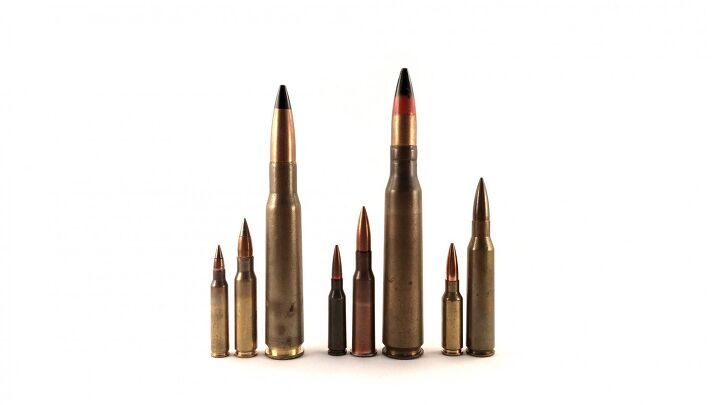
In a previous post about the sometimes ambiguous meaning of the word “caliber”, we discussed how the word had mutated through the centuries, picking up different definitions and connotations along the way. In that article, I wrote:
Where to Draw the Line? Managing the Weight of Next Generation Universal Calibers Using a Weight Calculator

How can one balance the trade-offs inherent in ammunition design to create a true one-caliber infantry weapon system that is both effective and lightweight? This is a question I’ve been exploring for close to a decade, and writing about for over four years. The question is extremely compelling to me because so much is demanded of the answer: Unlike with two-caliber systems, all the needs of the infantry must be met with one single caliber configuration, so each and every dimension must be carefully measured to allow the lowest possible weight, which is arguably the most important single characteristic of small arms ammunition.
Modern Intermediate Calibers 021: The US Army Marksmanship Unit's .264 USA

We’ve discussed a lot of different rounds in this series so far, but today we’re going to discuss a round that actually has a shot of being adopted (at least in some form) by the United States military as a next-generation small arms ammunition configuration. That round is the .264 USA, developed over the past few years by the Army Marksmanship Unit (AMU).
Future Firearms Ammunition Technology 005: Caseless Ammunition - Lightening the Load, Pt. 3
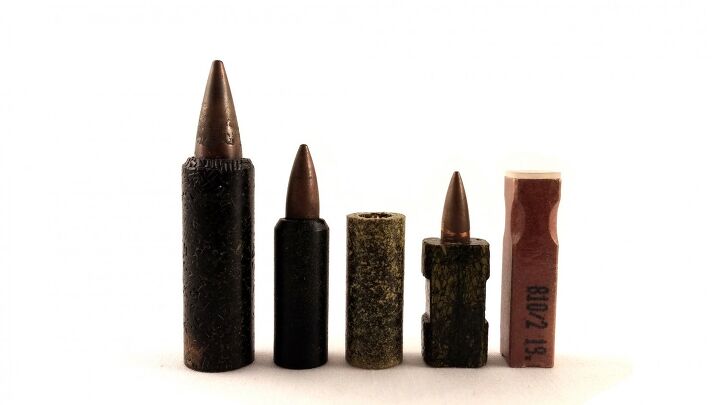
Previously, we discussed trying to lighten the soldier’s load by making the cartridge case out of different materials, including aluminum and compositing the case out of polymer and metal. Yet, wouldn’t the lightest possible case configuration be… Having no case at all? That’s the thinking behind one of the most ambitious ammunition configurations there is, the case-less round.
Future Firearms Ammunition Technology 002: Polymer-Cased Composite Ammunition - Lightening the Load, Pt. 2
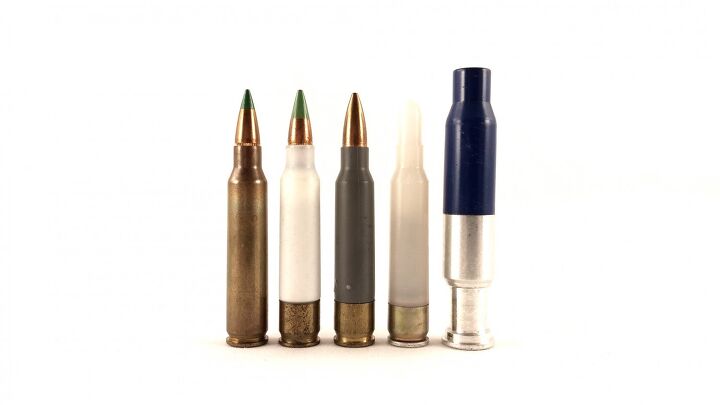
In the last installment, we talked about the growing need throughout the 20th Century to reduce the weight of the cartridge case, to lighten the burden of the soldier. Experiments in aluminum have thus far proven unsuccessful, but another material is even more promising: Polymer. Plastics and polymers burst onto the scene in the post-war era, and it didn’t take very long for engineersto start looking at them as a way to reduce the cost and weight of ammunition. If feasible, polymer is an ideal solution for cartridge cases, as it is even less dense than aluminum, while being cheaper and using no metals or other expensive strategic resources, just crude oil.
Future Firearms Ammunition Technology 001: Aluminum Cased Ammunition - Lightening the Load, Pt. 1
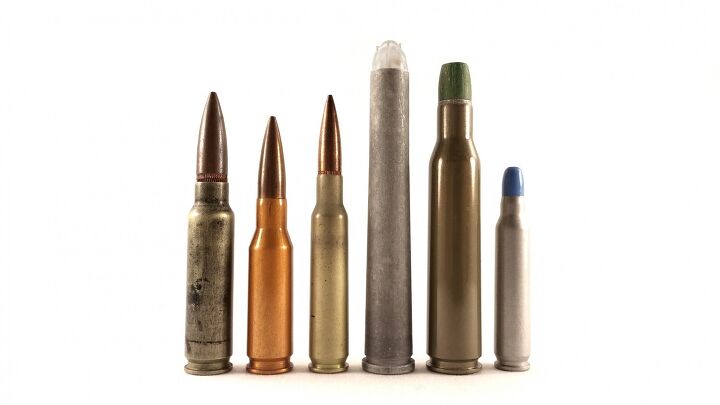
The metallic cartridge case was invented in the 1840s, and – starting in the 1860s – its military application brought with it a host of of advantages for the soldier: Now, ammunition was self-contained, weatherproof, and durable. Yet, despite it being a massive advance, the metallic cartridge wasn’t an across the board triumph. With the addition of a metal case, ammunition became heavier, and cost more to manufacture. In the early days of metallic cartridges, military weapons were slow to fire, and fired heavy bullets that made up the overwhelming percentage of mass of the ammunition, so this advantage was small. Ironically, though, the metallic cartridge allowed the invention of faster firing designs that expended ammunition more quickly, and as ammunition caliber shrunk and average bullet weight dropped, the percentage of mass contained in the metallic case grew.
New Ammo for British Troops: UK Develops More Effective 5.56mm and 7.62mm Ammunition

It’s not just the Yanks that are getting improved ammunition: Our friends across the pond have developed their own firepower upgrade for 5.56mm and 7.62mm weapons alike. Jane’s has a modest article on the subject, while The Register provides a quite good overview of exactly what the new rounds are and what they mean for today’s Tommy:
Modern Historical Intermediate Calibers 020: The 7.62x45mm Czech

After World War II, the nations of the world retired to lick their wounds and rebuild, but their arms engineers also began thinking about the next war. The war have brought forth a storm of new technologies and inventions, and one of the most significant in the field of small arms was the finally mature assault rifle in the form of the Nazi-developed “Sturmgewehr”, and its intermediate 7.92x33mm Kurzpatrone cartridge. One nation that took notice of this new weapon and its ammunition was the newly reconstituted Czechoslovakia. That nations engineers quickly took to copying and improving the 7.92 Kurz caliber, producing by the early 1950s a short-lived but unique round called the 7.62x45mm Kr.52, or more popularly the 7.62×45 Czech. The 7.62×45’s projectile was a near copy of the Kurzpatrone’s stubby, steel-cored one, but its case was much longer, while being slightly thinner, and having a greater internal volume. This gave the Czech round an additional 250 ft/s muzzle velocity versus the German 7.92×33 when fired from the barrel of the rifle that was designed alongside it, the strange but wonderful vz. 52.
Modern Intermediate Full Power Calibers 019: The Russian 6x49mm Unified

What happens when you take the two concepts of a traditional, full-power rifle and machine gun round, and a small-caliber, high-velocity round, and smash them together? You get one of the most extreme military small arms calibers ever developed, and one of the last small arms projects from the twilight of the Soviet Union.