3D Printed CARBON FIBER Suppressor to Be Introduced by Middlebranch Machine


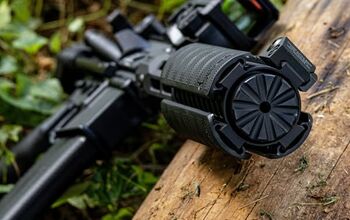
Canton Ohio custom gunmaker Middlebranch Machine has released a teaser image of a new kind of suppressor, which they say is made of “carbon fiber composite” construction. Unlike previous efforts at making carbon fiber suppressors, Middlebranch Machine’s design does not seem to use a straight carbon-fiber tubing body, but appears to be 3D printed, instead. This is strongly suggested by the background of the image which shows a customized Glock with a unique looking suppressor in front of what is probably a Markforged Mark Two carbon fiber 3D printer. Mark Twos are some of the only carbon fiber 3D printing machines in the world.
There have been few previous attempts at making suppressors out of carbon fiber. Though light and strong, carbon fiber tubing is not an especially good material for making suppressors. YouTuber gommie404 has a very interesting and entertaining video (embedded below) on constructing homemade aluminum/carbon fiber hybrid suppressors. In the video, he notes that straight carbon fiber tubes eventually fail, as the propellant gasses eventually stretch and work their way through the fibers, resulting in wall breaches. This phenomenon evidently plagued the carbon fiber suppressors made by Shooter’s Depot some years ago.
It seems likely that the printed construction of the MM suppressor will help compensate for this problem. However, it’s not yet well established how strong printed carbon fiber is, versus the conventional weaved variety.
Nathaniel is a history enthusiast and firearms hobbyist whose primary interest lies in military small arms technological developments beginning with the smokeless powder era. He can be reached via email at nathaniel.f@staff.thefirearmblog.com.
More by Nathaniel F








Comments
Join the conversation
Seems to me that the primary benefit of using 3D printing is that you have far more design liberty, and - for example - the exterior shape can be tailor made to match the gun's design, instead of restricted to a tube shape hanging off the muzzle. Slab-sided, slung beneath a pistol slide for more weapon maneuverability - or resembling a Mannlicher stock on a rifle to add interior volume without impeding sight line or extending firearm length as much, incorporating a pic rail for a small sub-slide laser on guns (e.g. 1911) not so equipped, etc. And as carbon nanotube comes more readily on line, material strength rises dramatically, although increasing interior volume in the above manner drops peak pressure and stresses the material less. Light weight without the need for esoteric metals is a plus, as well. Interesting development that should lead to increased effectiveness, after a little experimentation.
The resin binding carbon fiber begins to fail at around 375 to 400 deg. F. Other than the heat issue carbon fiber is light, strong, and will probably work for this application. The printed aspect really doesn't make much difference one way or another. Yes, I own a carbon fiber fabrication shop.