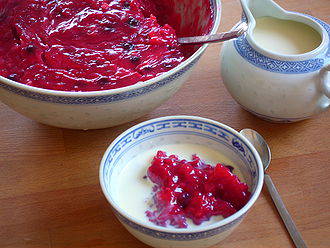
“The AK is as Danish as strawberry porridge with cream”
An article, author unknown, has been circulating on Danish internet forums. It claims that the AK-47 design should be attributed to Danes, rather than Russians.
Personally I do not buy this theory. Guns have evolved over hundreds of years since the cannon was invented. Each new development has been an improvement of one that proceeded it. There are few, if any, 100% original designs. If we attributed a design to the inventors of each concept that preceeded it, the AK-47 would probably have been invented by the Americans, British, Germans, French, Chinese and [insert any country here].
Still, you may be interested in reading the theory and making up your own mind.
Many thanks to Mark for translating the article into English for the blog.
The AK is as Danish as strawberry porridge with cream.
A personal theory with a bit of factual backing.
My interest for this theory was awoken by a inquiry from the Ukrainian Weapons Museum who wanted some Danish weapons in their collection identified. Amongst other things, I was asked when DISA [ Dansk Industrisyndikat ] produced an AK variant. I was feeling like a joker and asked the museum director if it wasn't the other way around - that the AK was a variant of DISA's "A carbine". I don't remember his exact reply, but it sounded like a coughing fit. Naturally it was actually an "A carbine" delivered to Finland in the 1950s in 7.62x39mm for testing. That made me wonder: Who got the idea, and how did it end up in the USSR (of which Ukraine was a part when they received said "A carbine")?
When the first AK fell into American hands in the Korean War, an enterprising American wandered down to the Patent Office with an AK - the USSR wasn't part of the Patent Union, so it should be smooth sailing from there. Sadly for him, it wasn't - patents are only given to new designs, and this design had already been patented, they told him.
A bit of reading shows that the rotating bolt was patented by the dane Quist in 1899 and the gas system was patented by S. H. Bang in 1903, both DISA associated. The concept itself was used by a dane by the name of Weibel in the 1930s. But was there a connection?
I found the first indication of a connection when the Army's Special School's exhibit of Warsaw Pact weapons, where an AK was exhibited from the first test series, lent by the Tøjhus museum [Arms Arsenal] who had borrowed it from DISA. It wasn't possible to find out where DISA had gotten it. It must have slipped out under the corner of the Iron Curtain in '47 or '48, so somebody must have had very good friends in the USSR at that time - and since it's the only one of its kind I can find outside the Warsaw Pact area, I have a hard time believing it's entirely coincidental.
DISA built a factory in Kowrow in Russia, on the railway line Nishnij-Novgorod when it crosses the river Klajsma, in 1913-1919 to produce Madsen machine guns for the Tzar's army. As director and day-to-day leader DISA had hired Jens Teodor Suhr Schouboe(2), who did his work well - so well that the Tzar adopted the Schouboe pistol(5) as a replacement for the Nagant revolver in 1917. How many were delivered is unknown, but probably not very many - though I have seen one! If Quist and Bang were ever in Russia is unknown, but there was a permanent ferry connection between St. Petersburg and Copenhagen until 1917, so it isn't impossible, and it's even probable, that DISA sent two of it's workers over to Russia to oversee the construction of the factory. In Denmark in 1916-17 you had to apply for a travel pass every time you traveled abroad - the Royal Archives can't locate the records of these things, albeit that this would be a wonderful source for historical investigations.
Of course, in 1917 the factory was nationalized by Lenin but stayed Danish-led, and many of the factory's workers went to Denmark in 1918. 130 Danes(3) and some Russians who no longer found the political climate healthy. Select few, amongst them Voiyekewitch, who had worked as a director from 1917 to 1921, with their entire families. Some of them worked for DISA well into the 50s.(1) The Voiyekewitch family lived in Bjergsted on Sealand for many years, where they had a chicken farm(1) along with their family in law, who they'd managed to take with them as well. DISA's largest investor, Søren Jensen, went bankrupt along with the Farmers' Bank and everyone else who had gambled too heavily on the 'Russian adventure'.
I've recently spoken to an older gentleman, Axel Dush, whose uncle had been in Russia to fight for the White Army. He once told his wide-eyed nephew that he'd visited a factory in Kowrow and had been surprised at the amount of Danes there. His nephew didn't believe the story until I told him about DISA's factory in Kowrow, 75 years after his uncle had told him the story.
A Russian General by the name Fyodorov/Federov worked as the communications officer between the Red Army and the factory. Complaints were filed that he was more interested in constructing a rifle than minding his actual job at the factory. Voiyekewitch and Federov were both directors at that time, which gave rise to a substantial amount of friction. Lenin's Central Committee ordered 9000 of the Federov Avtomat(9) in 1917, so beat the White Army. It was named AF 18, Avtomat Federov, and is said to have been in the final battles of WWI. Federov had already constructed a rifle in 1912 in 150 copies at the plant in Isjevsk, in 7.62x54r.(9)
It was at Kowrow that the term 'Avtomat' was coined, the Russian word for assault rifle. It was a light rifle capable of select fire and firing a weak round, the Japanese 6.5mm, making it controllable during automatic fire. Federov was made chief of the Soviet arms development office some time in 1917(4) and was in 1936 replaced by his second in command, Degtyaryov, who became a very active weapons designer. He was replaced by his second in command, Simonov, in 1938 - his second in command and replacement in 1946 was called Kalashnikov.
The factory in Kowrow still exits, and houses the Russian Space Program. Drawings of the Bang and Quist patents were present at the factory post-1945 - Federov had arranged this(4), so Kalashnikov didn't have to be very inventive to make his AK. That's why the enterprising American couldn't patent the AK in his name - DISA had made sure to patent protect Bang and Quist's designs.
It's kind of quaint to think that Sputnik was tooled on Danish machines - were weren't just in the space race, were were in the lead! Since 1918 the factory has been the Soviet Arrms Test Facitily, so it's not just probable, but quite certain that this was where the AK-47 was designed in Kowrow(7).
It wasn't only the Russians that enjoyed Quist and Bang's designs. The Americans used them as well - they just paid duly for them. The Garand borrowed several details from here - many have accused the AK of copying the Garand, but the true source of these designs were Bang and Quist.
Without knowing for for certain, I speculate that the AK DISA had was a present from the Russian Test Office, for old friendship's sake. In the late 40s Degtyaryov was still alive (died in January 1946 (6)), and he'd been at the plant when it was Danish-led, and still held the kind of authority to authorize such a present for DISA. Trade with Russia was still going strong in the 50s, and the walk from the harbors to the DISA offices in central Copenhagen is remarkably short and easy to make without being noticed...
7.62x39mm
As mentioned, Weidel had used the concept, he'd made a medium sized round in 7x44mm. DISA had also experimented - the Danish Ammunition and Arms Factory in Otterup had produced rounds in 7x35 or 7x36, and called these 7mm Mauser (according to the ammo boxes I have lying around, anyway). Otterup made a batch of assault rifles for Bergmann in 1941-42 for the German assault rifle trials, in which Walther, Haenel, Mauser, Vollmer and DISA also submitted trial models. The DISA, Otterup/Bergman and Vollmer models have been lost to time, and are not known today. Though I have spoken with a man who had seen a number, approximately 50, small rifles with long, curved magazines on the attic of the Otterup factory.
The rounds for these various assault rifles were in the Polte ammunition factory when it was captured by the Red Army in 1943 - they designated the 7.62x39mm round "M43". It was at Polte that the Germans had developed the 7.92x33mm - they had tested both 7mm and 7.62mm, but were told to stick to the 7.92mm for logistical reasons. The 7.62mm version was of course still lying around, and the Russians chose this one for the same reason the Germans chose the 7.92mm.
5.45x39mm (5.45x40mm sometimes)
After the Korean War the Americans started experimenting with different calibers and weapons again. In the 60s they utilized newly developed electronics to simulate different parameters for different calibers and powder charges without having to produce the rounds or the weapons to fire them, which made for a much more healthy work atmosphere in the testing facility. A few of these simulated rounds were produced for further testing, and 5.45x40mm was one of the ones that looked most promising. I've actually owned one with a Frankford Arsenal stamp at one point. The powder had a high nitroglycerin content (23%, which doesn't mean anything under normal conditions, but at extreme and rapidly changing conditions it could have disastrous consequences, ruining both the rifle and the shooter(8)).
General Electric developed a monster of a machine with a memory of several gigabytes, an alien term at the time, for these test trials. I was about the size and weight of an SUV. At the conclusion of the tests, this machine was offered up for sale, as long as it didn't end up in communist hands - it was far too high tech for that. Herlev Hospital, in Denmark, were running tests on different kinds of scanning, and were interested, but didn't buy the machine in the end. It sat in the parking cellar of the hospital for several months, where I saw it (it contained about 50 vertically mounted vinyl records, each about a foot in diameter), before an interested buyer appeared. This buyer was none other than the aforementioned Weimer's son, who had it put on a Russian freight ship and sailed back to the Motherland. Safely back in the USSR, the specifications for the new American round were extracted from the harddisk, and put into production. The new round saw it's first action in Afghanistan, where the Russians discovered the woes of the nitroglycerin content the hard way, resulting in the replacement of all AK-74s in favor of the old AKMs.
It seems that several aspects of the AK design have Danish roots - even the muzzle break seen on many Soviet weapons look very similar to designs patented by Bang.
Sources:
A Henchel. "Dansk Rekylriffelsyndikat, Compqnnie Madsen A/s gennem 25 Aar". Disa 1957
Werner Haubroe "DISA 1900 til 1960." Not printed; manuscript in the Haubroe home, with copies in the Archives.
Anonymous. Party flier printed to celebrate the 40th anniversary of DISA in 1936 for the guests at the party.
Anreij Bolotin "60 years of Soviet small arms."Anniversary book for the 50th anniversary of the October Revolution (in Russian) Moscow1967. (CIA found it so interesting that they translated a photocopy in 1975 in 10 copies)
"Small arms manual for the Soviet armed forces" (in Russian) Moscow 1941.
Jerrislav Lugs "Firearms in the past and present" (in Czechs, German and English ) Prague 1956.
Kalasnikov "My life and my weapon" (in Russian and German) Moscow 1991.
"US Ordnance Notes 1960-70" Aberdeen Proving Grounds 1971.
Daniel Musgrave & Thomas Nelson "The worlds Assault rifles". Vol II USA 1964.
V. G. Fyedorov "The Automatic Weapon" (in Russian) Moscow 1907.
V. G. Fyodorov "The basic elements in an automatic weapon and the design of this" (in Russian). Moscow 1919
Julian S. Hatcher, "Hatchers notebook". USA 1947."

I find it amusing that so many in the west believe the Russians and Soviets only copy.
The facts are that sometimes they do copy, and they do this for very clear and specific reasons.
The B-29 copy was because the Soviets had not developed a 4 engined bomber since about 1936 and when a couple of brand new B-29s landed in their lap they decided it would be quicker to start with those than start from scratch.
The Sidewinder missile was copied because its modular design was so simple and straight forward.. easy to maintain and fix… Soviet missiles at the time were complex and expensive and difficult to find faults and fix.
The Buran looks like the US space shuttle but is fundamentally different. The US space shuttle is like a C-130 transport with a huge fuel tank and two enormous solid rocket boosters to get it moving.
The Buran is a glider that sits on a Saturn 5 equivalent.
The US space shuttle is maintainence intensive for a craft with a 10-20 ton payload capacity.
With the Buran you dont have to carry around 10 tons of dead weight in the main engines like the US shuttle and if you want to build a space station with Buran you can remove Buran from the Energyia rocket and launch 120 ton payloads in one piece. Assembly in space is incredibly difficult and slow so being able to launch larger complete sections makes building space stations much much easier.
Regarding the Mig-15 looking like the German TA-183… the Ta-183 was in the western occupied part of Germany and all the scientists that worked on it and all their designs and plans went to the US… yet no one asks why the Sabre looks so much like the TA-183 and so different from the Shooting Star that preceeded it.
The Su-25 doesn’t look like the A-9… it actually looks like the Il-40 with the intakes shortened to the wingroots.
The Tu-160 is a rather larger and rather more powerful aircraft than the B-1B and if you look at the designs they rejected before they arrived at the Tu-160 design you would not say it was a copy, the fuselage profiles of both aircraft are actually quite different.
How about some western copies… they have adopted assault rifles without being accused of copying anyone.
The Bradley IFV was a copy of the BMP-2. The early prototype of the Bradley even had the same one man turret layout as the BMP-1 till the BMP-2 was revealed and they changed to a BMP-2 layout with a two man turret.
The F-15 was an almost direct copy in terms of layout of the Mig-25 and most subsequent US aircraft are copies of that basic layout… F-14, F-18, F-22, just like the Soviet aircraft adopted the same Mig-25 layout.. Mig-29, Mig-31, Su-27, PAKFA…
Now in Afghanistan the US have been adopting a marksman rifle in 7.62mm calibre to add reach for its infantry platoons… though few of them are as light and handy as the SVD.
Also in Afghanistan, US helicopters have stopped firing at the enemy from the hover and try to keep moving… like the Hind… western sources often tried to claim it was lack of power, but it was just sensible combat tactics.
Do I need to go on?
Smoothbore main guns in MBTs (T-62s).
Gas Turbine engines, both as primary propulsion of a tank and also as auxiliary power unit to reduce fuel consumption when the vehicle is stationary. (T-80).
The Soviets and Russians do copy when it suits them. They don’t deny it when they do copy, and general ignorance and superficial resemblance means many things designed to do similar things will look similar even if they are different.
Fashion and technical capability are factors too… for a while the only way to get a supersonic fighter on a short air strip was swing wings, or VSTOL.
Now it is more sophisticated wing design and powerful engines.
Same with the SKS most just call it the SKS while actually its called the SKS-45. The AK AKM debate is simeple most people dont know the differnce from a AK to a AKM so the most common slang used in movies and news is just AK-47 so everyone just calls it a AK-47 or just a SKS.
Its it true that if its a 5.45 caliber it is a AK-74 even east europen countries call them that even though they have there own sesingation for the weapon.
Well Steve i’m just the kind of guy that is pissed off by journalists calling any assault rifle “AK-47″.
Especially considering that most AK clones seen in western Europe are Romanian AIMs or Zastava rifles.
So i guess that would balance for the fact that you just call any 7.62 AK an AK-47.
Aurelien, I do try to keep it correct on the blog, but in general conversation …
The curious thing about the AK-47 is that – it isn’t!
The designation AK-47 was only applied by the Russians to the couple of hundred pre-production prototypes which were exhaustively tested by their army between 1947 and 1949. As a result that, many modifications were made before the gun was formally adopted as the “AK”. A decade later the introduction of the pressed steel received resulted in a change of designation to “AKM”. And of course, in the mid-1970s the change in calibre to 5.45mm led to the designation “AK-74″.
So the vast majority of Kalashnikovs actually in use today are designated AKM, with some of the old milled-received AK still around. The AK-47 is a museum piece only, with few survivors. Yet most people in the West insist on describing all AK and AKM as AK-47 – strange, isn’t it?
Tony, I agree, it is an intriguing social phenomenon. Personally, I call all 7.62x39mm AKs “AK-47″ and 5.45′s as “AK-74″. There must be a reason that in the West the AK is rarely ever called AKM (unless specifically referring to a AKM).
Tony, maybe the topic for a future book or article
If anyone wants to read an actual well researched book on the REAL history of the AK47. Read C.J. Chivers “The Gun”. Excellent read.
On the other hand, as far as I know, the first AK captured by the west was captured in 1956 (there was never any AK’s in KPA nor PLA in Korea, remember adopted in 1949, not deployed because of the stamped receiver problems, re-produced from 1951 even the Red Army didn’t have any around those days, hence the SKS production. The soviets gave stockpiles of ppsh, Mosin-Nagant captured german weapons, and, by the end of the war, some SKS but they never gave AKs to North Korea during the war, maybe some Soviet specops had some but there is no source of any soviet involvement on the ground).
That’s funny because the famous DISA’s A-Carabine the guy is talking about (and which everyone know as… Madsen LAR) was designed around 1955!
And they have an early production AK laying around in their collection… (possibly obtain via that Krovkov connection, why not?), but hey they didn’t looked at it.
So there goes a more logical time line, instead of looking into the Tzar’s manufacture (because if we do that I’m warning you, most Mosin-Nagant are French rifles): DISA obtain an early AK in circa 1949 (Soviet -> no patent), DISA patent Madsen LAR circa 1955, Unnamed GI can’t patent the AK (Vietnam war) since the Madsen LAR is to close from the AK…
Guess who copied who?
Interesting, but i wouldnt believe it. The ancient Greek sophists were right saying that everithing and it’s opposite can be proven.
to add to Tony Williams comments, i must point that the original text contains some more mistakes (or lies, call them what you like)
For one, the rotary bolt locking was used in manually operated guns since late 19th century, and Browning used rotary bolt in his 1900-vintage self-loading rifle (a.k.a. Remington model
For two, the Bang gas action has NOTHING to do with Kalashnikov-type action: Bang system used muzzle cup that was blown FORWARD by a muzzle blast, and this forward movement was transferred into rearward movement of the bolt group through the system of levers and links. Compare that with Garand or AK gas system
Actually the VZ-58 is a compy of the STG action and it like the STG looks like a AK but has a differnt action.
I agree with gregor.. everything originated from the STG44, it’s the grand daddy of all modern firearms..
Actually, the only rifle directly spawned by the STG-44 is the Mauser STG-45. The Stg-45 concept gun was quickly redevelopped by the French CEAM (Centre d’Etudes d’Armement de Mulhouse) in 1945, after the succesful retrieval of the whole Mauser Abteilung 37 (small arms section) and its transfer to France by Frech forces.
The CEAM came up with the .30 Carbine-chambered Mle 1950, which would eventually respawn as the CETME/G3 rifle in Spain a few years later.
And manufacturers do that all the time. They buy/capture other designs, study them, then come up with their own once the patents are public.
That is why in the 1800s new revolvers came around every 20 years in the US. Thats why we have such fine guns as the 1911, BHP and CZ-75. They are basically the same weapon on paper, but they are all refined in their own way.
Nobody cares if Kalashnikov took some other designs. He put them together, and made it work. And it’s still working today.
After all, who knows the AK-47 design ? Everybody and his dog. Who knows the “DISA A-Carbine” ? Some dane who should not have an internet connection.
Plus, they should be proud, Madsen being mostly known for providing weapons to S.P.E.C.T.R.E.
Stefan F,
Apparently you don’t consider the concept that similar/identical criteria lead to similar/identical engineering answers. The Tu-4 is largely a B-29 copy. But your remaining examples aren’t. Like the AK-47 and Stg-44, the Buran shuttle, Tu-160, Su-25, and MiG-15 only resemble other designs simply because they were designed to perform functions similar to the Western designs you quoted. Even then there are important differences in the details.
Tony,
You have have no idea how refreshing it is to have someone contributing to a firearms venue who actually knows what he’s talking about. Thank you, sir, for your participation.
Also has anyone looked into their more recent rifle developments? Very innovative and useful designs. The Russians are famous for their firearm designs. Cheap, reliable, durable and powerful all the things firearms should be.
The MiG-15 is not a FW TA-183 it used its tail and swept wings but it fuelulage and landing gear and weapons are 100% differnt. The AK is NOT a STG clone The STG uses a simular H&K rolling back style action. The looks are simular but very differnt inside. Same as the 7.62×39 is not a 8×33 Kurts copy both were developed in secret at the same time.
The Soviets made some Original and exilant weapns The WW2 T-34 and YAK-9 both proved surpieror to most German wepons dureing the whole war. The Russians today have T-80UD and the MiG-29OVT which can match the M-1A1 and F-18E inperformance anytime. Never discredit Russia’s technology. Hitler did that and shaw how that ended.
While it is possible that Hugo Schmeisser spent some time in Izhevsk, it had nothing to do with the AK.
Mikahail Kalashnikov developed his AK-46 at the Red Army testing range near Moscow, several thousand miles from Izhevsk, and co-designed the AK-47 (which was an entirely different beast) in Kovrov, also quite a distance from Izhevsk.
In the course of AK-47 development Kalashnikov and Zaitsev borrowed from quite a lot of other designs, including Browning, Holek and Bulkin (Kalashnikov’s rival in the 1946 and 1947 trials), but they hardly borrowed a thing from the Stg.44 except perhaps its general layout and appearance.
The only thing that Schmeisser could possibly have done during his time in Izhevsk was to transfer his knowledge about the rapid production of large and complicated stamped parts, but even if he did so it was all in vain, as in 1950-51 the Izhevsk plant failed to produce the original AK with stamped receivers and had to revert to machined receivers due to the excessive number of rejected guns.
Why believe that the Russians couldn’t design guns by themselves when all the evidence points the other way? They actually had a college specialising in the design of automatic weapons and from the 1930s onwards produced some of the most impressive guns anywhere. In aircraft guns, for instance, their equivalent of the .30 Browning (c.1,200 rpm) was the ShKAS (1,800 rpm) and they also had a “super-ShKAS” in service (2,700 rpm – from a single-barrel gas-operated gun). Their equivalent of the aircraft .50 BMG (800 rpm) was the 12.7mm UB which was lighter and fired at 1,050 rpm. And so on…
Russians are notorious for copying Western designs. B-29 copied rivet for rivet into a Tu-4. They copied our space shuttle. Blackjack is a B-1 clone. SU-25 frogfoot a copy of Northrop’s failed A-9. MIG-15 closely resembles the FW TA-183 design by Kurt Tank. So it is no stretch that they copied or were influenced by other weapons for their weapon designs. Kalashnikov was no genius. If he was he wouldn’t have been a tank mechanic.
“General Electric developed a monster of a machine with a memory of several gigabytes, an alien term at the time, for these test trials.”
This person is full of manure on this and almost everything else.
I think if anyone deserves credit for helping to develop the AK, it’s Hugo Schmeisser, a German arms designer that died in 1953. It would make sense that the Soviets wouldn’t give an ounce of credit to a German for helping develop the AK right after World War Two.
Not until recently I didn’t know that there was an AK-46, a more feature-filled (which probably made it too costly) assault rifle than the AK-47.
As Bill said, most gun and ammo developments are based on previous work. Most of the automatic gun operating principles were pinned down well over a century ago, and so was ammo design: what’s happened since has mainly been a process of refinement and minor variations, with different materials anmd manufacturing techniques becoming more significant since WW2.
I have a translation of a Russian history of the 7.62mm M1943 round by Bortsov, Korablin, Lovi and Sazanov. They clearly had access to official documents when researching the history, and say the following:
“The immediate spur for the development of the new round was a meeting of the Technical Council of the People’s Commissariat for Armament (NKV) held on 15 July (1943) on the topic ‘New foreign weapons firing lower-powered rounds’. Those attending the meeting were shown trophy weapons captured form the Nazis at the front, as well as an American M1 Carbine that had been made available to the USSR for examination. The authors have been unable to find reliable information as to whether the USSR had any previous knowledge of the development of intermediate rounds in the West. The experts were particularly interested in the new German 7.92mm round with its 33mm case and the accompanying MKb42(H) carbine, which had undergone trials in the field army….Those attending the meeting…correctly judged the importance of the new German personal automatic small arms system…The meeting decided that a new reduced power round must be developed….The OKB-44 design bureau was given responsibility for developing the new round..”
I think that this report is credible because it isn’t the usual nationalistic claim, it acknowledges that the 7.62×39 was directly inspired by the German 7.92×33.
There are various other claims often made about the origin of the 7.62×39, so I’ll deal with them below:
As far as the Geco cartridge used in the Vollmer M1935 is concerned, this is dealt with in “Assault Rifle Ammunition 5.6mm to 11mm Calibre” by Peter Labbett, a specialist military ammunition historian. This was a 7.75×40 round based on the 7.92×57 case, and was therefore fatter than the 7.62×39 (11.9mm diameter rather than 11.3mm). So the Russian cartridge was not a clone of that.
Labbett goes on to describe two other Geco rounds: one from the 1930s was attributed to Winter, but this measured 7.9×33.5mm so again was different from the M1943. The final Geco round sometimes quoted as the origin of the MM1943 is the 7.62×39 Mittelpatrone, which sounds as if it might be the same – except that it is also 11.9mm in diameter and, according to Dynamit Nobel (Geco’s postwar parent company), dates from 1960.
So, there is no known German cartridge of which the 7.62×39 M1943 could have been a copy.
As far as Kalashnikov’s gun is concerned, I have not the slightest doubt that the Stg.44 was studied carefully as a part of the design process (the Russians had loads of them by then), but it was taken as a starting point for improvement rather than copied.
There’s an article on the history of assault rifles and their ammunition on my website here: http://www.quarry.nildram.co.uk/Assault.htm
Sometimes I don’t know who are most offensive, Russians who think they invented everything of merit* or other nationalities that try to portray the Rus as nothing more than bumbling incompetents and intellectual thieves. The truth is in the middle and far from either of those extremes. The final rendition of the AK-47 and its cartridge were strongly influenced by many designs from other nations. Of that there is no doubt. But as Steve noted, name more than a half dozen or so throughout history that didn’t do the same. You’d be hard pressed to complete such an inventory. So to discredit the Russians in general and M. Kalashnikov in particular is intellectually dishonest.
The article translated from the Danish forum is laughable in several areas. Who was this intrepid but un-named American that wanted to patent the Kalashnikov in the early 1950′s? He couldn’t have been very smart, since the Army of that era saw anything less than a full power battle rifle as little more than a toy. Furthermore, can the author expect anyone to take his work seriously when so much is based on “I knew this old guy and he told me…”-type “facts”? But the most amusing bit is about how the Soviets obtained a monstrous computer to get the specs for experimental .22 caliber rifle cartridges. I guess the patriotic Dane doesn’t know that the Soviets used a 5.6x39mm cartridge during their participation in 100m Running Deer competition at the 1962 ISSF World Shooting Championships. Nor does he consider that the Reds could get as many 5.56 NATO rounds as they’d want by testing rifles and ammo captured in Vietnam. Naa, the computer story sounds far more believable.
*This was even part of the original Star Trek series. Remember how Ensign Chekov was proud to announce this or that was a historic Russian innovation? This happened in a couple of episodes.
Gregor, I never had a chance to examine a STG-44, but I keep reading that they are completely different from the AK mechanically despite the similar appearance. Yeah, I guess you can argue that the concept (select-fire, removable magazine, intermediate rifle cartridge) is stolen. If you believe that, then all lever actions are Henry rifles and all bolt actions are Dreyse needle rifles.
Writing this while Kalashnikov is still alive, I’ve gotta figure this guy has balls the size of the Ukraine.
The engineering of the AK is only half the story- the Russians figured out how to make a design so ubiquitous and inexpensive enough to arm proles and conscripts across the world en masse. Oh, and then they actually did.
The AK-47 is NOT a STG-44 copy it looks outside like a AK but internally is much closer to a G-3.
This is sad. I cant help that the Danes don’t win anything so they make there own victories up.
RSC1917 (France) => US M1 Garand (USA) => USM1/M2 Carbine (USA) => AK47 (USSR/Russia)
6.5x52mm Mannlicher-Carcano (Italia)=> GeCo 7.75 x 39 (Germany) for Vollmer M 35 => 7.62M43 (USSR/Russia)
USM1/M2 Carbine & SMG Ppsh 41 have the same tatical impact than the MP42/STG44 with same effectiv range of accurancy (150-200m) & balistic. The 3 weapons have Full auto & semi mode.
Primarily I’d put it on the Germans and the STG44.
How and why would the Russians get their hands on Danish guns post WW2, when they could get, literally, thousands of STG44s from the Germans?
And actually… Danish roots? Well I say! What about the guys who invented guns in the first place? I don’t recall them being Danish at all!
What about the Fedorov automatic: http://world.guns.ru/assault/rus/automatic-fedorov-e.html
Actullay the SKS is based off the STG44 more than the AK is. The AK looks a lot like a STG44 but internally they are quite different. The SKS however has very similar internals to the STG44 in fact the bolts almost look identical. All assualt rifles can be traced back to the Mexicans with the Mondragon rifle and the Russians with Fedorov Avtomat which was the first successful Assualt Rifle. The danes just want someone to pay attention to them, the are the Canadians of Europe.
It was stolen from the german STG44 anyway. So, who’s gonna write what gun the germans copied to create the STG44?
I agree entirely with zincorium’s statement, but I found the article amusing as an example of petty nationalism, and as an example of how many things are interconnected.
Doesn’t this mean the Danes got their invention stolen by the Russians! Wouldn’t be the first time or the last for the Russians. The are probably proud of this.
Damn, i should write something claiming the G3 rifle – and therefor the MP5s and all – was invented by French people, and then march on Germany to reclaim all that rifle money they made.
Seriously, people have way too much time on their hands.
The article reads to me like an old soviet history textbook, where everything was in fact invented by communist and then stolen by the evil capitalists “bourgeoisie”.
I have no respect for people who say “But I could have invented that!”
You didn’t, someone else did.
Mikhail Kalashnikov is not lauded for coming up with something out of the blue, but for creating something that worked perfectly for the situation it was designed for. No aspect of his design can be criticized from the perspective of it’s intended issuer.
Very interesting. We will probably never know but it wouldn’t suprize me.