#Velocity
BIG Freakin' Cartridge Test 003: Vympel .223 Remington Golden Tiger 55gr FMJ, 14.5 Barrel, and Accuracy

Next up for the Big Freakin’ Cartridge Test is Vympel’s budget 55gr FMJ load in .223 Remington, made in Amursk, Russia. This ammunition features a lacquered steel case, bimetal jacketed 55gr FMJ bullet and purple neck sealant. This is one of my favorite practice rounds due to its environmental toughness. The test procedure was as follows:

BIG Freakin' Cartridge Test 002: IMI 77gr Razor Core 5.56x45mm, 16″ and 20″ Barrels

The first round up of the Big Freakin’ Cartridge Test is IMI’s take on the Black Hill’s classic heavy precision load, Mk. 262. Branded as “77gr Razor Core”, IMI’s version sports annealed 5.56mm NATO cases, neck and primer sealant, and of course 77gr Open Tip Match projectiles. Continuing on from the first installment, we are now looking at the velocity test results for the 16.1″ and 20″ barrels. The test procedure was as follows:
BIG Freakin' Cartridge Test 001: IMI 77gr Razor Core 5.56x45mm, 14.5″ Barrel, and Accuracy
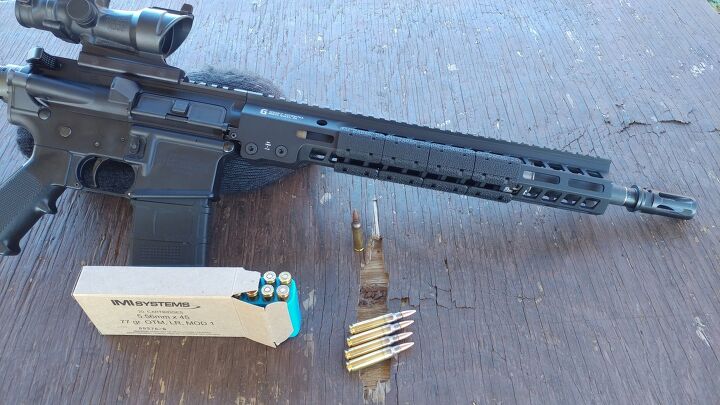
The first round up for the Big Freakin’ Cartridge Test is IMI’s take on the Black Hill’s classic heavy precision load, Mk. 262. Branded as “77gr Razor Core”, IMI’s version sports annealed 5.56mm NATO cases, neck and primer sealant, and of course 77gr Open Tip Match projectiles. Based on reputation alone, I expected the best accuracy and relatively high muzzle velocities from this ammunition. The test procedure was as follows:
TFB's Big Freakin' Cartridge Test! Introduction

Through the Modern Calibers series of posts, we’ve covered 40 different rifle and pistol calibers, ranging from the diminutive .22 Winchester Magnum to full power calibers like the 7.62x51mm NATO. The series was intended to give readers a baseline picture of how different calibers compare to each other in performance, but its biggest limitation has been that it is entirely theoretical. The ballistics graphs in that series were created based on numbers spat out by a conventional calculator using nominal muzzle velocity and static ballistic coefficient figures – and while this is accurate enough to give us an idea of the performance of different rounds relative to one another, it is imperfect. Well then, it’s time to get empirical: Introducing the Big Freakin’ Cartridge Test.
Thales EF88 Completes First Operational Deployment

The Thales EF88 assault rifle has seen its first operational deployment, and the reception is reportedly very warm. According to an article in Defence Connect, the rifles were deployed with Task Group Taji 5 (5th rotation), a battalion of Australian Defence Force advisers for Iraqi forces deployed as part of Operation Okra. The article reads:
Preference-Driven vs. Process-Driven Design in the Field of Small Arms Ammunition: Discussion

In yesterday’s article, we took a look at examples of two different methods of design, which I called “preference-driven” and “process-driven”. For these examples, I supposed two engineers from two different cultures – called “Romulan” and “Vulcan” after the aliens from the Star Trek universe.* In the “Romulan” example, we explored preference-driven design, where a final product is outlined by amalgamating preferred characteristics from previous works to create a desired whole. For the “Vulcan” example, we examined the more elaborate method of developing processes that can be fed data to procedurally generate characteristics as an example of process-driven design.
Romulan, or Vulcan? Preference-Driven vs. Process-Driven Design in the Field of Small Arms Ammunition
If you were designing the next small arms round, how would you do it? What methods would you use to determine its physical characteristics and performance attributes? How would you know what was too large or too small, too powerful or too weak? Perhaps more critically, how do different methods for answering these questions compare to one another? Could some methods be better or worse than others?
Modern Personal Defense Weapon Calibers 013: The .22 TCM and .22 TCM 9R

It has been a little while since we visited the subject of modern personal defense weapon calibers, so to start it off again we’ll be taking a look at a new high velocity round that is only a few years old: Armscor’s .22 TCM. This round was reportedly developed by Fred Craig as a high velocity caliber for the 1911 platform, and picked up by Philippine company Armscor. Originally called the “.22 Mini Mag”, the .22 TCM (Tuason-Craig Magnum, after Craig and Armscor’s president) is designed to fit inside the magazine well of a 1911 and function from .38 Super 1911 magazines. Although a pistol round, the .22 TCM is based off the .223 Remington case, shortened by about three quarters of an inch. Thanks to the thick web of its parent case, the .22 TCM is capable of handling high pressures of 40,000 PSI. A version with a shortened projectile, the .22 TCM 9R, is compatible with shorter 9mm magazines for weapons like the Glock 17.
Does Pointing Your Gun Up Affect Accuracy? ARDEC Study Reveals the Effect of Weapon Orientation on Ammunition Velocity and Consistency [NDIA 2017]
![Does Pointing Your Gun Up Affect Accuracy? ARDEC Study Reveals the Effect of Weapon Orientation on Ammunition Velocity and Consistency [NDIA 2017]](https://cdn-fastly.thefirearmblog.com/media/2024/05/16/14206654/does-pointing-your-gun-up-affect-accuracy-ardec-study-reveals-the-effect-of-weapon.jpg?size=720x845&nocrop=1)
Does pointing your gun up or down affect its accuracy? The answer is “maybe” according to a recent US Army Armament Development, Research and Engineering Center (ARDEC) presentation released at the 2017 National Defense Industry Association small arms conference. The presentation covers a study conducted by ARDEC which examined the effect of ullage (free space in a loaded round) and orientation on the consistency and velocity of small arms ammunition.
Modern Personal Defense Weapon Calibers 012: The 5.8x21mm Chinese
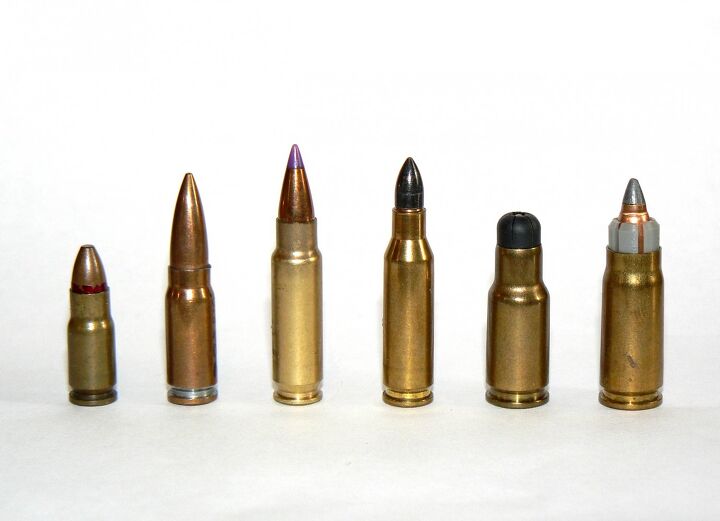
It is not only the West that has developed small caliber, high-velocity pistol-compatible personal defense weapon ammunition; in the early 1990s, the People’s Republic of China also developed such a round. Called the 5.8x21mm DAP-92, it fires an 0.229″ caliber dual steel/lead cored bullet at a nominal 1,738 ft/s from the QCW-05 (Type 05) SMG, or 1,574 ft/s from the QSZ-92 handgun. It is shorter and less powerful than either the 5.7x28mm FN or the 4.6x30mm HK, making it a more suitable round for use in handguns than its Western counterparts.
Modern Personal Defense Weapon Calibers 011: The 6x35mm KAC/TSWG, Revisited

When I started the Modern Intermediate Calibers series, I did not expect it to grow as large as it has. The initial plan was for 7 major calibers, which grew into well over 20, and the spinoff Modern Personal Defense Weapon Calibers, which itself will have at least 20 entries.
Modern Personal Defense Weapon Calibers 009: The .22 Winchester Magnum Rimfire

So far in the Modern PDW Calibers series we’ve talked about small caliber, high velocity PDW rounds like the 5.7mm FN and 4.6mm HK, and we’ve tackled larger, punchier calibers like the 10mm Norma Auto and the 7.5mm FK. However, we still have not tackled the very extreme low end of the spectrum, that is rounds that are so small and impotent that many question their usefulness as antipersonnel rounds at all. However, small size brings with it some benefits in recoil and round weight, so it’s worth taking a closer look at this kind of round.
Modern Personal Defense Weapon Calibers 008: The 10x25mm Norma Automatic

Oh yes, it’s that time. The 10mm Automatic, what hasn’t been said about it? Well, a decently sourced article about its history*, maybe, but that’s for another time. Right now, we’re considering the 10mm Auto (or 10mm Norma as it’s more prim and properly called) as a personal defense weapon and submachine gun caliber. The 10mm was designed in 1980 by Swedish company FFV Norma AB with input from Jeff Cooper as the most powerful and capable automatic handgun round of its day, but will that extra power pay off when pushed beyond its design limits into the 50-300m range, at least according to the JBM Ballistics calculator?
Modern Historical Personal Defense Weapon Calibers 006: The .30 M1 Carbine

The US .30 cal M1 Carbine is one of the most important developments in the personal defense weapon story, being one of the very first* intermediate calibers to be adopted as standard issue by a nation, and arguably the first purpose-designed PDW caliber in history. Even today it occupies a strange halfway point between pistol and rifle cartridges, being similar in design to a long pistol round or magnum revolver round with its straight-walled case and round-nosed bullet, but loaded with rifle powders designed for the 18″ barrel of the handy little M1 Carbine.
Modern Personal Defense Weapon Calibers 005: The 5.56x30mm MARS

Today on Modern PDW Calibers we’re going to look at what might seem like a humdrum round, but which represents an important performance band for the modern personal defense weapon. That round is the 5.56x30mm MARS, a purpose built “micro assault rifle” cartridge from Colt designed to fill a similar niche to the WWII-era .30 M1 Carbine.