#Weapon
What Would a Long Range Sharpshooter Infantry Paradigm Look Like? Part 3: Organization and Tactics

In the first two parts of this article on a new long range infantry rifle paradigm, we painted a picture of what sort of weapons would be needed to maximize the infantry’s long-range capability, in theory allowing them to achieve “overmatch” versus enemy infantry armed with existing .22 and .30 caliber weapons. We created estimates for both the cost and weight of the infantry rifle, and we also examined the problem of training soldiers to maximize their capabilities with the new longer-ranged weapons.

Has "The Silencing" Begun? The Marine Corps Experimenting by Suppressing an Entire Battalion

On the defense side, sound suppressors have been relegated to special roles ever since their invention. Used to give stealth to special operatives, assassins, and direct action teams, silencers have been valuable tools, but not central fixtures in normal military operations.
What Would a Long Range Sharpshooter Infantry Paradigm Look Like? Part 1: The Weapons

More and more, it seems like we are on the cusp of a break in the small arms “plateau”, and that major changes may be coming both in the technology and use of infantry small arms and ammunition. The biggest harbinger of this coming paradigm shift has been Picatinny’s Lightweight Small Arms Technologies (LSAT) program, now superseded by the Cased Telescoped Small Arms Systems (CTSAS) program. As CTSAS and similar programs make headway, it seems increasingly likely that some sort of next generation lightweight ammunition paradigm will force a shift in infantry small arms, and that the current fleet of metallic-cased ammunition and the weapons designed to fire it will have to be replaced by new designs.
A Trip to the Bundeswehr's Fantastic Defense Technology Museum in Koblenz, Part 7: Pistols [GUEST POST]
![A Trip to the Bundeswehr's Fantastic <i>Defense Technology Museum</i> in Koblenz, Part 7: Pistols [GUEST POST]](https://cdn-fastly.thefirearmblog.com/media/2024/05/15/14173024/a-trip-to-the-bundeswehr-s-fantastic-i-defense-technology-museum-i-in-koblenz.jpg?size=720x845&nocrop=1)
The history of modern small arms is in part so fascinating because of how many firearms have been developed even in obscure circumstances, and how many of those obscure small arms still exist in museums and private collections around the world. Even though I make learning about obscure modern small arms my hobby, I am continually surprised by the new and unique weapons I uncover both on the Internet and in real-life excursions to some of the aforementioned collections.
Will France and Germany Adopt a Unified Weapon? Heckler & Koch Poised to Take European Rifle Market

France has just adopted the HK416 as its new standard infantry rifle, replacing the FAMAS, and Germany is on a path to a new weapon, aiming to divest herself of the controversial G36. This raises the question: Will Germany and France adopt a unified arm? These two nations, historically enemies but often partners after the Second World War, could possibly standardize on the excellent Heckler and Koch HK416 rifle, derived from the American AR-15 with the HK-designed male-piston short stroke high strength operating rod. Polish writer Remiguisz Wilk, writing for IHS Jane’s writes a short report:
Full Auto Controllability, Continued: How Do We Define Useful Fully Automatic Fire?
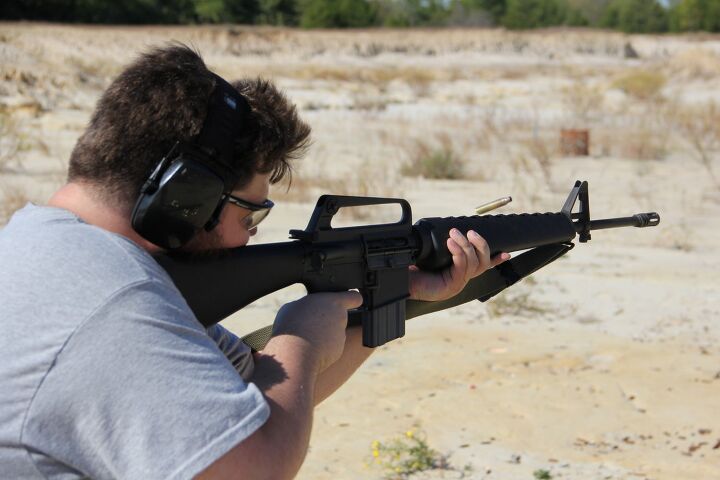
Previously, we talked about the word “controllability”, and what it means in relation to the recoil and ergonomic characteristics of a firearm. If you haven’t already read that article, I recommend you click the link here and do so first, as this post will assume that you have. We discussed how a rifle – due to its ergonomic design and the skill of its shooter – may seem to be “controllable”, even if it produces recoil to an extreme degree and rate. What we didn’t talk about is the effect that terrain, fatigue, and other secondary factors have on rifle controllability, and how those factors fit in to a broader calculus on controllability thresholds for military automatic individual weapons.
6 Reasons the AK-47 Is the Most Reliable Rifle in the World: A Guide to Kalashnikov's Magic for Aspiring Gun Designers, Part II

Yesterday, we took a close look at the AK’s operating group, to enumerate the details that make this pattern such a dependable design. Today, we’re going to be looking at some of the other elements of the AK that make it so reliable, but first I want to clear up some confusion that arose in the comments section of the previous article, regarding what the term “anti-preengagement” refers to. Hopefully the video below will help:
6 Reasons the AK-47 Is the Most Reliable Rifle in the World: A Guide to Kalashnikov's Magic for Aspiring Gun Designers, Part I
Today we know the Kalashnikov family of rifles as one of the most successful and reliable weapon families ever designed. Even as the rifle’s legend has begun to be peeled back, the weapon’s reputation for reliability is still largely unquestioned, and many consider it to be the most reliable individual automatic weapon ever made.
Modern Historical Personal Defense Weapon Calibers 003: The 7.65x35mm MAS, a .300 Blackout in the 1940s?

Since we’ve covered the two most prominent PDW rounds of today, I want to take a quick detour and look at an interesting – but obscure – personal defense weapon/assault rifle round from history. After World War II, the apparati of the German war machine were being dismantled, and anything of value claimed by the Allies as spoils. While the Americans got Germany’s most prominent rocket scientists, the French claimed Germany’s tank designers, and many of her small arms engineers. As France was looking to replace their motley and outdated collection of small arms (a suite which developed more organically than by design, thanks to two devastating World Wars), they put these German engineers to work, including one Dr. Heinrich Vollmer, who before and during the war worked at Mauser. Vollmer had been involved in development of – among various other projects – the StG-45 assault rifle, which possessed a unique roller-retarded blowback action that promised an inexpensive and reliable, yet lightweight weapon. This rifle would eventually lead to the G3, but during Vollmer’s stay in France, the French government set him to work making a smaller version of it, in variants chambered for .30 Carbine as well as a new round: The 7.65x35mm MAS.
"Why Didn't He Design Anything Else?" Looking at Mikhail Kalashnikov's Forgotten Firearms Portfolio

Last weekend, I took the major arguments of Kalashnikov conspiracy theorists head on, and one of those – which I hear rather frequently – is why he did not design any other weapons besides the AK-47.
The Modern Civilian PDW Reborn? BreachBangClear Slings a Glock, and It's Somehow Not Terrible

The National Firearms Act really is a drag. Thanks to its legal restrictions on short barreled rifles, some of the lightest and handiest classes of firearms are substantially restricted from common ownership in the US. The police carbine ( semiautomatic short barreled pistol caliber rifles) and the PDW are two of the hardest hit classes: Both kinds of firearm are handy, easy to shoot, and inoffensive, but both are at their best with barrels under 16″, right where the NFA cuts them off.
The Simplest Homemade Pistol? Mark Serbu Gives the World the GB-22 "Gun Buyback Special"

What is the simplest gun you can possibly make? When you hear this question, the kind of gun that comes to mind is probably a simple zip gun, like the one below, which has a forward-moving mass, a trigger, a barrel, and not much else:
Is Serbia the First Nation to Adopt the 6.5mm Grendel?

The 6.5 Grendel is in many military small arms enthusiasts’ eyes the ideal military caliber, in theory combining the best characteristics of both 7.62mm and 5.56mm rounds. However, in the thirteen years since the round’s introduction, it has found little if any traction with actual military users – until now. It seems that the Serbian government has quietly adopted the “slow and steady” six five earlier this summer. From Novosti Online:
Firearm Showcase: The Heckler & Koch XM29 OICW, the ULTIMATE Individual Weapon? - HIGH RES PICS!

In May of this year, I got the rare opportunity to travel to Heckler & Koch’s headquarters in Ashburn, VA, to take a look at some of the experimental and prototype firearms they have located there in their famous “Grey Room”. It wouldn’t be worth as much for me to just tell you about it and to snap a few foggy cell phone pictures, though, so I brought along Othais of C&Rsenal to help me take high resolution light box photos of these unique and rare firearms.
"Controllable" vs. "Low Recoil" – What Do We Really Mean?

We hear a lot of talk about how some firearms are “controllable”, while others are not. The word “controllable” or “manageable” is often used in gun reviews to describe the recoil characteristics of a gun, even though without additional context or clarification it tells us very little. I want to talk very briefly about what the word “controllable” means in the context of firearms, and how it actually relates to a firearm’s recoil characteristics.