#Design
Future Firearms Ammunition Technology 001: Aluminum Cased Ammunition - Lightening the Load, Pt. 1
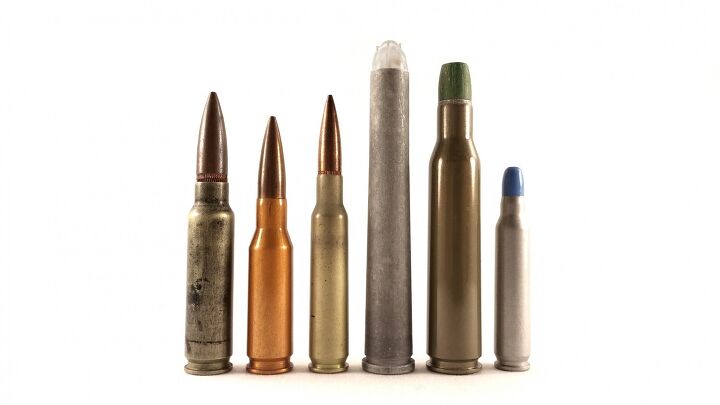
The metallic cartridge case was invented in the 1840s, and – starting in the 1860s – its military application brought with it a host of of advantages for the soldier: Now, ammunition was self-contained, weatherproof, and durable. Yet, despite it being a massive advance, the metallic cartridge wasn’t an across the board triumph. With the addition of a metal case, ammunition became heavier, and cost more to manufacture. In the early days of metallic cartridges, military weapons were slow to fire, and fired heavy bullets that made up the overwhelming percentage of mass of the ammunition, so this advantage was small. Ironically, though, the metallic cartridge allowed the invention of faster firing designs that expended ammunition more quickly, and as ammunition caliber shrunk and average bullet weight dropped, the percentage of mass contained in the metallic case grew.

Cracking the Machine Pistol's Code: Is a Useful Fully Automatic Handgun Possible?

In a previous article on TFB, we compared a Mauser 712 Schnellfeuer to a Glock 17 with an auto sear, and along the way discussed how very limited the usefulness of the modern machine pistol is. Fully automatic pistol-sized weapons have been around for over a hundred years, but they’ve only ever seen limited use in specialist roles, with their adoption and then subsequent abandonment coming seemingly in waves as departments and forces pick up the concept and then discard it upon learning how impractical the weapons are in actual use. The history of machine pistols is fascinating, and those who are interested can follow the link to a podcast I participated in on the subject to learn more.
Operating Systems 301: What Is Underlug?

Note: In this article, I call this mechanical feature “underlug”. However, this is an error. Several friends of mine and I have been discussing the mechanics of firearms operation for close to a decade now, and we misremembered the term “underslide” from a book by Brassey’s as “underlug”. More details on the error are available in the comments. Regardless, “underslide” is the proper term for this principle, not “underlug”.
Taking a Closer Look at the Cycle: Firing (Operating Systems 201)

In the first post of the 101 level series on firearms operating systems, we briefly described what the word cycle means in terms of the operation of automatic firearms. However, there’s a lot more to the cycle of an automatic firearm than just the completion of one round of firing, so let’s take the time to explore the concept a little more deeply.
Operating Systems 301: Introduction to Advanced Concepts

So far we’ve looked at the most basic concepts in firearms operating mechanisms as part of the 101 series of posts, and some more advanced concepts like locking and bolt configuration in the 201 level entries. However, there is a whole lot more depth to the subject, so much that the advanced 301 level discussions will really only be able to scratch the surface. Before we start talking about these subjects though, be forewarned: So far I have avoided including any serious math in the 101 and 201 level posts, but we will have to tackle some math as we delve deeper into how these weapons really work.
Exploring the Untapped Potential of 7.62×39 as an "All Around" Hunting Caliber

What if there was a caliber that was suitable for everything from coyote to brown bear, kicked less than your whitetail gun, fit in a micro-length (2.25″/58mm) action, and cost a quarter a round to shoot? That would be a pretty awesome caliber, wouldn’t it? It turns out that this caliber might already exist, if the industry can fulfill its potential: It is the Russian 7.62x39mm caliber used by the infamous AK-47 rifle.
Ballistics 101: What Is Rifling?

Previously in our introductory series on ballistics, we’ve discussed the concept of caliber, as well as ballistic coefficient and its close relative form factor. Today, we’re going to look at the concept of rifling, and how it relates to bullet stability.
Operating Systems 201: Tilting Barrel Locking

Previously, we looked at the most common type of locking mechanism for rifles, but what about handguns? Well, today we’ll be looking at tilting-barrel locking, a method used in virtually every modern locked-breech handgun today.
Operating Systems 201: Intro to Locking Mechanisms

In the second of our 101-level discussions on firearms operating mechanisms, we mentioned that firearms may have what’s called a locking mechanism, which prevents the separation of the breech and barrel during the high pressure ignition of a round of ammunition. For 101-level posts, we’ll mostly note whether locking occurs or not and nothing more, but today’s 201 post will begin to talk about locking mechanisms in detail. First, we need to understand that there are two different things meant by the term locking. The first is the more proper understanding of a fully locked breech which must be opened by some external force, but the second is often referred to as “locked” as well, even in some professional literature. This second use is more properly called half- or semi-locked, and describes locking elements that are used in retarded-blowback mechanisms.
Operating Systems 101: Introduction and Foundation

What makes an automatic (or semiautomatic) weapon work? How do these weapons accomplish being able to fire round after round through a single barrel with no interference from the operator? That’s what I aim to explain in this series, which hopefully will give my readers a brief and readily accessible foundation on firearms operating mechanisms. For some of you, many of these articles will not tell you anything you don’t already know, but be patient: I plan to be very thorough in my coverage of different operating mechanisms. The scope of this series will be the operating mechanisms of single-barreled firearms, minus their feeding mechanisms (which I will cover separately).
Ballistics 101: What is Form Factor?

In the second installment of Ballistics 101, we took a look at the concept of a “ballistic coefficient”, or a drag model based on an empirically tested projectile, against which other projectiles can be measured and compared. Mentioned in that post – but not explained – was the concept of form factor, which is the subject of today’s installment.


What's Killing the Bullpup (and How to Cure It)

The concept of a stockless – or “bullpup” – rifle has been around since the very dawn of the 20th Century. It was invented in the United Kingdom, the country with which it still is most closely associated. After World War II, the concept began to gain traction, but bullpups saw their greatest success in the 1970s and ’80s, being adopted by Austria, Britain, France, Singapore, and many other major nations of the world. However, in the modern military market, the concept’s popularity has declined. The questions of why, and how designers can create more competitive military bullpups are the subjects of this article.


The Flaw of Averages

How many people really are “average”? Is it possible to design a system to fit the average person, and if not, what’s the alternative? A recent article published on thestar.com examines this question, excerpting the work of L. Todd Rose from his recent book The End of Average. Rose’s narrative is somewhat massaged, but the central thesis about averages and their relationship (or lack thereof) to the individual user is well-developed and quite pertinent. We will explore these ideas through excerpts from the article, beginning with the one below: