What happened to the mythical undetectable plastic gun?
Back in the 70s it was rumored that the KGB possessed a three-barred disposable all-plastic pistol, called the Troika, that could pass though airport scanners undetected. So when the polymer-framed Glock pistol first came to market in the early 80s, it really excited the imagination of politicians, reporters and novelists who believed that plastic guns capable of being smuggled aboard airplanes were just around the corner.

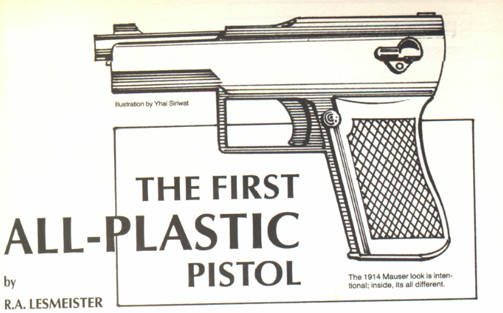
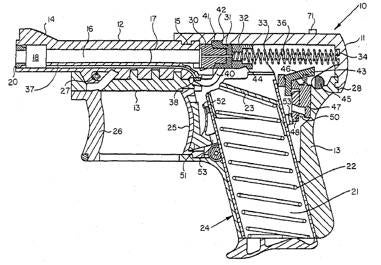
In 1984, a couple of years after the Glock landed, David Byron, a 32 year old gunsmith and manufacturer of plastic pistol grips, filed for a patent on an all plastic pistol design. His patent, which was issued in 1987, does describe a plastic .22 gun but offers no hints as to what plastics and ceramics could be used to build it. Congress got wind of this patent and hysteria ensued. Members of the House tried introducing legislation to ban the importation and manufacture of these hypothetical plastic guns.
Byron teamed up with a wealthy former cemetery salesman and formed Red Eye Arms Inc., a company dedicated to bringing the .22 pistol and plastic military weapons to market. Byron said to an Orlando Sentinel reporter:
"Can you imagine the difference between a three-man crew firing a weapon from a tripod and one soldier running around the battlefield firing the same weapon from the shoulder? It would give our side so much firepower superiority that it wouldn't be any contest. And with the reduction in midrange nuclear weapons, superiority in conventional weapons is what our country needs right now."
Between 1986 and 1988 numerous magazine and newspapers article were written about Bryon's plans. After 1988 he seemed to drop off the map without having demonstrated a functioning plastic pistol.
In 2000 he formed a company called Magnum Technology Inc. and in 2001 secured almost $800,000 of research funding from Department of Defense to construct a light-weight non-metal ceramic gun barrel. He claimed that the they had successfully fired small caliber rounds in ceramic barrels ...
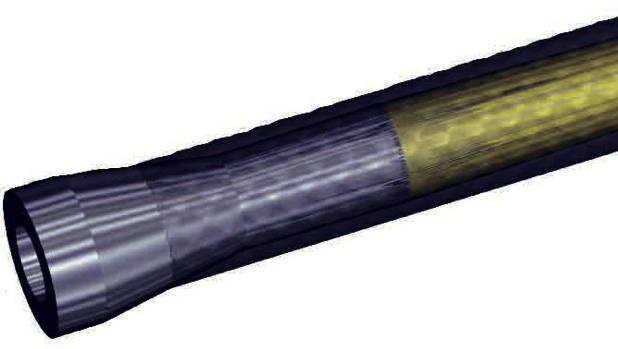
... ceramic barrels that are reinforced to enable their satisfactory use as gun barrels. The basis of our technology is the reinforcement of materials that are extremely hard and brittle so that they may be used for purposes not previously feasible, such as gun barrels. Referred to as Composite Reinforced Ceramic Technology (CRCT), this technology has been privately researched and funded. A proof of principle has been successfully demonstrated with thousands of satisfactory firings in small caliber.
The barrels were apparently made from a machined zirconia (a type of ceramic) over-wrapped with resin-coated carbon fibers.
Magnum Technology was shut down in 2007. I was unable to find any evidence that a functional lightweight ceramic barrel was actually delivered to the military.
According to Byron's LinkedIn profile, last year he started up a new defense-related company called AlEX Ventures. I suspect that this is his latest attempt at the mythical ceramic barrel and all-plastic pistol.
Is Byron a dreamer or just a very clever salesman? I don't know.
[ Many thanks to Clayton for help researching. ]

They are making plastic ammo now, why not an all plastic gun. Before Glock proved different people thought there was no place for plastic in a pistol. This guy has been working on it his entire life, if he doesn’t do it someone will find his research and do it. Look at Goodyear tires story.
Those crazy enough to think they can change the world, just might be crazy enough to do it.
Sounds like somebody is running some kind of scam to rip off our government by getting grants for make believe ideas.
No one will buy it I guess, After all the famed LAPD legend, Detective John McClane already said this gun is cost more than you make in a month.
The ceramic barrel seems completely pointless.
“Can you imagine the difference between a three-man crew firing a weapon from a tripod and one soldier running around the battlefield firing the same weapon from the shoulder?”
Yeah, they called that a BAR, when they did it the first time. And they did it by using conventional engineering.
Cubic zirconia has a specific gravity of about 5.7, steel is 7.85-ish. That’s only about a 27% weight reduction, and I’d bet zirconia is brittle enough that weight savings are physically impossible to realize. I’m guessing cost would be pretty ridiculous, as well.
Aluminum’s sp. gravity is only 2.7. That’s less than half that of zirconia. Didn’t Winchester or someone make a shotgun way back when, with a 100% aluminum alloy barrel? And another company, maybe that one was Winchester instead, made a shotgun with a super thin barrel wrapped in some type of fiberglass.
American Derringer still makes a model with an aluminum barrel, in the lower pressure cartridges. http://www.amderringer.com/m7.html And I’ve got a 12 gauge to .22 LR shell with an all-aluminum rifled barrel, made by these guys. https://www.dinaarms.com/ Still hits a paper plate at 5 yards, still has the rifling in it, after a couple hundred shots of Remington Thunderbolts (and the mediocre accuracy could easily be due to the ammo as much as anything; never seen it keyhole, at least).
You’d have to be several kinds of crazy or foolish, to try and save weight with zirconia instead of aluminum, at least in something chambered for .22 lr. Wrapping it with a composite like carbon fiber would be a great idea, though. Lots of advantages over the aforementioned fiberglass-reinforced one, which actually existed. Aluminum and carbon fiber could VERY easily and VERY cheaply make a VERY light gun in .22, .44 spl, 12 ga., etc. (have fun shooting it if it’s that last one, though).
Then if you want a ridiculously light barrel, suitable for powerful cartridges, just use a beryllium alloy. Beryllium’s sp. gravity is 1.85 (completely insane), and the better alloys are actually more than strong and heat-resistant enough to be a completely realistic barrel material. Of course, that 3″ barrel for your 4 ounce .22 pistol will run you something like $100,000, maybe more.
Uh, wait a minute, they actually called it a Lewis Gun when they did it the first time. I wish I could edit these things.
I guess the BAR is more of an example of conventional engineering, though the unconventional bits of the Lewis gun (clockspring for the mainspring, and using the gas-op mechanism to drive the pan magazine) repeatedly proved themselves to be excellent, in combat.
Then AGAIN again, in practice, the Lewis gun was still part of a 3-man team far more often than the BAR was. Albeit a much, much more mobile 3-man team than one supporting a tripod-mounted weapon.
Editing! I need it! Okay, I’m definitely done now.
Beryllium is a fantastic element, unfortunately the dust is extremely toxic/carcinogenic, even when part of an alloy. They used to use it in airplanes brakes and fluorescent lighting. Manufacture and use of a barrel has huge concerns.
Yep, exactly. IIRC, the most expensive thing about working with beryllium is ensuring your workers don’t get 8 different kinds of cancer. That’s what really makes the cost prohibitive. Amazing stuff, otherwise.
No Glock 7… LOL
Interestingly enough, according to BATF regulations and federal law, firearms composed entirely of a material that can defeat standard airport metal detectors and x-ray machines are already illegal to manufacture, transfer or possess. Additionally, firearms must be of a shape and size conducive to detection, per a detection standard blank known as the Security Exemplar. It’s USC 922(p)(1) if anyone is curious.
In addition you need a metal plate to engrave the serial number. Look on the bottom of any polymer framed pistol.
Unless what you’re getting at is that it’s law that you must use a metal plate, you could just as easily engrave the SN on a ceramic plate.
Hmph..the biography left out the years he was marketing the Medusa, Taurus Triad, Ruger XGI and all the other vaporware firearms that were ‘just around the corner’ yet never seemed to actually get here.
…Lemme just point out, for the “OMG, they’ll smuggle them on planes” set, that anything dense enough to make a gun (especially the chamber and barrel) out of will show up on an X-ray. Or a TSA pornoscanner.
That’s why I disguise my plastic pistol as a hair dryer. Not only can it fool the scanner but the pistol grip and trigger are already in place.
An all plastic/polymer gun? Better off coming up with a zero-metal composite gun even including ammo. Someone already tried an all composite M4 type rifle using carbon fibres and polymers. But back then composites were so flimsy they can’t survive more than a few hundred rounds fired.
Maybe someone out there has done better by now..
The real reason his work has never been seen is that it is too costly.
Each pistol costs more than a policeman makes in a month…
The use of plastics (or polymers or whatever) in the production of weapons is not revolutionary or new. It made the weapons lighter which did allow the soldiers to bear more weight in ammo and commo gear and body armor.
But what is the need for an all plastic gun? And what the hell is it going to fire as a bullet?
I remember hearing that line in Die Hard 2 and thinking “bullet?” The Steyr AUG is all plastic but for the barrel and precious few internal components. We all know about the Glock. Yes, we can use plastic components on weapons. But I can’t see a need that this concept can fill. I may be wrong. I see a proposed solution looking for a question.
re. the Steyr AUG:
You forgot the receiver (extruded aluminium with a steel insert).
Also, the “precious few internal components” include the entire bolt assembly.
When I trained with the Aussies in 1988, we went through the AUG a few times. It is my recollection (but I could be mistaken) that the bolt was internal.
Yes, the bolt is internal.
I only object to the “precious few” (which creates the wrong impression)
What’s the bullet supposed to be made of?
Ceramic with plastic liner for grip in the rifling?
I’m having real trouble coming up with a reason for an all plastic pistol – I mean obviously, there will be a market for airplane riding terrorists, high school drug gangs and would be Presidential assassins, but for everyday military / LEO / civilians, it would seem to be a non-starter.
I know – what if Magneto attacks your local mall? Problem solved.
Anyone else get a chill down their spine after reading this? – ‘Byron teamed up with a wealthy former cemetery salesman and formed Red Eye Arms Inc.’
An auto eliminates heat build-up by ejecting the spent case immediately after firing.
Even a ceramic case would transfer heat.
I’m willing to bet the CIA would buy a few hundred. As would other countries who are friendly to the US, such as Israeli Mossad.
The biggest problem I have with this idea is the fact that it is an automatic. Surely a revolver would be much simpler, as it would not require you to come up with non metallic versions of recoil and magazine springs. Also, with a revolver it could be muzzle loaded, with the chambers simply being filled with powder and a ceramic bullet (in a plastic sabot or cup of some sort) with a plastic percussion cap, eliminating the metal case. I know that plastic cased bullets are being developed, but this seems like as easier solution (for the time being at least). Much harder to reload, but lets face it, this weapon is for assassinations and the like where this will be less of a problem.
Non metallic spring = rubber ball or an air piston or combination of both. Oh, how about an english yew bow?
“Can you imagine the difference between a three-man crew firing a weapon from a tripod and one soldier running around the battlefield firing the same weapon from the shoulder? “
That’s surprising, most gunsmiths know that recoil exists. I guess that guy skipped that day at gunsmithing school.
“machined zirconia (a type of ceramic) over-wrapped with resin-coated carbon fibers”
That doesn’t exactly sound soldier-proof. Also sounds like it would have heat problems. And I notice there’s no mention of what an all-plastic gun would use instead of springs.
All good points, which also provide the answer to the question.
The guy is a salesman, or perhaps more accurately a huckster.
You have to think completely differently. This is how advances are made while other people stick to 200 year old traditions. Look at how fundamentally different the construction of the Boeing 787 is from earlier planes. If you treat these materials like a metal substitute, it won’t work.
CFRP is can be made to be elastic in certain axes without any fatigue like metals. The entire gun can be made to flex as a recoil buffer and it will spring back to shape. You could engineer the fiber axes and layup of the receiver, for example, so that it would deform at exactly the right pressure and directions to cycle your round. A no-sliding parts gun.
Zirconia is extremely well insulating and withstands very high temperatures. It will insulate in the heat instead of transferring it to gun components. It’s used in combustion engines for this purpose, so there’s no problem in it handling intermittent rounds. There would be advantages in reduced IR signature.
A ceramic barrel would not have a heat problem, it would be able to heat up a lot more, tensile strength is where ceramics fall short. I was interested in the idea of an all ceramic barrel years ago, the best ceramics would not last through a 38 special chamber pressure, the rare chance that a ceramic chamber withstood a firing any imperfections would weaken it considerably and when it fails it shatters catastrophically. The only feasible plan I could come up with is a set of ceramic spiral shards, 5 or 6, placed together each forming 1 rifling groove, an inch or so each, stacked length wise to form the barrel, and then a binder to hold them all together, perhaps wrapped carbon nano tube. It would have to be one hell of a strong wrap to withstand 35,000 psi of stretching force, shards would only need to withstand that crushing force. I still think metal would work out better in the end. A high tensile strength ceramic (one with elasticity) would have far more applications than just gun barrels, like car engines, it would absolutely revolutionize the whole world.
Has anybody sensed like when Russians lack the time,tech,innovation to develop a MilTech they first open the idea,let the fruit grow then harvest with GRU,like atomic tech leaks?…http://en.wikipedia.org/wiki/Klaus_Fuchs
The all plastic gun is not an impossible target to reach however like all markets, if there is a demand someone would answer it. You could in fact the vast majority of a weapon polymer, the only metal parts need be anything pressure bearing (unless you design some kind of caseless ammunition.