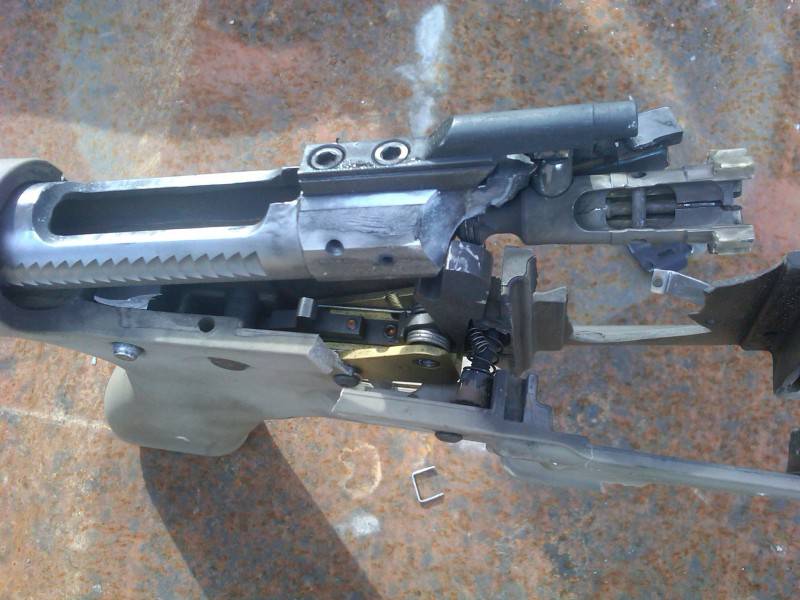
Big AR-15 KABOOM
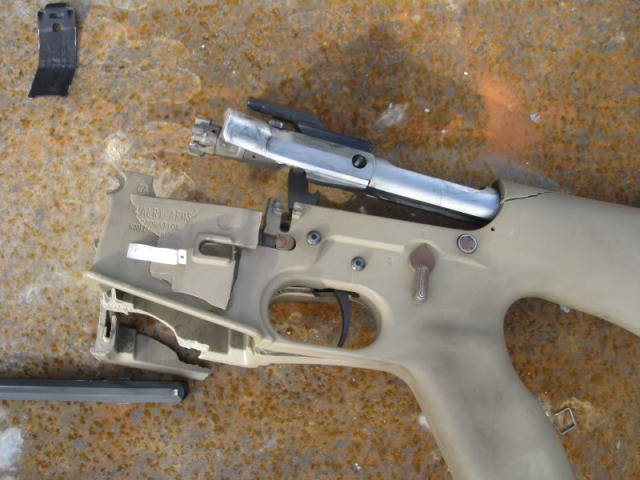
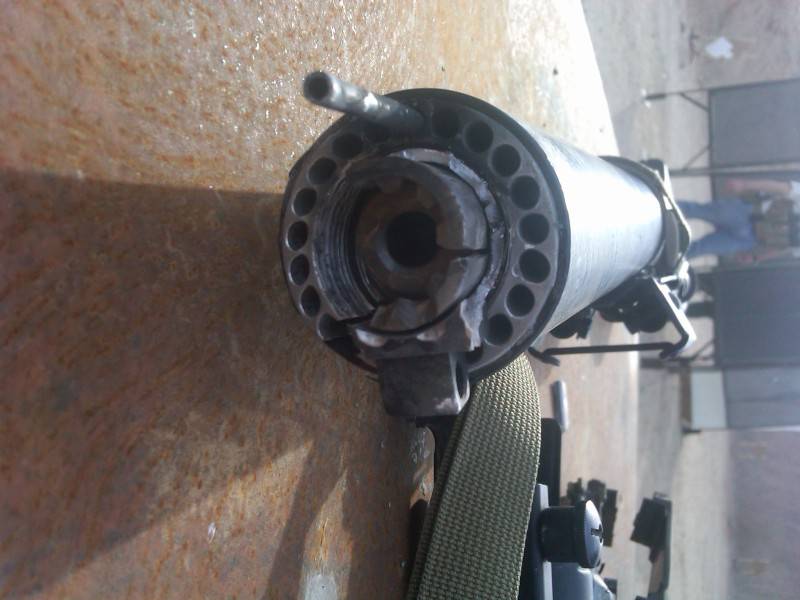
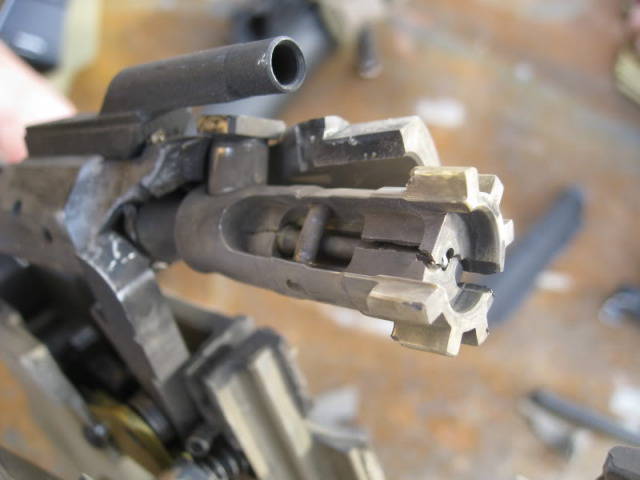
This is by far the worst AR-15 kaboom I have ever seen on the internet. The operator somehow mistakingly mixed pistol powder and rifle powder in a few of the cartridges he loaded. The result was catastrophic failure. Just about all the parts were destroyed. Photos from ARFCOM ...
Apparently the gold-like coating on the bolt and carrier is from the vaporized brass cartridge. Can any engineers or chemists confirm this?
The shooter was ok, other than getting whacked in the face with the charging handle and having small pieces of the carbon fiber freefloating tube embedded in his forearm.
More photos after the jump ...The rifle parts list ...
Parts list:
Cav-arms mk2 lower in tan + lower parts kit.
Custom trigger pins.
Compass lake 18" govt profile douglas premium airguaged stainless steel barrel with matched bolt.
Ameetec cam pin, firing pin, firing pin retainer pin, slick side upper receiver.
Charging handle
USGI 30rd aluminum magazine with Magpul follower, and Magpul magpul in OD green.
Miculek brake
YHM low profile gas block, gas tube
Clark custom forearm, carbon fiber lightweight tube
Young mfg bolt carrier.
Timney triggerParts destroyed:
upper, lower receivers.
BCG: total loss
Forearm
barrel, gas tube, gas block, muzzle brake,
LPK: mag release, bolt release, custom trigger pins, take down pins.
charging handle is bent.
USGI mag with magpul follower and ODgreen magpul.
Parts salvaged:
sling, bipod, buffer, buffer spring, selector(safety), timney trigger(maybe I have not tested it yet),
ACOG.
[ Many thanks to jdun1911 for emailing me the link. ]

Wow never knew there was that much difference between pistol and rifle powder.Sure did a number on the AR.
Ouch!! I would of sharted on myself if that happened while I was shooting!
Damn! That sucks so bad! I just build my very own Custom AR15. If you need step by step assistance I’m trying to put together something to help people build their own AR15.
Thanks!
I want to know one simple thing.
Is pistol powder safe in my plastic Glock? and 1 more, can I use rifle powder in my Red Ryder? maybe Red Dot?
Hey Maybe instead of using this stuff in enemies ammo we should use it in enemies Enemas !!!
What a Blast!!!
Engineer here, I doubt the brass on the bolt is from vaporization. This was a high pressure event, not an high temperature one.
My guesses: Titanium nitride surface coating on the bolt or some sort of copper anti-seize grease. They use the TiNi coating on drill bits and the like to reduce friction and wear. Greases containing copper flakes are not uncommon either (like a new Glock)
http://en.wikipedia.org/wiki/Titanium_nitride
http://www.midwayusa.com/viewProduct/?productNumber=111554
I see some yellowish color on the square side of the cam pin as well. It it hard to believe that vaporized brass would deposit on the locking lugs, skip the bolt carrier, and end up only an inch away on the cam pin where it contacts the carrier.
probably some kind of coating or lube…???
Justin, thanks for your input.
He would’ve been fine if it was an AK!
Piece of junk AR-15!
Lol
(kidding, just kidding, please dont flame me)
That, my friends, is a 10/10 on the fail scale.
the gold coating on parts? vaporized cases? are you kidding me?
NO!!! its titanium nitride parts.
The discoloration on the bolt carrier is very possibly from the brass “vaporizing”. After working over 15 years in firearm manufacturing doing test fire, I’ve seen that many times on purpose and by accident. Not a fun experience and glad the shooter is O.K.
@KCBCraig
Your wrong a lower is a lower and ive seen $50 Olypic lower beat out Colts or LMTs or Bushmaster lowers in performance any time.
The melting temp of brass is at about 1650 F and with a full charge of 85 grains of powder in that .223 confined it is easily seen that the case melted rather than rupturing from the intense heat (the confining pressure of the barrel was enough to prevent a premature rupture). The shell began to melt and the pressure increase at extraction would have caused it to explode as a fine liquid which would coat anything it touched. The pressure of the blast would be enough to prevent it from building up. So yes that brassy look is all the brass coating everything.
Well there’s your problem, the whole thing was being held together with a staple!
Sabotage ammo has been done (at least) all the way back to WWII. The Germans even manufactured special hand grenades with a 1 sec timer instead of the usual 7 sec. Pull string, start counting 1, bang
5.6 grs. of Unique makes a nice squib load in the .223 cartridge with the 55 gr. bullet. (Unique as you know is a faster burning powder, suitable for pistol or shotgun.) Thinking you have a charge of 27 grs. of Varget but instead have Unique might be a problem! Operator error here. He’s lucky he has his digits intact and his topknot secured. A lesson learned the hard way.
Terrible kaboom, no doubt, and thankfully there were no serious injuries. The reloader got a reasonably priced lesson in What Not To Do.
Speaking of price….that’s a whole lot of expensive stuff to hang on a Cav Arms one-piece plastic receiver. The lower didn’t affect the failure, since the upper had to KB first, but it’s surprising to see such a rifle built up on an $89 lower.
Thats why if you reload ammo use and buy only clearly marked commercial powder made from relighable comanies like IMR, Winchester, and Allient powders. Dont use crap in someones coffe can who knocked off $20 in cost for you.
Looks similar to one I saw not too many years ago. fellow opened up a brand new box of purchased ammo and on the second or third round, kaboom. never did hear if anyone ever figured out the cause on that one
see there for burn rate comparison… compare those in the vicinity of varget (one of my favored 223 powders) to the pistol and shotgun powders (I use tightgroup for pistol quite successfully) on the left
http://www.reloadbench.com/burn.html
bill,
If it were a bullpup the guy won’t have a face left at the very least.
Does pistol powder burn faster than rifle powder. I can’t find anywhere in the above posting where this is stated.
Hey, can somebody tell me if pistol powder burns faster than rifle powder?!?
I’m just chuckling at the 20 people repeating the same comments over and over.
@Daeglan
XD
holy mother of god the liberal media would just love you.
@Daeglan
Already been done. Isn’t that what Project Eldest Son did in Vietnam? Only some other sort of explosive was used, not pistol powder.
just dip your cases in Bullseye Powder to the rim. Compresses easy and works great…..for producing this effect.
Daeglan, already been done:
Project Eldest Son
http://www.jcs-group.com/military/war1964/project.html
Wait, so let me make sure I understand this correctly… pistol powders burn *faster* than rifle powders?
At least we all agree!
At least the Trijicon is okay.
This post is for HUEY148, I am sorry you thing it is a DI system that helped cause this, The chamber pressures from rounds loaded with the wrong powder(pistol, as said in other posts) would have done that with any gun, there is just so much that the rifle is designed to handle. The chambers and bolt face are the same on DI system and a piston system are basically the same. So when loaded with the wrong powder you will get the results you see above. If you don’t believe that try spending a little money and duplicate the issue, but please don’t be holding on the rifle when the trigger is pulled. Don’t blame the gun, blame the person who loaded the ammunition. It happens from time to time, and we are thankful that the person only has to replace a weapon rather an losing an eye or worse.
I remember checking a photocopy of the 7th edition of Cartridges of the World a friend gave me some time ago (circa 1996) for base mil-spec loading data. It has proof load data. Here it is:
Bullet: 56 grs.
Powder: HPC3
Type: double base flake
Charge: 20.0 grs.
Case: stannic stained or nickel plated
So, beings a regular 5.56 charge is 24-25 grains, that would easily exceed proof load testing pressures. But it would be close. Of course, this would depend upon where HPC3′s burn rate is in relation to what our “operator” used.
“I just thought of a really evil thing to do to terrorists and insurgents. Start leaving AK ammo loaded with pistol powder around for them to find and use.”
I’ve heard of US troops in Vietnam loading 7.62×39 cartridges with C4 and leaving them to be found. Supposedly a few VC were found with AK bolt carriers in their skulls. I have no idea if it’s true though.
As for the brass vaporizing, the melting point of brass is ~1700 degrees (F). That’s just to melt it, to vaporize it that quickly would take a whole lot more heat than that. It could happen, and I wouldn’t be surprised.
@Daeglan:
Evil.. or potentially HILARIOUS?
My question is, if this kind of failure/explosion happens in a bullpup rifle. Is it more dangerous for the shooter?
I think it’ll be but there are so many bullpup in service with the forces.
Wonder if an AK would have held together?
Actually that’s a CavArms lower which iirc doesn’t use a buffer tube but rather a channel molded into the polymer one-piece stock/lower assembly. Sucks for him
Someone slipped TNT into that round?
Daeglan,
Google “Project Eldest Son.” It was done during the Vietnam war, followed by forged announcements (ostensibly from the North Vietnamese command) explaining how the quality control problems with AKs and their ammo were being addressed by the Chinese… who’d be getting back to them any year now.
Speaking of pistol powders, I saw the results of mistaking 2400 for Unique in a 10″ Super Blackhawk. IIRC, the topstrap and half the cylinder went skyward and the revolver recoiled *downward*. You could grasp the remains of the piece by the barrel and grip and flex it readily.
At 21 grains, it was a rather “unique” load.
Immediately after this happened he should have gone out and bought a lottery ticket, it was the luckiest day of his life.
Steve I said no putting 222 mag cartridges in a 223 rifle :0
Looks like a over charge in the cartage lucky the shooter wasn’t serious hurt. At east the most expensive piece the ACOG survived BUT the force of the explosion may have knocked the retical off.
I’d hate to see a pic of his underware.
Daeglan, search Project Eldest Son, a MACV-SOG Vietnam program much like you describe.
@Daeglan, leaving doctored ammunition about has to be carefully done, because it’s possible that friendly forces may find the ammunition and use it.
@Daeglan
You’re about 40 years too late with that idea – MACV-SOG came up with that during Vietnam. Project Eldest Son successfully placed tens of thousands of PETN-filled AK rounds behind enemy lines for the VC to use and accidentally kB their rifles with.
The buffer tube cannot be salvaged. The buffer tube and lower are one piece for Cav-arms mk2 lower.
… you stole my idea ^-O
that carbon in the arm is not going to be fun. If you dont get it all out the bod wont eject it and you’ll have an itchy/painful spot were its still inside you. i had a carbon arrow blow up on me and was lucky to have it just slap off my arm and leave a huge welt
Daeglan, I believe this was a tactic of ours in Vietnam. We would salt stockpiles of Viet Cong / NVA ammo with cartridges filled with high explosive that looked like normal ammo. Kaboom!
If someone is more in the know please fill in the blanks.
I know it is sad and selfish to think this way, but my first thought was, “Wow, finally, a loading that makes that stupid star chamber (where the bolt locks up) easy to clean. Certainly, I have spent too much time in the Army.
That said, here is a another set of pictures to keep near your reloading bench. A reminder to check, check, check again. When in doubt, disassemble, throw it out.
daeglan, an old trick that came into effect around the time of the vietnam war, was to pull a bullet, pour out the powder and stuff the case with plastic explosive. It was one way of stopping the enemy from using looted ammunition.
Happened here in SoCal. Dude took powder out of “Russian 5.56″ cartridges and “filled” his 30-06 cases, seated a bullet and went to the range. He was “reloading” in a sense most of us would never have even thought of.
When he pulled the trigger his model 700 exploded in his face. Someone dialed 911 and our excellent emergency personnel saved his life. I was at the range the next day, when I saw bits of scalp and hair on the awning over the benches I had to ask the RM what happened.
Even rifle powders cannot be mixed. What works in a 223 does not and cannot work in a 30 cal.
At least for once someone online admits that it was their own fault for making a mistake in their reloading. Usually, when I see posts about KaBooms online the shooter blames the gun. “Oh, [insert manufacturer] makes worthless POS guns”. Only later do you find out that it was a bad reload that caused the damage.
Holy crap that could have been bad! Glad to hear the owner didn’t get too badly injured.
The only ka-boom remotely close to this bad that I’ve seen was when someone loaded a 20GA shell and a 12GA shell in the same barrel, just about the same thing happened.
Looks like he was a victim of Operation Eldest Son.
http://en.wikipedia.org/wiki/Project_Eldest_Son
@ Daeglan
I’ve heard lots of rumors that 7.62×39 ammo was “spiked” with PETN (high explosive, see shoe/underwear bombers) during Vietnam and left in caches by special forces. Never have been able to confirm it though.
So, ACOG’s are pretty sturdy then?
Uhm,.. well, at least the buffer tube can be salvaged…
I blame the improperly staked (unstaked) gas key for this kab00m.
I just thought of a really evil thing to do to terrorists and insurgents. Start leaving AK ammo loaded with pistol powder around for them to find and use.
There is a chart – probably of some age – that list common propellants and their “relative quickness.” This takes into account both material burn rate and surface area. As previous comments have noted, pistol propellants have the highest relative quickness while large caliber rifle propellants have the lowest. (I’m not sure if it takes into account the burn rate exponent as well. Gun propellant burns at different rates depending on breech pressure. The burn rate isn’t linear with respect to pressure and is often characterized by the exponent of the best-fit-curve.)
Also, rifle propellant is single base. It contains only nitrocellulose and is very stable over time. Modern pistol propellants are “double base” and contain both nitrocellulose and nitroglycerin (in addition to a small amount of stabilizer.) Pistol propellants are double base to create a higher specific output per a given quantity of powder in order to give the most performance with a small volume cartridge in a short barrel at the sacrifice of some degradation over time. So, there is an actual chemical composition difference between the two that not only causes the pistol propellant to burn quicker but also with a higher specific gas output.
I’d speculate that the gold on the bolt assembly isn’t from the brass case since the event probably happened in such a time span that wouldn’t allow it heat to the point required to vaporize copper. Rather, gun propellant usually leaves a matte tan appearance when it doesn’t burn completely burn due to too low of breech pressures. The gun probably ruptured before all of the propellant fully burned in order to leave that residue.
Yeah the pic of the bent upper just about gave me a heart attack. It truly is amazing that he wasnt hurt.
That’s spooky and one expensive lesson. I’m glad he is ok.
Pure negligence destroyed a fine rifle, luckily the shooter had no serious injuries. You do have to pay attention and follow basic safety rules when handloading or you will have unpleasant results. This “Accident” is along the same lines as “Geez, I didn’t know it was loaded”.
So guys, I’m not sure how this happened. Is it possible that pistol powder burns at a different rate than rifle powder? I haven’t seen a comment about that yet.
That right there would be some really fun physics to see in slow-motion. I was surprised that none of the bolt lugs sheared off when there was enough force being applied to launch the bolt back into the carrier like that. Then I realized that the barrel extension must have bulged and blown out far enough that the lugs didn’t have anything left to push against and the bolt just rocketed back into the carrier and ripped it apart. It looks like the barrel its self just bulged, and it was the extension that blew apart. That is pretty damn impressive…if a little scary.
- Bret
Glad he’s okay. That was by far the worst kaboom I’ve ever seen.
On the upside, at least he can reuse the acog.
@Rob pistol powder burns a whole lot faster. In rifle quantities and the restriction of a .223 bore, it can and will detonate. I once loaded a .223 case with about 24 grains of WPR291, because I wasn’t sure what I had in my powder measure. Luckily it was in a seriously overbuilt stationary test rig, the back of the case blew out through the extraction slot and it took a divot out of the ceiling.
do you know what powder is was going to use and what he did use??? just wanted to know……
@Rob
As I understand, pistol power burns faster and at higher pressure than rifle powder, because it must accelerate the projectile in far less space.
Pistol powder burns faster thus develops pressure faster. That’s probably the cheapest way to completely destroy an expensive rifle.
Rob, pistol powder burns much, much faster than rifle powder. In a pistol, the bullet leaves the barrel before the pressures get high enough to blow it apart. This is necessary to get decent velocities out of short barrels. Also, pistols use much less powder than rifles.
Put a large amount of fast burning powder and try to contain it for a long time…..and get the above.
This boys and girls, is why we keep powder in its original bottle, keep one type on the bench at a time, and label what’s in the powder measure. This guy is lucky all his carelessness cost him was his rifle.
Because pistol powders burn faster, and create a pressure peak very quickly due to the very short barrel. Rifle powders burn slowly and create their pressure peak when the bullet is half way down the barrel or so.
It was a DI system, I knew it! If this had been a piston system this wouldn’t have happened!!!
:->>>>>
Pistol powder burns a lot faster than rifle powder. With the amount in the cartridge it wouldn’t have generated a controlled burn but instant explosion hence the rifle letting go.
The gold coating on the BCG would indeed be vaporised case
wow big no-no. Pistol powder burns much faster than rifle powders, and generates higher pressures and temps as a result – you should never mix 2 types of rifle powder due to different burn rates, let alone rifle and pistol powder. Probably should have saved some money on the fancy rifle components and bought a good book on basic handloading safety practices instead
I’m sure it was accidental but you really shouldn’t even be loading rifle and pistol at the same time, to avoid things like that (since we all, inevitably, do make mistakes). At least noone was (seriously) hurt
Pistol powder burns much faster than rifle powder, also magnum powder for a revolver should never be changed for the same amount of fast burning pistol powder !
Assuming you would use Vithavuori N310 which is normally used for small caliber pistol loads, in a .223 rifle and fill up the cartridge with then this could happen.
He is lucky he came away unscathed. I heard about this happening to a guy that did the same thing loading 30-06 rounds for his bolt action, but he was injured quite badly. It must have something to do with the burn times of the different powders.
Damn! That sucks…
And Rob, I’m pretty sure that he made a mistake, hence the statement above “The operator somehow mistakingly mixed pistol powder and rifle powder in a few of the cartridges he loaded.”
Sheesh.
Looks like it got ran over by santas raindeer
Rob,
It’s all about pressure. Pistol powders and rifle powders burn at different rates and create pressure at different rates. The powder he used must have had a very high burn rate that built up pressure in the chamber faster and higher than the gun was rated for. Burn to fast and the bullet does not have a chance to clear the muzzle (thus relieving the pressure) before the pressure reaches a critical level.
It does not take much – overcharging a pistol round with pistol powder can achieve the same catastrophic failure – reloaders must be very careful about HOW much of WHAT kind of powder they put in every round of ammunition.
Mark
Another person reloading that shouldn’t have been messing with it.
I’m guessing it was a perminently attached brake, otherwise it’d be hard to see how that part would be a loss…
Glad to hear he’s ok though.
Pistol powder burns faster for maximum velocity in shorter barrels. In this situation, the burning powder builds up pressure faster than it can be released down the barrel. Path of least resistance.
Makes sense. Consider the amount/type of powder, and its burn rate. The case was likely filled, nearly to the neck, with what he thought was rifle powder. Pistol powder will usually create a much steeper pressure curve and MORE volume of gas over a MUCH shorter time than an EQUALLY weighted charge of rifle powder. Consider also the tiny bore, a bottleneck cartridge, the small rifle primer touching it all off, and you have a superb hand-loaded recipe (pun gratuitously intended) for destruction. I bet you could do this with most any bottleneck rifle caliber and you’d very likely see similar fragmentation. Lucky he wasn’t hurt seriously. He very likely would have if this had been a more serious caliber ;P
It must really suck because he had as much $$$$$$$$ into that rifle as some have in 3-4 firearms. Now he’ll have to settle for an entry level AR15 after selling those salvaged parts
Rob, due to the small case sizes for pistol calibres, the powder is significantly hotter than rifle powder (which in turn is hotter than shotgun powder/black powder). This leads to very dangerous over pressures, as blatantly shown
Ouch! Glad the shooter is okay.
happened to a local guy here in AZ… posted on the shooting forums here… Very very lucky… always load your own hand loads and ensure no double charges
I am looking at parts of the AR-15 I am not supposed to see….
I’m no expert, but I think that the pistol powder is faster burning and that would cause massive over pressure.
@Rob Pistol powder burns faster than rifle powder and thereby produces higher pressures. That being said, holy mother of God. If ever a Ka-Boom could be called a catastrophic failure, it’d be this.
why would pistol powder do this to a rifle? that seems crazy!