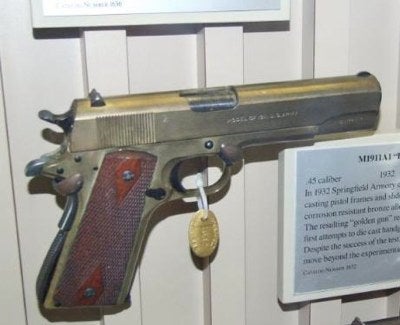
The Bronze 1911 pistol

I have seen guns made from bronze alloys before, but never an autoloader. Back in 1932 Colt and the Springfield Armory teamed up to test the suitability of using a die cast bronze alloy for gun parts.
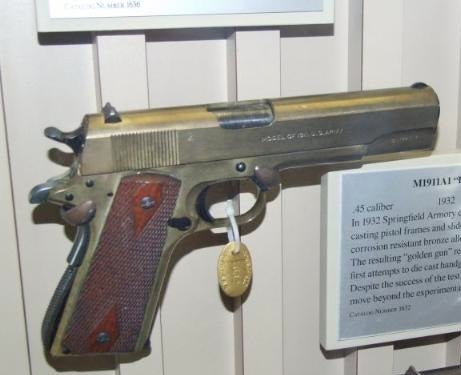
Bronze 1911 Pistol
The Golden Gun

The gun is exhibited at the Springfield Armory Museum.

In 1932 Springfield Armory experimented with die casting pistol frames and slides from a high tensile corrosion resistant bronze alloy called ‘brastil.’ The resulting ‘golden gun’ represents one of the first attempts to die cast handgun components. Despite the success of the test, the project did not move beyond the experimental stage.

There is a discussion about the pistol at the 1911 Forum.

So the question remains … who is going to be the the first to build a bronze AR-15?

Thanks to Sven for the link.

Related Posts

Steve Sep 10th 2009 handguns Tags: , , 21 Comments

21 Responses to “The Bronze 1911 pistol”

  1. Albert A Raschon 11 Sep 2009 at 12:24 am link comment

    I’ve seen bronze lowers, but of course I can’t remember where…

    Regards,
    Albert
    The Rasch Outdoor Chronicles
    PeTA: Purveyors of Stalinism

  2. B Woodmanon 11 Sep 2009 at 12:42 am link comment

    Any advantages to bronze over steel? Or was this just an experiment to see “if it could be done”? Interesting. . . .

  3. Nick Pacificon 11 Sep 2009 at 12:56 am link comment

    I’ve been burned one too many times on one offs and prototypical gadgetude. Let someone else be the first to commission that.
    Of course then my girlfriend will beg for one with a mirror polish. Either way my wallet is going to lose.

  4. Colinon 11 Sep 2009 at 2:23 am link comment

    I’ll send you some more photos of Springfield Armory when I go home. There is alot of ridiculous fireams there.

    Rifle struck by lightning
    Rifle with bullet in barrel
    Rifle with a stock gnawed to hell by a porqupine.

    One of my fav there is a M-14 that Eisenhowser was suppose to get, but it had a slight flaw and was rejected!

  5. anonon 11 Sep 2009 at 3:22 am link comment

    We’ve moved past bronze to plastic (oops, I mean polymer). It’s cheaper and easier to work with.

    The question is: When do we get polymer uppers?

    Or maybe the question is: when do we get polymer slides with molded in steel breech blocks?

    Actually, I’m kinda surprised that the techniques used for the Nylon 66 aren’t the norm for 22’s.

  6. Matt Groomon 11 Sep 2009 at 8:35 am link comment

    That is a truly amazing and fascinating thing. I read in the standard catalog of Smith and Wesson that S&W actually made aluminum framed N-frames BEFORE WWII. If they had made an 8-shot Aluminum N-frame in .38/.44 or .357 Magnum in 1946, it seems likely to me that revolvers would have remained in the hands of Law Enforcement in the US for at least another decade.

    Colt apparently developed the Colt Commander 1911 with an Aluminum frame between 1949-1951 in anticipation that the military would want a lighter pistol in the future. It was built in 9mm in anticipation that the newly formed NATO would adopt that caliber as standard. It’s interesting to imagine that 9mm Colt Commanders could have seen service in the US military during the Korean War.

  7. Steveon 11 Sep 2009 at 9:57 am link comment

    Colin, I would appreciate that.

  8. Komradon 11 Sep 2009 at 10:09 am link comment

    When society collapses bronze will be easier to make than steel. Plans for molds and the exact tin/copper ratio would make a post-apocalyptic society a wee bit safer for me and my hoard of mutants.

  9. Jason Smithon 11 Sep 2009 at 1:07 pm link comment

    From what little research I could do with google, “Brastil” is a trade name for a particular Copper-Zinc-Silicon alloy made by Doehler Die Casting Co. and is similar to Webert Alloy by American Brass Co., and Tombasil Alloy from Ajax Metal Co.

    http://www.aimehq.org/search/docs/Volume%20137/137-33.pdf

  10. Vitoron 11 Sep 2009 at 1:41 pm link comment

    Spartans liked bronze.

  11. Steveon 11 Sep 2009 at 2:01 pm link comment

    Jason, great find! I tried to use google to find it out but was unsuccessful.

  12. Matt Groomon 11 Sep 2009 at 2:21 pm link comment

    @ anon

    The Kel-Tec SU-16 is made on a polymer upper and lower. So are most modern H&Ks. The Carbon-15 has a polymer upper and lower. Carbon fiber is the glass content of the plastic, but it’s still plastic. Cavalry Arms has their famous CAV-15 lowers too. I can’t think of any other uppers.

    As for “…polymer slides with molded in breech blocks” the closest thing to that is the uber-expensive FN Five Seven that has been featured in a number of posts here on the Firearms Blog. Stamped sheet metal slide with a polymer cover on top. It’s ugly plastic like a High Point, cheaply constructed like a RG, and expensive as hell like a Hammerli.

  13. Nickon 12 Sep 2009 at 2:09 am link comment

    Whoa.

    Let’s not compare the plastic of a Five-seveN to a Hi-Point.

    I’ve seen both (and owned one). The Five-seveN’s plastic quality is far superior.

  14. Komradon 12 Sep 2009 at 8:51 am link comment

    FN Five seveNs are a new concept with a currently small market. A semi-concealable weapon that can get through body armor is not a bad idea. If any major ammunition manufacturer made 5.7mm ammo, FN would expand their line and other companies might start making 5.7mm weapons. The price would come down too. As for this brastil. It has a 85,000-95,00 pound tensile strength, and a yield strength of 65,00 to 70,000 pounds. I have no idea what that means but compared to the other brasses on the chart, that is pretty impressive. It contains 80-81.5% copper, 13.5-16% zinc, and 3.75-4.25% silicon. Now, correct me if I’m wrong, silicon is more expensive that steel and maybe more expensive that copper and is certainly more expensive than aluminum, doesn’t that make it ill suited to mass production. Maybe a few parts could be made from brastil but to mass produce something like a 1911 for a conflict as big as WWII made from a silicon bass is just unfeasible.

  15. Komradon 12 Sep 2009 at 8:53 am link comment

    Here is the address for the chart. You will have to download it as a PDF. http://www.aimehq.org/search/docs/Volume%20137/137-33.pdf

  16. Matt Groomon 12 Sep 2009 at 12:41 pm link comment

    @ Nick,
    High quality plastic is still plastic.

    @ Komrad,
    The Five-Seven is NOT semi-concealable, unless you compare it to a rifle. It is a full sized service pistol and easily bigger than my Beretta, although it weighs less. We have one at work and I have shot it extensively. It is not uncomfortable or ungainly in the hand, although I dislike the rounded magazine plate which makes accurate shooting from a bench quite difficult. It is also very light weight, but the price and the construction make it a loser in my book. If it was a $400-$500 pistol, I might consider buying one, but the $1K price tag sends it right into the rediculous catergory.

    A major ammuniton manufacturer, Fiocchi, loads all the 5.7×28mm that FN sells to the general public. Nobody else loads it, because nobody wants it. Nobody else makes guns for it, because it is an akwardly long and poor performing cartridge in it’s non-military format. Fiocchi loads their ammo very hot and with very good quality; they’re one of the largest ammo makers in the world.

    Silicon is purified sand, and it is not more expensive than Iron and certainly not more so than most grades of Steel. Copper is more expensive than both. Aluminum used to be more expensive than all of them, but the price of Aluminum has been lowered dramatically with the advent of Nuclear power, so Copper is the most expensive. Also, Brastil would be very heavy compared to something made with an Aluminum or Plastic frame.

  17. Jason Smithon 12 Sep 2009 at 2:25 pm link comment

    Komrad,

    The link has already been posted.

    Matt & Komrad,

    One thing you are leaving out is that the purpose of the Brastil gun was NOT because the materials were cheaper, but rather that they were able to be DIECAST (as opposed to forged) for almost as much durability but at much lower production costs. The hope was that the increase in material cost would be overcome by the cheaper production costs.

    I’m not up on my 1932 material or production costs, but apparently the test was TECHNICALLY feasible, while it may or may not have been ECONOMICALLY feasible. Without more details, we will likely never know why this was not pursued at the time.

  18. Komradon 13 Sep 2009 at 5:03 am link comment

    @matt
    I was comparing it to a rifle which is why I said SEMI-concealable.
    @jason
    The only knowledge I have of silicon is solar grade which is very expensive. Thank you for correcting me.

  19. Kenon 14 Sep 2009 at 8:13 am link comment

    From a curiosity standpoint the gun looks different. But there is a reason we are not in the bronze age anymore. “Bronze” and “die cast” in the construction doesn’t sound too durable to me. Being a machinist of 16 years bronze and its variants are easy to machine versus a steel. Under no circumstance as a designer of firearms myself would I incorporate bronze in any part of my work.

  20. thebronzeon 14 Sep 2009 at 11:07 am link comment

    You rang?

  21. Muon 16 Sep 2009 at 2:40 am link comment

    On the misconception “plastic is plastic”, there are now composites out there that can take temperatures over 300C, stronger and lighter than the best steel or aluminum alloys. We make rocket cases from it.
    Now, the $500/lb price is still a downer, but don’t compare today’s high tech polymers with your plastic trash bag or bakelite.

Leave a Comment

Comment Policy: I reserve the right to remove comments at my discretion. Think of comment threads like a dinner party at someone's house. If you make the party unpleasant for others or me, you won't be invited back. I am happy to tolerate a wide range of viewpoints, even extreme ones, but I'm not going to tolerate nastiness, rudeness, trolling, vitriol, or excessive snarkiness toward the author(s) or other commenters. You may make your case passionately, but civility is expected. Please stay on topic and respect the technical nature of this blog.
Spam Filtering: To avoid spam, comments are filtered using Akismet and then manually approved. Do not be alarmed if you comment does not appear instantly. I do not check the spam folder more than once per day.