1911 Blown up

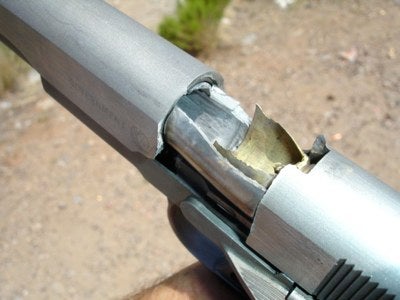
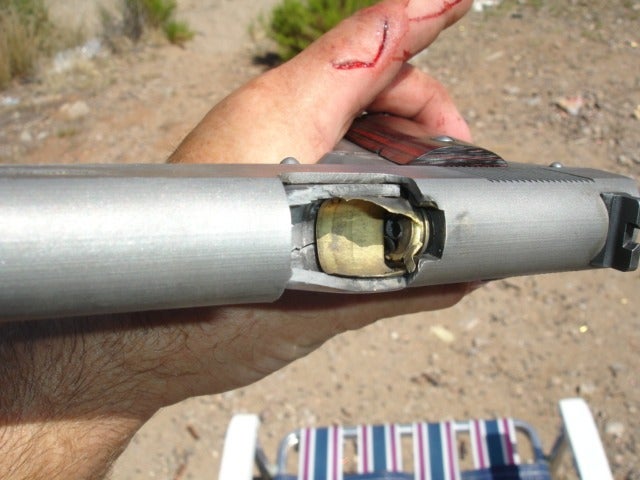
These photos are of a AMT Combat Government Hardballer 1911 pistol that fired a handloaded .45 ACP round that was overloaded with powder. The result is quite spectacular. The top of the chamber has been blown right off taking a considerable section of the slide with it.
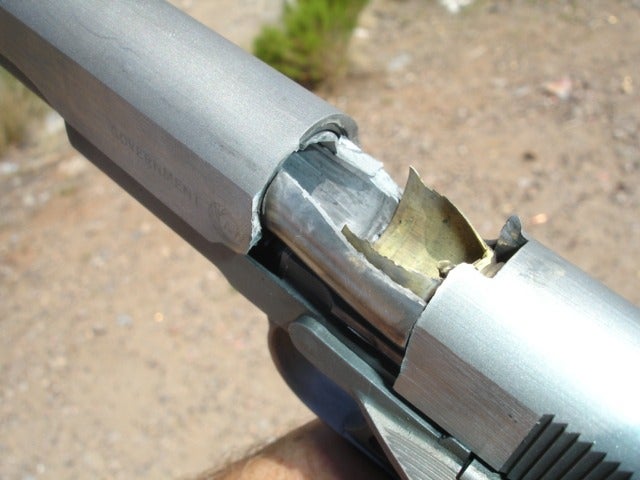
Amtkaboom2

Amtkaboom1-1
That looks sore.

The photos are from Photobucket via. the Blue Gun Blog.

UPDATE: Elvis for identifying the pistol.

Related Posts

Steve Jun 25th 2009 ammunition, handguns Tags: , , , , , 24 Comments

24 Responses to “1911 Blown up”

  1. elvison 26 Jun 2009 at 12:17 am link comment

    amt

  2. Steveon 26 Jun 2009 at 12:22 am link comment

    elvis, thanks!

  3. Muon 26 Jun 2009 at 2:58 am link comment

    I’m always surprised of claims of “overfill” for handloads blowing up. Most regular loads will fill up 90% of the case, so you can’t get more than an extra 10% into the case. And while pressure development isn’t linear, you should still be under the 30% overpressure guns are supposed to take under CIS rules. Sounds more like a case of wrong powder to begin with.

  4. Chadon 26 Jun 2009 at 4:02 am link comment

    It appears from the way the metal failed that it is a casting.

  5. SPQRon 26 Jun 2009 at 4:16 am link comment

    I’ve seen a bunch of 1911’s blow up, but I can’t recall one that spectacular at all. They normally blow out through the bottom of the chamber, blow out the magazine and blow off the grips.

  6. SPQRon 26 Jun 2009 at 4:17 am link comment

    Oh, and if one is using a fast powder like AA#2 or Bullseye, there is plenty of empty space in a .45 ACP case for excessive charges.

  7. Freiheiton 26 Jun 2009 at 6:38 am link comment

    This is probably a stupid rookie question, but even though the gun failed, did it fail in a safe manner??

    I think it did. We’re seeing pictures of a blown out chamber, busted slide, and a cut up hand. It’d be different if it was x-rays of a 1911 slide in someones skull.

  8. Ride Faston 26 Jun 2009 at 7:05 am link comment

    [...] How to kill a 1911 [...]

    I agree. Almost certainly the wrong gun powder and maybe too much of that.

  9. Matt Groomon 26 Jun 2009 at 7:25 am link comment

    Probably wrong powder. I always tell people not to use any powder where the max charge is less than 60% of the case volume. You usually won’t feel it during seating if you have a compressed charge or a double charge, but if you dump powder everywhere when you go from one station to the next, you’re likely to notice it.

    It’s easy to figure this 60% rule: With a given brand of cases and a given powder, fill the case up to the case mouth, level it by scraping off excess with a card. Measure the remaining powder, divide the charge by 10, then multiply by 6, and you have 60% of volume.

    If reloading data calls for 3.0 grains of Bullseye, for example, and you know that 60% of a .45 ACP case is 6.2 grains with Bullseye, DON’T USE THAT LOAD. Especially on a progressive or with any kind of volumetric powder dispenser. Use a single stage and a digital scale to measure each charge for this type of load.

  10. Crystalon 26 Jun 2009 at 8:06 am link comment

    Ouch. Nice homemade cross section of the case though!

  11. Michaelon 26 Jun 2009 at 11:03 am link comment

    Heartache and ouch.

  12. Kevanon 26 Jun 2009 at 3:11 pm link comment

    If it was too much powder or wrong powder, then it was a reload. It could also have been a case failure if the guy was reloading himself–The case may have seen it’s days.

  13. Bolteron 26 Jun 2009 at 6:29 pm link comment

    When will people learn that they can’t beat the factory equipment and quality checks, the fact that the factory is insured against liability for failures of their products arising from defective design and manufacture, etc.? Don’t reload people, just buy new. Why take the chance? If you want reloads, do it yourself, you have no idea what John Doe did when he loaded those cheap rounds you bought at the gun shop. Is your expensive firearm worth the savings? Is your health or life worth it?

  14. bothenookon 27 Jun 2009 at 5:31 pm link comment

    hey bolter… hate to rain on your parade, but have you actually tried buying factory rolled lately? home rolled, when done safely (no kids, no booze, no multi-tasking) works great. i’ve got a 45 load i worked up that shoots well in both my SA and ParaOrd. for way less than commercial, if you can find it.

  15. Matthewon 30 Jun 2009 at 5:08 pm link comment

    hmmmmm why do I suspect someone trying to re-invent the wheel here with rifle powder?

  16. Timon 01 Jul 2009 at 9:58 am link comment

    I can’t believe some of these comments! I have reloaded over 50,000 rounds and one of the first rules is only fire the ones you roll yourself.

    I have had two squibs during that time (no powder) due to circumstances which I may never figure out. I have also fired one heavy round out of a Kimber 1911 steel gun with no ill effects other than a large flame at the muzzle and puzzled looks from some onlookers. I would dare to say that it was not a double as I am very careful to avoid pulling the lever if I am not sure, but there was way over my standard load on board and no explosion noted.

    I think it is wise for people to pay attention when reloading, don’t max your loads unless you know what you are doing, and know that some calibers are going to go faster than others. The .40 caliber in a Glock barrel does not tolerate excessive powder charges well, but I have seen .45 rounds fired out over 50% faster than they should be for half a day before someone finally stepped in and put a few over the chrono. A good solid gun should be able to handle a 10-30% overcharge in calibers like the .45, and at least 10% over in the .40 caliber before the do something like this.

    I suspect this image shows one of two things, either a severely overloaded cartridge, or there was a bullet stuck halfway down the barrel from a previous round that did not have enough powder to push it all the way out.

    TiteGroup in everything I own, just pay attention and it works fine.

    STI Eagle in .40, Kimber 45’s in steal and alloy frames, and a couple random plastic guns to fill out the mix.

  17. Bolteron 01 Jul 2009 at 2:30 pm link comment

    Tim, it’s a free country (for a while at least). For a guy like you who knows what he is doing, no problem. And it is certainly your right to shoot what you want. But most people don’t know what they are doing, don’t take the care you do, et cetera. Buying a reloading press does not make you a good reloader. Anecdotally, the blown up guns I’ve seen (like the causes for this accident as you mention) have been due to operator error (quick firing two rounds, one never leaves the barrel, other one stacks behind it) or bad (almost always reloaded) ammo.

    Bolter

  18. Mackon 02 Jul 2009 at 3:57 am link comment

    But most people don’t know what they are doing, don’t take the care you do, et cetera.

    Precisely the attitude used to justify all kinds of nanny-state nastiness.

    It’s tough to get a load that fills more than 60% of the case capacity for older cartidges like the .45 ACP or the .45 LC, and limits your powders choices to big fluffy powders like Trail Boss. My two favorite target loads for the .45 ACP are less than 5.0 grains of Clays, neither of which comes close to the 60% level.

    The problem is that you’re talking about a cartridge that’s been around since the early 1900’s – powder technology has evolved quite a bit since then. The best protection against double charges of powder is having a tight process, whether you’re using a single stage or a whiz-bang progressive.

    Saying that the only solution to safe shooting is factory ammo is like saying that the only way to insure against food poisoning is eating at McDonalds.

  19. Bolteron 02 Jul 2009 at 10:58 am link comment

    Mack,

    First, I am totally against nanny state stuff and the “Nerfing” of America. I personally like the sharp edges in life.

    Second, I never said the “only solution to safe shooting is factory ammo.” In my first post I said “If you want reloads, do it yourself…”

    Regards,

    Bolter

  20. Timon 02 Jul 2009 at 2:42 pm link comment

    All good talking points. I guess the thing I was trying to say is that the gun in this image really looks like a squib left a round in the barrel, rather than a simple powder over charge. Of course there could be other factors in play such as a poorly manufactured barrel, but being a SO for IDPA and a range safety officer for USPSA I have seen a lot of squibs from both cheap factory and reloaded ammo, I have also seen some really hot rounds leave the barrel.

    Usually case failure vents down into the grip and not out the top of the barrel like this, so that is why I suspect either a triple charge, or a blocked barrel. Luckily for both me and those I watch over while at the range I have a good ear for those rounds that don’t leave the barrel and have always managed to get the shooter to stop before something like this does happen.

    4.4 grains of TiteGroup pushes a 230 jacketed bullet out of a 5 inch gun just right for anything I do and you could easily put 14 grains in there and still seat the bullet if you were asleep at the wheel, but if you are prone to such blackouts reloading is probably not for you.

    Regarding the 45 colt, if you have a Ruger Bisley you can put 23 grains of H110 in with a 335 grain gas checked bullet and give your wrist something to complain about! That load would be impossible to double on as you have to give the powder a little push to seat the bullet :-) If any people new to reloading read that DON”T do that with any gun but the Ruger Bisley single action or you will blow up the cylinder. It works in the older Blackhawks to but the hammer might end up buried in your forehead.

  21. Patrickon 05 Aug 2009 at 5:28 am link comment

    True that Tim. I love my SS 45 Bisley. :D

  22. Daveon 11 Sep 2009 at 3:00 am link comment

    Sorry for the late comment. SPQR’s first comment agrees with my experience. I accidentally detonated a double charge of WW-231 in my 1991A1. The case ruptured right past the extractor groove and blew DOWN the feed ramp. It ended up blowing the magazine out the grip and burning my hand. A gunsmith inspected it and it has performed well ever since. The extractor had to be repaired, but that is the only required repair. Frankly, I’d hate to have the same thing happen in a barrel with a fully-supported chamber.

    I agree that there is something more at work in this photograph than a simple overcharge of powder. The case didn’t rupture down the feed ramp – it ruptured up. I don’t think that the Hardballers came with a fully-supported chamber, so I believe it was the victim of a barrel obstruction. It looks like a squib load left a bullet in the barrel right in front of the chamber.

  23. Themancomesaroundon 23 Nov 2009 at 6:30 am link comment

    It seems I am way late on this one. Re-loading your own ammunition is just as safe a practice as buying factory ammunition. If you pay attention to detail. I never get overzealous and attempt to load several hundred cartridges in an hour or so on a progressive or allow distractions to enter into my reloading area. Progressives are convenient but their drawbacks far outweigh their speed, in my opinion. I use a turret press and assemble my loads using the batch method. I’m not saying that progressive users are incompetent. But when it comes to consistency, round to round, there is a better chance of keeping everything uniform if every piece of every lot of ammunition assembled is inspected as the process goes on. Progressive presses are a fantastic tool for the high volume shooter. However, no matter how careful and savvy a progressive user may be, there is always the chance for a malfunction (or misadventure) to occur at what is considered, in my opinion, to be the most critical station. The powder charging station. Baffles and levers aside, there have been cases where progressive users have inadvertently double charged a case with a low volume, high density powder through no fault of their own. Just so happened their equipment let them down (I do apologize but I’m having trouble trying to find one of the cases I’ve read to site here, so I know I’m speaking without having fact to back it up right now. But please, bare with me.) The photo seems to be the result of an overcharged case. However, I do feel that poor metallurgy had something to do with the way the firearm spontaneously disassembled itself. I have blown up only 1 firearm. It was a Springfield standard 1911A1, loaded model. When the factory made the bottom cut for the dust cover they made the upward cut, right under the front cocking serrations, too deep. I was at the range practicing controlled pairs, failure to stop drills and attempting to nail down my double-taps. This caused the the minuscule over-cut (cut depth was approx .003 inches too deep) to get bigger. At this point, I had run only 260 rounds through the pistol. All factory ammo. After finishing off the final round out of the third 10 round, Chip McCormick magazine, the whole front end flew down range, along with the recoil spring and bushing. The barrel was still intact and in pristine condition, as were all other components of the pistol. As well, it was noted that the steel used to form the slide was not made of quality material as the break revealed, when the pieces were recovered and examined. There was a marked discoloration, possibly due to poor tempering. The innermost of the cross section was almost white in color while the outermost was grey and silver, sort of like lead. And it was extremely porous. I contacted Springfield, sent them the remains of the firearm, the remainder of the FACTORY Winchester 230 gr. FMJ, “wal-mart value pack” target loads and the 30 casings that I had fired that day. After explaining the situation and circumstances, the woman on the phone asked no questions and just told me to send it in. In return, I was sent a brand-spanking new Springfield TRP! I was not expecting that. I guess it was their way of saying, “Sorry for the trouble.” Anyway, Yes it is safe to re-load ammunition. And sometimes it isn’t even the ammunition that is at fault for catastrophic incidents. Bottom line: Sometimes bad things happen, no matter what. But the fun is worth the risk.

  24. Haywireon 26 Jan 2010 at 2:54 pm link comment

    I’m surprised you had the nards to post pics of such an idiot move!

Leave a Comment

Comment Policy: I reserve the right to remove comments at my discretion. Think of comment threads like a dinner party at someone's house. If you make the party unpleasant for others or me, you won't be invited back. I am happy to tolerate a wide range of viewpoints, even extreme ones, but I'm not going to tolerate nastiness, rudeness, trolling, vitriol, or excessive snarkiness toward the author(s) or other commenters. You may make your case passionately, but civility is expected. Please stay on topic and respect the technical nature of this blog.
Spam Filtering: To avoid spam, comments are filtered using Akismet and then manually approved. Do not be alarmed if you comment does not appear instantly. I do not check the spam folder more than once per day.