.50 BMG Flechette rifle
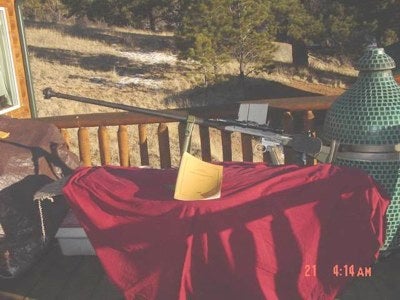
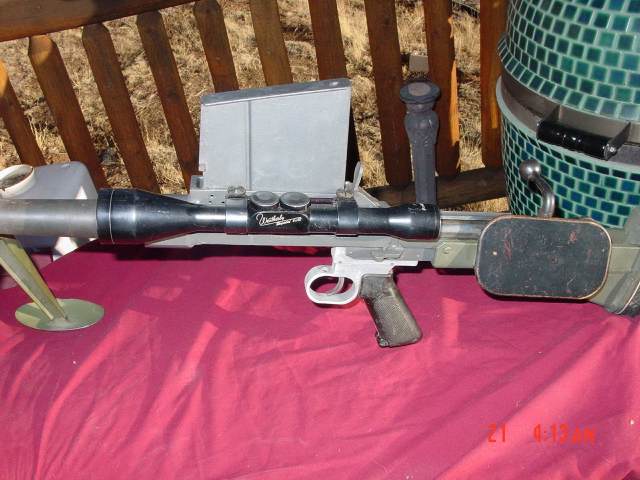
Daniel spotted a very interesting auction at gunbroker.com. The rifle on sale was a Boys Anti- Tank rifle modified by TRW-SYSTEMS GROUP and rechambered for .50 BMG. It was intended to be used for .50 BMG flechette rounds.
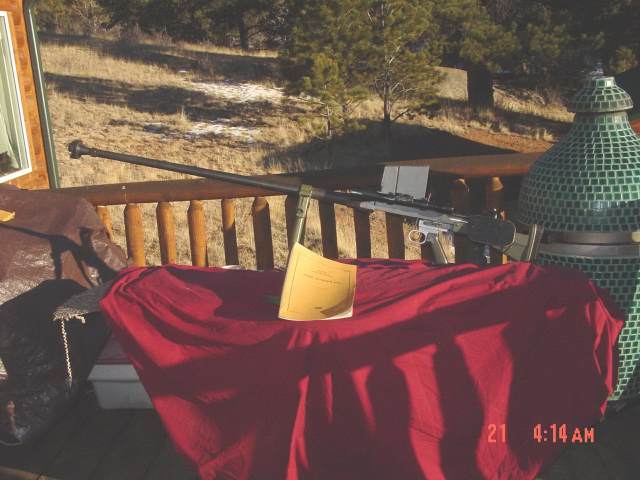
The auctioneer claims that it is only one of twelve built and the only other known example resides at the Ford Benning sniper school.
The .50 BMG Flechette rifle project was contacted out by DARPA in 1960’s. The projectile consisted of a saboted depleted uranium dart weighing 11.9 gram ( 183.6 grains ).

.50 BMG Flechette round cross section. © Paul Smith (Used with permission)
The sabot was fired out of a smoothbore barrel with the dart achieving 4500 feet/sec velocity. That is more than a 32 grain .204 Ruger!
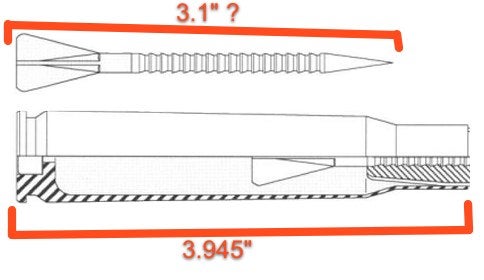
Detailed Drawing © Paul Smith (my modification are in red)
I tried to work out the caliber. Given that 1 cm3 of depleted uranium weights 19.1 grams and the length of the dart is 7.81 cm (I rounded down to 6cm to take into account the spiraling and the point) and then used the formula of a volume of a cylinder:
11.9 / 19.1 = 0.62
sqr(0.62 / ( 6 x pi )) = 0.18 centimeters
[ My math skills not great these days, go easy on me in the comments
]
A caliber of .07″ is seems some what small. It is impossible to know how much titanium is in the depleted uranium alloy.
Time Magazine wrote about the project back in 1967:
TRW’s magic bullets are unimpressive at first glance. Less than 4 in. long and one-tenth of an inch thick, they resemble the steel flechettes (French for “little arrows”) used in some U.S. antipersonnel weapons in Viet Nam. What the TRW flechettes lack in size, they make up in penetration power. In recent tests, they punched completely through a 2-in.-thick armor plate that would stop most steel flechettes or heavy-caliber bullets fired at it.
Dramatic Travel. It is the uranium that gives the flechettes their impressive muscle. Cleansed of its fissionable isotopes U-235, the depleted uranium is safe to handle. Because it is one of the heaviest natural elements (a 1-ft. cube of uranium weighs 1,167 lbs.), even a tiny uranium flechette fired at high velocity from a gun has so much kinetic energy that it can penetrate a target at an angle as oblique as 60°.
At 0.10 in caliber it would have an incredible ballistic coefficient weighing in at 180 grains! In theory it should be super accurate. In reality it was quite the opposite. It shot 10 shot groups of 6 – 8 feet at 600 yards. That’s over 12 MOA!
TRW was hoping to use the flechette in a rotary gatling / mini gun type system. Daniel writes:
The rifle in the GB [gunbroker] ad looks like the one shown in a photo in Peter Senich’s “The Complete Book of U.S. Sniping”. The photo was credited to Don Stoehr, a former TRW employee.
Among his projects were the Low Maintenance Rifle (LMR) and HIVAP (High Velocity All Purpose) machinegun. The HIVAP was really wild. It was an eight-barrel .31 caliber Gatling based on the Dardick open chamber principle. Like other Dardick-derived open chamber weapons, it used ‘trounds’. The HIVAP trounds used lexan cases loaded with saboted flechette. (However, solid bullet variants intended for testing purposes can be found.) The really wild part was the cyclic rate: just shy of 30,000 rpm. Stoehr later wrote that the twin feeders could support 42,000 rpm and that a switch to electrical priming would allow them to double the existing cyclic rate.
However, I don’t know how they’d ever keep such a monster fed. The weapon pod under design only held either 3,000 or 6,000 trounds.
It is an interesting cartridge that unfortunately will probably never be further developed due to the politics and health concerns of depleted uranium. Carrying DE rounds around would likely be a health hazard to the soldier using them.
More information on the round is available at cartridgecollectors.org.
Many thanks to Daniel E. Watters for information and links and to Paul Smith for the use of his photos.


Is it just me, or should there be some twist on the dart stabilizers? Seems like that would give it more range and accuracy.
“…and health concerns of depleted uranium.”
Oh please, not you too?
The amount of hysteria these days over just about everything is quite depressing. I had higher hopes for such an intelligent blog as this.
As for the fins, a former TRW engineer John R. Sellars has written that they did experiment with a slight fin angle. The original fin angle was 1 degree. This was found to add too much drag, adversely effecting the range of the fléchette. Sellars thought that they might be spinning so fast that they were bending the shaft in flight. Later efforts used a 0.5 degree cant. According to Sellars, 20,000 of the .50 BMG DU fléchette round were made.
FWIW: The prototype HIVAP rounds used steel fléchette. This was probably due to the weapon being a proof of concept model. DU fléchette are a bit much for function testing. You hardly want to contaminate the factory test range, and at ~30,000 rpm, it would get pretty expensive in short order.
Around the same time, AAI worked on DU fléchette in 7.62mm NATO. The latter had the unfortunate designation DUDS: Depleted Uranium Discarding Sabot.
I really need to add these to my article on SPIW and fléchette over at The Gun Zone.
http://www.thegunzone.com/spiw.html
My friend and I were thinking the same thing Phil, twisted stabilizer fins would give the projectile better accuracy but it would slow it down. I don’t know whether it would slow it down to the point where range would be hindered but I bet it would (see murphy’s law: no good deed goes unpunished). Imagine arching the round, if the moa were tighter then you could reach further but again I have no idea what the specs would be. I’m sure they thought about twisting the fins but maybe you can’t effect a spin at speeds approaching mach4, maybe it would time travel, maybe they didn’t actually think of it, who knows? We never will and that makes me sad.
Tony, lol. Seriously through: would you be happy to carry about radioactive decaying uranium in a pouch on your body? One thing in an aircraft, tank or ship (?) magazine, but another thing on the body. That is asking for trouble.
Also the chemical produced when DE corrodes can spontaneously combust at room temperature!
It will destroy any rifling in a matter of a few shots at the speed that the Flechette leaves the bore.
The fins is more then enough to stabilize the Flechette. The M829A1 is able to gets hit at over one mile.
I agree with jdun1911
I don’t know about this example, but rifled sabots are typically a soft material that will not wear on the gun’s bore. Besides, this gun must be a smoothbore since the flechette is not designed to spin. (Which would also explain why the flechette load wouldn’t work in a regular .50BMG rifle.)
Regarding the depleted uranium: It’s no more hazardous to touch than lead. What little radiation it does emit is of a very low energy. A marble floor or granite countertop could pose a greater radiological hazard. Granted, like most other heavy metals it is toxic. You don’t want to breath it or swallow it. Also, at high temperatures (like those created when a supersonic projectile hits a hard target) DU becomes “pyrophoric,” which means it will burn, releasing even more energy at the target.
Carrying DE rounds around would likely be a health hazard to the soldier using them.
not unless you suck on them like lollipops. or throw one in the campfire and inhale the smoke.
depleted uranium metal really isn’t all that radioactive — the half-life is in the billions of years. the fission products are also radioactive, but not much more dangerous than uranium itself for several steps of decay; things don’t get iffy until you hit radon, which is a gas, and so would be trapped in the metal matrix i’d wager.
in fact, depleted uranium has been used as radiation shielding to protect against more vigorous radiators. works about as well as lead at that. has similar backdraws as lead too — they’re both toxic heavy metals, and you don’t want to ingest either one.
i’m an idiot who shouldn’t be posting so late at night. in addition to forgetting to close that link (i’d meant it to cover only two words…), i went and talked about fission products when i meant to talk about decay products. uranium (even depleted uranium) will spontaneously fission, too, but absent a nuclear reactor that’s such a rare event as to not much matter.
DE is pretty innocuous when it’s still riding in your tank’s (or rifle’s?) magazine. The nasty bit comes after it has turned the inside of an enemy APC to burned crispies . . . then you have slightly radioactive, toxic dust left from the round you shot them with. It’s one more thing to worry about (a little) when you are checking a burned out hulk for anything (or anyone) useful in the field
Well guys, I stand corrected on the topic of DE and its toxicity
They’ve got one of these at MCRD (Marine Corps Recruit Depot) San Diego in the museum. It’s .55 caliber, was used in WWII (been almost 1.5 years since I visited the museum, but I’m fairly sure it was WWII) by the British, and was also known as “The Boy’s Gun.”
No DU (obviously). If memory serves, it was used up to 550 meters in an anti-tank.
Don’t remember if the total number produced was specified by the museum, but 12 doesn’t sound unreasonable, as the weapon was not widely used.