TFB Review: KRISS Vector Gen 3 in 9mm
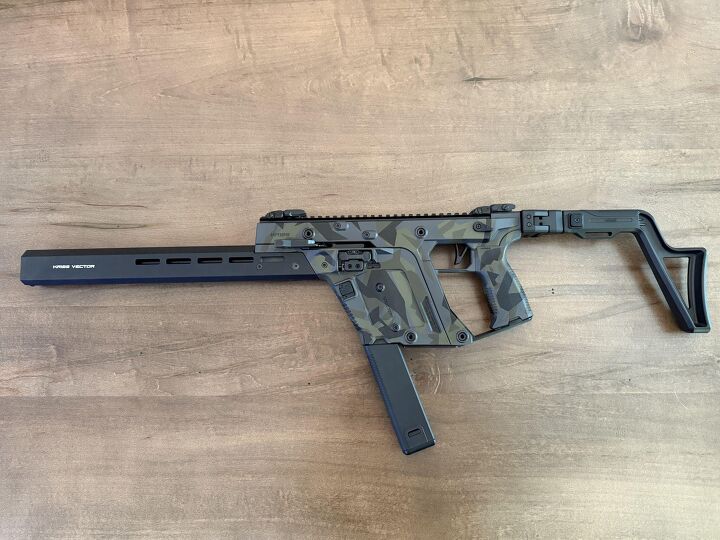
Picture this, you’ve just entered the range, among the myriads of people shooting the various types of firearms on the line, you pull out a big range bag. As you remove what’s inside, already people around you are taking notice. What you take out is so far removed from what everyone else has, but at the same time, is also almost instantly recognizable. That’s the effect the KRISS Vector Gen 3 9mm has. It’s a gun that many not even involved in firearms know about. A firearm that’s been in the public zeitgeist through its plentiful appearances in film, video games, and animation. Even less known about but equally important is its limited use in Special Operations, among still being seen in modern conflicts. With its futuristic appearance, and operating system foreign to the average shooter in America, how does it hold up?
Introduction:
The Vector Gen 3 is an SMG/PDW that comes in a variety of calibers and barrel length options. Currently, you can get one in 9mm, .45 ACP, and 10mm. Priced at $1,499.99, with the price rising depending on which variation you choose, it’s slightly higher than some cheap pistol caliber carbines, but also cheaper than some higher end offerings. They offer options from a 5.5” pistol build, all the way to a full 16” rifle. The 16” rifle variants have a faux suppressor shroud over the barrel that includes MLOK cut outs making accessory attachments still viable. Stocks are mounted by way of a picatinny mounting back plate, allowing the installation between a pistol brace, or once completed with your Form 1, a standard stock of your choice if you go with the 5.5”/6.5” pistol option.
It includes standard but incredibly serviceable folding MBUS-style sights pre-mounted onto the picatinny rail. You can very easily mount whichever optic you choose and depending on height are capable of co-witnessing. I used my personal EOTECH XPS2 for this review, and while just peeking slightly over the optic view port, I was still able to view and use my back up sights effectively.
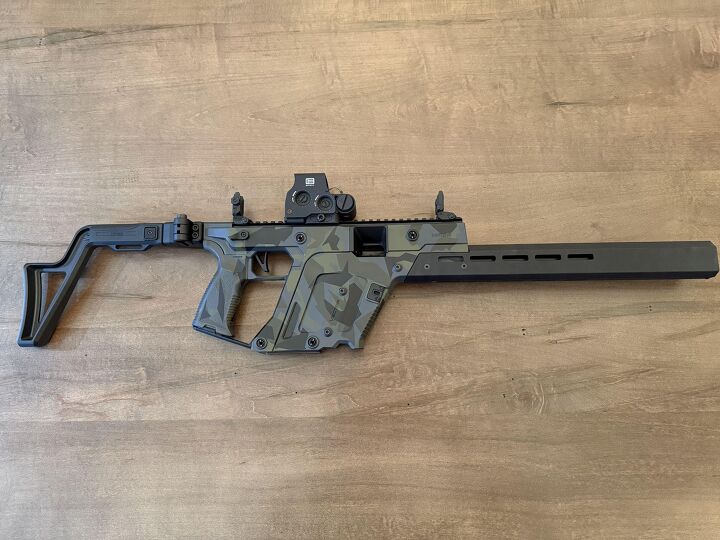
One of the most starkly different features of the KRISS Vector Gen 3 is its use of a delayed blowback operating system, which KRISS refers to as the Super V Recoil Mitigation System. This translates into a small bolt carrier group that travels downward into the firearm, placing much of the recoil blowback into the lower section of the gun, instead of into the shoulder. This, with its low bore axis, makes an overall comfortable experience from the first round of the mag, to the last. The gun is also built with an overall mindset of ambidexterity. From its safety selector to ambi mag release, the firearm is very adjustable to different shooters, enabling the user to cater it to what works best for them.
Getting a new gun is always a pensive but optimistic affair, and one thing I will say outright that I appreciate from KRISS is exactly how outside the mold they go. Normally, you get your gun, and if you are lucky, you get a magazine, along with standard paperwork. Already, the norm is broken, when KRISS provides you with a full-size cushioned range bag, cleaning tools, safety lock, and a very thorough manual that will answer most of your immediate questions. This might seem like a small boon, but if you’ve bought enough guns like me, a rare treatment like this should be standardized more.
For the sake of my review, I opted for the 9mm version of its 16” rifle variant.
Ballistics
During the over one thousand rounds I put through its barrel, I opted to evaluate performance with a selection of different ammo companies, and grains. I will note that when I spoke with KRISS, they did state they personally recommend 124gr FMJ or equivalent hollow point for best performance, however I did test with both 115, and 124gr. Below, I’ll break down a simple chart of ammo used, along with experiences.
PMC Bronze 9mm 115gr 250 Rounds
PMC Bronze 9mm 124gr 250 Rounds
Winchester Target 9mm 115gr 150 Rounds
Browning Target 9mm 115gr 200 Rounds
AAC FMJ 9mm 124gr 300 Rounds
The first five hundred rounds through the barrel I will say were rather uneventful in a good way, I cleared through PMC in both grains with no malfunctions, and the firearm itself handled very well. From slow purposeful shot placements to double tap, and rapid fire, it held onto the target accurately. The first issue I had however, occurred with the Winchester target with a stoppage at round 10. Once cleared, the rest of the ammo burned through with nothing notable to report. However, the same cannot be said with Browning, which had numerous stoppages. Originally, I was worried that it was the gun itself, but with some help from a ballistic expert, we progressively went through the rest, replicating the issue several times. After careful examination, we determined this not to be the issue of the gun, but instead the ammo. While it should go without saying keeping your firearm clean is important, special emphasis is made on keeping the ejector of your bolt clean of carbon, something I made sure of before each firing. KRISS, in my conversation with them, also commented that certain ammo manufacturers have inconsistent rim sizes, causing the very issue listed, even with a properly maintained bolt. Thankfully, performance in the final round count with AAC was exceptional, with no stoppages clearing even in rapid fire.
Overview
Shooting the Vector is an interesting experience compared to what you are accustomed to when it comes to guns in the SMG/PDW category, because it’s just so utterly different. Yet, that’s also what makes it such an overall enjoyable gun to shoot. It’s sleek, futuristic looking, and most importantly fun. With a decent stock trigger that has a good reset, I found myself alternating from carefully placed shots to mag dumping with ease. What made this even more enjoyable experience was how consistent it was with its accuracy as well. Groupings were tight even with alternating shooting styles from carefully placed, to quick drills. I did the double tap drill for example, several times, and even with quick ready ups, it was grouping tight on target. In my entire time burning through the 1,000+ rounds, its accuracy felt absolutely on point.
The one thing I will cover, that I’m sure more than a few are wondering about, is how the faux suppressor barrel shroud for the 16” version fairs. While it does of course add a little extra weight, it’s also not without function, as it includes MLOK cut outs going up to around just over halfway the barrel shrouds length. The benefit to this is that you can very easily attach a light or laser without worrying of having the majority of your light coverage blocked. Is it still awkward? Yes, I’d be a liar if I said it wasn’t. Is it a deal breaker though? Absolutely not. This is less a failing of the gun and more of the system making this a necessity.

In terms of maintenance for the gun, KRISS's own manual includes in depth instructions on how to both break down the gun step by step, and what areas you should focus on. First time tearing it down is very simple with only a few minor differences to what you may be normally accustomed to. With just four takedown pins, the end process splits the weapon with its main trigger group being in the upper, and its barrel in the lower. As I highlighted before, KRISS themselves recommend maintaining the bolt, and specifically keeping the ejector clear of carbon. The cleaning tools included will help you easily tackle most of this, as well as clean the barrel. Once again, KRISS including these, while a small gesture, is one I welcome wholeheartedly as it just means one less extra step. For amateurs to experts, it’s the small things like that, that help.

The included stock on the 16” rifle version, while at first glance is very much in the minimalist style, I found it to be far more comfortable than I expected. It has a decent cheek weld enabling you to use either the included sights, or your own mounted optic, with confidence. You can also extend or retract the stock length, as well as fold it for smaller transport size. It’s all completely serviceable, and adjustable, but if you find yourself not favoring it, thanks to the Picatinny rail backplate, you can easily swap it out with other stocks better fitting your style.


For the habitual modifier out there, you’ll be pleased to know that such things as the pistol grip as well can be swapped out with any aftermarket AR15 grip, and several different triggers. Keep in mind though that some of these have legal issues across the country, so always verify before doing so.

Conclusion
In a market flooded with many firearm designs, most of which being clones in one way or another of each other, it can be hard sometimes to distinguish the one that separates itself from competitors. The Vector in many ways achieves these hands down, but in my overall experience with the gun, the most important thing that I found is that it was not just a very effective firearm, but a fun one. Every mag I burned through was enjoyable, and had me wanting to load another, even as I had to send back the gun.
KRISS has progressively worked on the Vector since its design inception in 2006, honing their edge, listening to feedback, and upgrading its design to move with the times. I can say genuinely it is exciting to see what they do next with the Vector, along with anything else in their lineup. In an industry that’s become inundated with AR clones, it’s refreshing to see something that’s both different, but also staying true to its core design philosophy.

More by Doc Strangelove





![[SHOT 2026] Winchester SXR2 Semi-Auto Rifle Keeps The Fudd Dream Alive](https://cdn-fastly.thefirearmblog.com/media/2026/01/21/15091/post.jpg?size=350x220)


![[SHOT 2026] New Rifles From Howa](https://cdn-fastly.thefirearmblog.com/media/2026/01/23/00562/post.jpg?size=350x220)


![[SHOT 2026] OK, Boomer: Charter Arms Whips Out New Wheelguns](https://cdn-fastly.thefirearmblog.com/media/2026/01/22/03471/post.jpg?size=350x220)


Comments
Join the conversation
Goofy. The front grip places all the weight on the index knuckle.
Weird. You find the gun unique, customizable, reliable, accurate and enjoyable, but conclude that although it’s a fun gun it’s not effective. I read nothing in the review that supported this conclusion. Kind of left the reader hangin’ there.
The only issue I’ve had with my 10mm SDP is occasionally hitting the bolt catch while firing. (Never the mag release thanks to the Gen 3 redesign.) I solved this by adding Kriss’ angled hand stop and I added Kriss’ folding extendable stock. I also slapped on a reflex sight that co-witnesses with the irons. I was perfectly happy with the gun and decided it would be my new PDW at home, but I chose to take it a bit further. I installed the RATL-R which gave me a forced reset trigger, (1,200 RPM), and I then adjusted the diving board spring in the FCG to improve trigger reset and reduce trigger pull to just under 3.5 pounds. Damn! I find the gun to be unique, customizable, reliable, accurate, enjoyable and very very effective.
I confess to one thing though. If I were going into battle, I would choose my Colt AR-15 over my Kriss, (or any other gun in my safe), without a second thought. I’m not dumb.