#Projectile
[SHOT 2018] Inceptor Ammunition Offers New Loads with ARX and SRR Bullets
![[SHOT 2018] Inceptor Ammunition Offers New Loads with ARX and SRR Bullets](https://cdn-fastly.thefirearmblog.com/media/2024/05/19/14554081/shot-2018-inceptor-ammunition-offers-new-loads-with-arx-and-srr-bullets.jpg?size=720x845&nocrop=1)
Inceptor Ammunition has introduced new cartridge offerings loaded with their ARX and SRR projectiles. Particularly, they now offer the defensive/frangible ARX bullets loaded into 10mm Auto and .450 Bushmaster rounds. The SRR bullets are now available for the .223 Remington and 7.62x39mm.

LSAT Cased Telescoped Ammunition, and the Problem of Cookoff (Brief Thoughts 002 Follow Up)

In the comments section of my recent Brief Thoughts article regarding caseless ammunition, there was a discussion about whether the cookoff issues of caseless would also be problem for LSAT-style polymer cased telescoped ammunition. Based on conversations I have had with subject matter experts regarding polymer cased ammunition in general, I noted that a lower cookoff threshold is one of the challenges I would expect CT ammunition developers to face. However, after some back-and-forth in the comments, I decided to contact LSAT/CTSAS program officer Kori Phillips regarding this issue (as it was not something I covered in my three-part interview with her), and she kindly agreed to allow her comments on the matter to be published here on TFB. They are below:

"It'll Never Happen" – Until It Does! Caseless Ammunition, and Looking Back – Brief Thoughts 002

Caseless: The ammunition designer’s holy grail, and the engineer’s worst nightmare. It would obsolete the cartridge case overnight, resulting in cheaper, lighter, and more compact ammunition. Weapons would be able to carry 50, 60, or more rounds in slim, inexpensive magazines, and expel them at a rate of fire much higher than current weapons are capable of – not only because the ammunition is lighter and therefore more could be carried to feed such thirsty guns, but because the extraction and ejection cycles of the weapons themselves could be eliminated.
900 Meter .300 Blackout Round? Hold On a Sec

Idaho company Trom Technologies (formerly PNW Arms) is advertising a new .300 Blackout round that it claims extends that cartridge’s effective range to 900 meters, more than twice the generally accepted 400 meter value for that round. They claim the new round maintains a 100% chance of hitting an IDPA silhouette at that distance, and that it retains over 400 Joules of energy making it, they say, “effective on biological organisms of all kinds”. The company released a somewhat esoteric PDF that not only extolled the virtues of their new ammunition (which also comes in subsonic and .308 Winchester flavors), but details their corporate strategy of selling consumers “the subscription experience”. What this has to do with ammunition is not made clear in the file.
Modern Intermediate Calibers: Trade-Offs – Bullet Mass
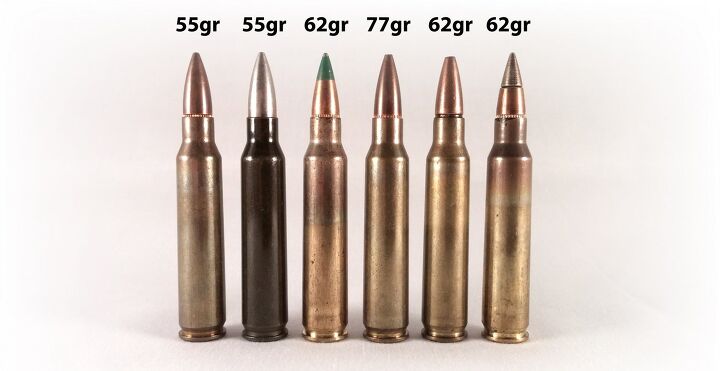
In the last installment, we talked about the trade-offs involved in increasing or decreasing the projectile’s diameter (and, thereby in convention systems, the bore’s diameter as well). One of the major pieces of the equation that we left out was how changing the projectile’s mass affects the round’s performance, and it’s this that will be the subject of today’s post.
Modern Intermediate Calibers: Trade-Offs – Bullet & Bore Diameter

Probably the most obvious element of ammunition design is the choice of caliber, or more specifically the choice of bore and bullet diameter. These two dimensions are of course closely linked in conventional ammunition systems (they can be decoupled with sabots, but those are outside the scope of this series), and together they relate to some of the most central trade-offs of any ammunition system design.
Modern Historical Intermediate Calibers 024: The 4.6x36mm HK/CETME

Today we’ll be looking at a round with one of the strangest-looking projectiles ever designed for a military weapon: The joint Heckler & Koch-CETME 4.6x36mm round designed for the HK36 en-bloc clip fed assault rifle. The rifle was, as the name suggests, developed by HK, and based on their successful family of roller-retarded blowback rifles, including the G3, MP5, and HK33. It fed from an unusual fixed 30-round magazine, which was loaded from the side through a panel with a polymer 30 round en bloc clip. The projectile was developed by Gunther Voss, of CETME, the very same who invented the unique aluminum-cored projectiles for the 7.92×40 CETME a couple of decades earlier.
Modern Historical Intermediate Calibers 023: The 6.35/6.45x48mm Swiss GP80

Information on this round and the weapons designed to fire it is scarce, so the details in this article may be at times incorrect. Just letting you know. -NF
Future Firearms Ammunition Technology 006: Multiplex Projectile Ammunition - Two, Three, Four for the Price of One?
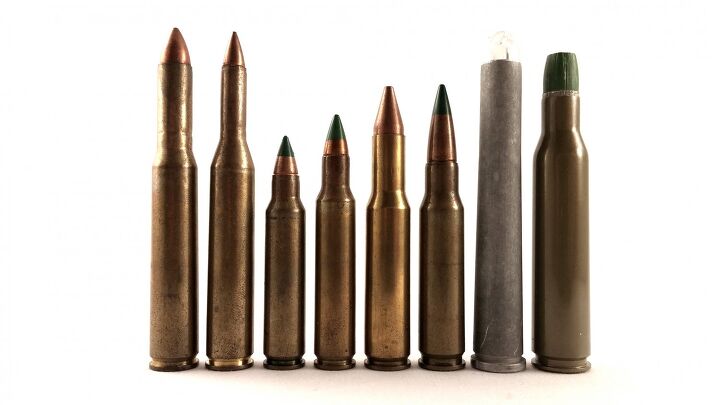
After World War II, US Army analysts determined that the effectiveness of the infantryman was not as closely related to their marksmanship discipline as had been previously thought. It seemed that instead, the random environmental circumstances and effects, plus the concealment and movement of the target, had much more of an influence on the probability of a hit than the ability of the shooter to fire his weapon with precision. With this knowledge in hand, arms designers in the West set out to improve the chances of the soldier to hit his target, and the most obvious solution was to simply send more lead downrange. The simplest way to do that was, of course, to create ammunition that fired more than one projectile per round.
Future Firearms Ammunition Technology 005: Caseless Ammunition - Lightening the Load, Pt. 3
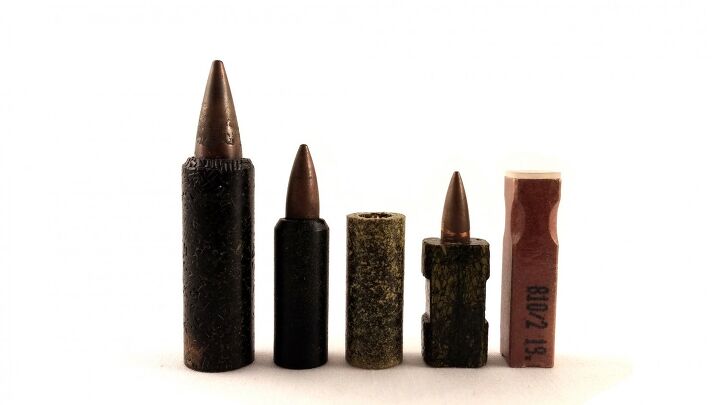
Previously, we discussed trying to lighten the soldier’s load by making the cartridge case out of different materials, including aluminum and compositing the case out of polymer and metal. Yet, wouldn’t the lightest possible case configuration be… Having no case at all? That’s the thinking behind one of the most ambitious ammunition configurations there is, the case-less round.
Future Firearms Ammunition Technology 003: Sabots - Performance-Enhancing Shoes for Your Bullets
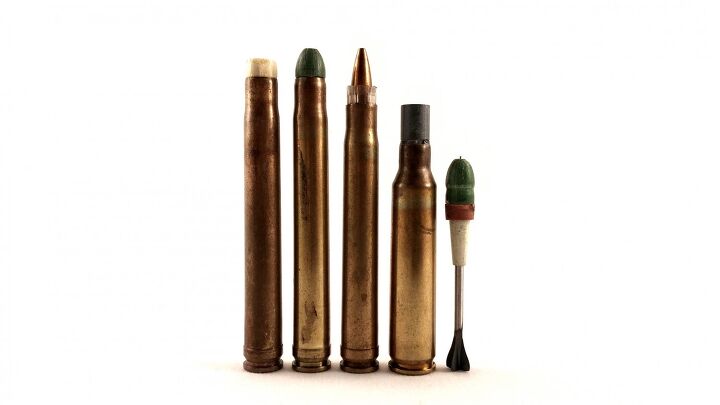
One of the problems of small arms ammunition is that of swept volume. That is, the most ballistically efficient projectiles are the longest and thinnest ones, which cut through the air more easily than squatter, fatter projectiles. Yet, the best projectiles from a propulsion perspective are the widest ones, as they have the most area at their base for the expanding gases to push on, making them more efficient, especially from shorter barrels.
Future Firearms Ammunition Technology 002: Polymer-Cased Composite Ammunition - Lightening the Load, Pt. 2
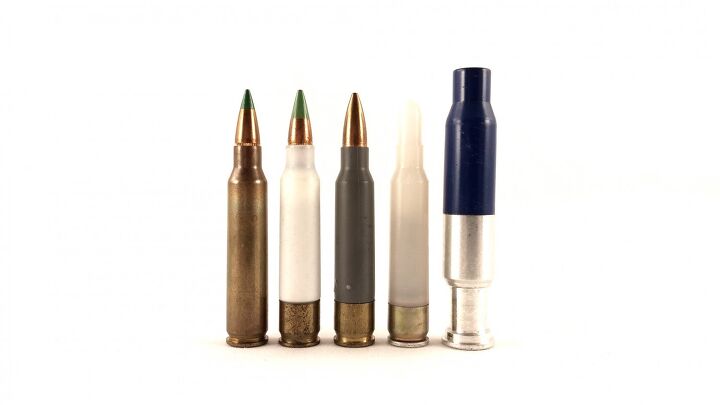
In the last installment, we talked about the growing need throughout the 20th Century to reduce the weight of the cartridge case, to lighten the burden of the soldier. Experiments in aluminum have thus far proven unsuccessful, but another material is even more promising: Polymer. Plastics and polymers burst onto the scene in the post-war era, and it didn’t take very long for engineersto start looking at them as a way to reduce the cost and weight of ammunition. If feasible, polymer is an ideal solution for cartridge cases, as it is even less dense than aluminum, while being cheaper and using no metals or other expensive strategic resources, just crude oil.
New Ammo for British Troops: UK Develops More Effective 5.56mm and 7.62mm Ammunition

It’s not just the Yanks that are getting improved ammunition: Our friends across the pond have developed their own firepower upgrade for 5.56mm and 7.62mm weapons alike. Jane’s has a modest article on the subject, while The Register provides a quite good overview of exactly what the new rounds are and what they mean for today’s Tommy:
Modern Intermediate Calibers 016: The 5.8x42mm Chinese

In the mid-1950s, the People’s Republic of China followed the Soviet Union’s example and adopted the intermediate 7.62x39mm round. This decision substantially helped to promote that cartridge’s ubiquity throughout the world, as millions of cheap Chinese-made SKS and AK rifles were exported to every corner of the globe. However, at the very end of Chairman Mao Zedong’s regime, an effort was started to develop a new, modernized caliber that would improve performance and conserve materials versus the 7.62×39. That program resulted in the 5.8x42mm caliber, standardized in the late 1980s with the DBP-87 and DBP-88 rounds. Unusually, the 5.8x42mm used a system with two different overall length standards, one of about 58mm for the DBP-87 rifle cartridge, and the other of about 62mm for the DBP-88 support round. This allowed the marksman’s rifle to shoot the DBP-87, if necessary, but also allowed for a longer, lower drag bullet to be put in the DBP-88 case, improving the ballistics of the QBU-88 marksman’s rifle and the QJY-88 general purpose machine gun.
Modern Intermediate Full Power Calibers 015: The 7.62x51mm NATO

Shouldn’t “Modern Full Power Calibers” be its own series? No, because then there would only be two episodes! So instead, we’re rolling today’s two most popular full power .30 cal rounds into the series on intermediates, primarily as comparison pieces. There are really two pieces of information I want to disseminate with this, which are the answers to “how do these full power rounds compare with intermediate calibers?” and “how do they compare against each other?”