No Such Thing As Parallax Free


Dave Merrill of Breech Bang Clear explains that there is really no such thing as parallax free. He breaks it down rather simply and it is easy to grasp.
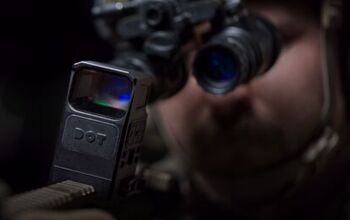
Here is a photo that illustrates how the reticle is reflected in the optic.

Most of the time a shooter will not experience much parallax shift if they have a good solid and consistent cheek weld. The issues comes down to unusual shooting positions and the focal length of the dot in relation to the target.
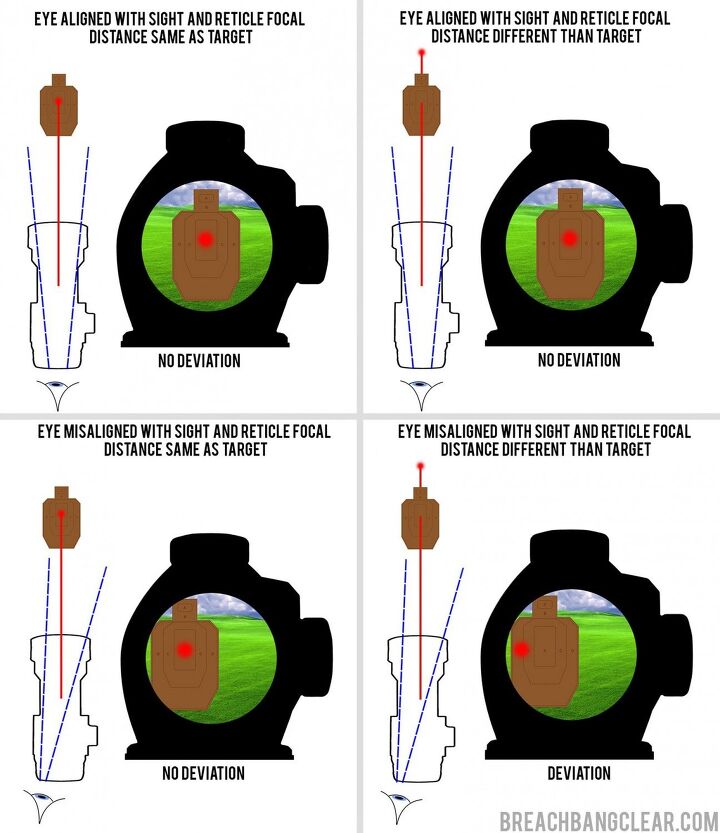
Here is a very simple yet clear demonstration of how this works.
How do manufacturers deal with parallax? Here is Merrill’s explanation.
Have you ever seen 1x RDS with a parallax adjustment turret? Me either. There are several different methodologies that manufacturers employ to reduce parallax. One of them is focusing at infinity. Remember that perceived movement at longer ranges is reduced. A dot focused at infinity will have less apparent movement, especially with targets further than 50m away or so, than a dot focused at a closer range. A red dot sight with a smaller objective window will also have less parallax, simply because your vantage point can only deviate so much before you’re out of the window entirely. Many reflector setups will utilize a Mangin mirror, which is a concave lens that helps to ensure the dot stays in line with the body itself. This setup is especially useful for reducing parallax from lateral movement, though they still remain susceptible to deviations in vertical movement. No doubt there are several more methods.
Merrill does test this himself. Using a picatinny rail, a vice and a camera sliding rig he sets up some red dots and a target out at 68m. Here are the optics he tested.
- Aimpoint Micro H1 (4 MOA)
- EOtech EXPS
- Trijicon MRO
- Leupold LCO
- Trijicon RMR 01 (3.25 MOA)
- $40 Tru-Glo Walmart Special
To check out Merrill’s article click here.
More by Nicholas C


![[SHOT 2026] Day 2: The People Of SHOT Show](https://cdn-fastly.thefirearmblog.com/media/2026/01/22/03012/post.jpg?size=350x220)
![[SHOT 2026] New Sierra & Barnes Products and TrueData Ballistics App](https://cdn-fastly.thefirearmblog.com/media/2026/01/21/11571/post.jpg?size=350x220)


![[SHOT 2026] CVA Gets Into The Rimfire Game With New Cascade Rimfire](https://cdn-fastly.thefirearmblog.com/media/2026/01/23/17451/post.jpg?size=350x220)
![[SHOT 2026] North Country Armory Reduced Heat Signature Suppressor](https://cdn-fastly.thefirearmblog.com/media/2026/01/21/23141/post.jpg?size=350x220)




Comments
Join the conversation
As I have written before in a reply to an almost identical article covering the same topic, you TFB writers need to learn the difference between actual parallax and PARALLAX-LIKE errors in optics that take place when (example used: collimating red dot sight) is NOT a "real" collimating sight because the light source and semi-reflective curved mirror is used instead of a true collimating sight which uses a light source, flat mirror and a lens to do the same exact thing but better.
Thus even if some "adjustment knob" would be added to simple non-magnifying red dots then there is no f***ing way on Earth you'd be able to compensate for a "parallax" which is actually very small flaws in the curvature of that semi-reflective curved mirror, and not an actual parallax. This is a flaw that stems from over-simplification of red dots, and is EXACTLY why some sights have apparent POA shift while others less and some none at all.
This is also a side-effect which will never be solved as the same curved mirror acts as a lens that warps the shooter's own field of view both dead on and when the view shifts to either corner of the field of view, so basically those two flaws just stack on top of each other.
And yes, true collimating sights do focus on infinity, and thus no point of aim shift happens because of that.
As for holographic sights they are still a mystery to me and I to this day despite my many attempts simply can't understand to a 100% satisfaction how they work, so I won't speculate about those. But I do assume the problem there is similar.
As long as my Eotech, AIMpoint and Mepro hit where the dot is pointing I'm fine with the "parallax free" fine print.