Blackhawk barrel takes a beating

Rugerblackhawk
Click to enlarge

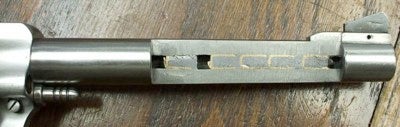
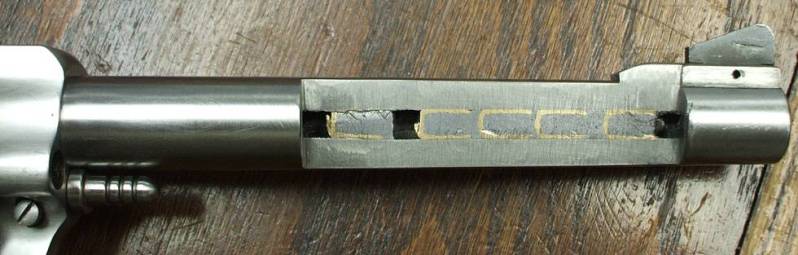
There are at least five bullets stuck in that revolver barrel. RugerForum members seem to think is a Ruger Blackhawk in .357 Magnum. The squib loads could have been low powered .38 Special rounds or very badly loaded .357 rounds. That the shooter did not notice it after the 1st, 2nd, 3rd or 4th round is crazy!

It is hard to see if there is a bulge in that barrel, a symptom of a round fired into a blocked barrel. I think if had been a semi-automatic pistol there would have been a disaster. A revolver can vent gas in the gap between the cylinder and the barrel but in a autoloader pistol for a brief period of time the gas has no where to go and the pressure build up would be considerable.

A few weeks ago I was shooting some old .22 Longs out of a rifle which I had not fired them out of before. I nearly crapped my pants after the second round when I realized to forget to check the spotting scope to ensure that the first round made it out of the barrel and hit the target. I was shooting iron sights and could not see the target. I learnt a good lesson. Always make sure you hit the target, especially when you are shooting low powered ammunition.

Thanks to Advocate for the link.

Related Posts

Steve May 28th 2009 handguns Tags: , , , , , 16 Comments

16 Responses to “Blackhawk barrel takes a beating”

  1. Sven Ortmannon 29 May 2009 at 12:15 am link comment

    The fifth bullet is not in contact with the 4th.
    It’s extremely unlikely that the barrel itself stopped it. Bouncing doesn’t fully explain that photo as well.

  2. Jose Giganteon 29 May 2009 at 12:40 am link comment

    I’ve seen five stacked in a barrel during a cowboy action match. We shoot our revolvers pretty fast and he simply stacked them up and simply thought he’d missed the steel. All five were pushed out and no damage was done to the barrel and he continued the match.

    I’ve no idea why anyone would grind away a barrel like that!?

  3. DrStrangegunon 29 May 2009 at 1:39 am link comment

    It’s cut because I can see just from the photo that the barrel is pretty badly bulged.

    As far as the spaces, there may have been enough lubricity while hot to let the trapped air pressure between the rounds push it back a bit.

    As far as seeing the bulge in the photo, you can see it in two subtle clues; first is the slight arch in the bore between shots four and five, and the second is the reflection of the overhead fluorescent light in the barrel surface behind the cut (towards the frame). The major reflection is too blown by the camera sensor to be useful, but the secondary reflections have an undeniable wave to them.

  4. clampon 29 May 2009 at 2:32 am link comment

    You sure that is not a .22lr?

  5. RipRipon 29 May 2009 at 3:28 am link comment

    Do they even make jacketed .22lr bullets, sure look jacketed to me.

  6. DrStrangegunon 29 May 2009 at 3:47 am link comment

    Clamp, if you look closely those are jacketed bullets. They just look smaller because the cut isn’t all the way into the bore (look at the front sight base for a registration point)

  7. Paul_In_Houstonon 29 May 2009 at 6:12 am link comment

    #
    clampon
    You sure that is not a .22lr?

    I strongly doubt it; the front sight appears to be high enough to compensate for the recoil from the mass of a larger bullet than a typical .22 round. .38/.357 seems about right. They look like wadcutters.

    -

  8. Paul_In_Houstonon 29 May 2009 at 6:26 am link comment

    Follow-up:

    With what looks like wadcutters, he may have been reloading target rounds.

    When I reloaded (way back in the ’70s) a popular .38 Special reload was about 3 (THREE) grains of Bullseye Pistol Powder. That amount took up space about the size of an aspirin tablet, and was not easily noticeable in a .38 Special case.

    If you’re too casual about this, it’s not that difficult to fail to notice that the case you are seating a bullet in has no powder and will only have the power of the primer to launch the bullet into the barrel and lodge there.

    A subsequent round (WITH powder) could then move it, and itself, down the barrel, but not emerge. Further rounds would only compound the problem.

    I’m surprised he didn’t notice a difference in sound. Does the gas escaping from between the cylinder and the back of the barrel make enough noise that a difference would be unnoticeable? (Probably so, if on a range with other firing going on.)

    -

  9. Muon 29 May 2009 at 9:45 am link comment

    I agree, that’s most likely a 22. The barrel wall strength is around the same size as the bore, if this is a .38 type round you end up with more than an inch of barrel diameter.

  10. Oswald Bastableon 29 May 2009 at 10:34 am link comment

    Saved by the cylinder gap!

  11. DrStrangegunon 29 May 2009 at 11:21 am link comment

    It’s a .38/.357, the barrel isn’t sectioned all the way into the bore.

  12. Domon 29 May 2009 at 12:20 pm link comment

    Unless they started making .22LR dumdums, that’s a 357. Er, was.

  13. Advocateon 29 May 2009 at 1:07 pm link comment

    no way this is .22

    …with that flat base pin and pinned front sight, it’s def .357 or possibly .44, the angle of the cut just throws off the look of the round.

    .38 special semi jacketed waddcutters would be my bet. I’ve fired some old light loads that i could tell were squibs (just to clean out an old box), but had it been in competition, i could MAYBE, MAYBE see something like this happening for a second shot…. but not 4 times

  14. Advocateon 29 May 2009 at 1:12 pm link comment

    @Sven Ortmann

    there’s plenty of barrel bulge to account for that bullet being moved back by the hardcore cutting that was soon to follow.

    IMO of course

    -advocate

  15. J.A. Jameson 02 Aug 2009 at 8:13 am link comment

    You can see part of the hollow point cavity in the first round as well as seeing the way the lead was compressed forward of the jacket on the rest of the rounds.

    Also with the first bullet, if you look just below the rear of the sight ramp, you can see where the jacket is bulged upwards above the line of the bore. This is caused by the way the barrel vibrates when the gun is fired. The front sight is heavy enough and high enough off the center line of the bore that it acts like the weight on a fishing line. When fired, the barrel expands slightly, twists slightly around the center of torque of a mathematical point related to bore, land, groove, barrel diameter and taper. In addition, it vibrates vertically (pitching). If you look at a fast enough video, the barrel makes a tiny ‘crack the whip’ kind of movement every time it’s fired. This is what barrel weights are used to mitigate on some target guns.

    The extrusion of the bullet jacket on the first round is caused by the way the barrel bulged during one of the ‘crack the whip’ actions of one of the other rounds. Just guessing I’d say most of the damage was probably done by the fourthand fifth rounds. It wasn’t until the fourth round lodged in the barrel that the bore was occluded by enough compressed lead and jacket material that the propellant gasses bypassing the fifth round weren’t able to find a way past the previous bullets. That’s the reason for the gap between the fourth and fifth bullet.

    To get a visual analog of the way the barrel acts when fired, take a look at a high pressure hose. While the material in the gun barrel is orders of magnitude stiffer and more resistant to deformation by the fluid inside it, we’re still stuck in a universe constrained by basic physics.

    The bullets will also have moved from their ‘as fired’ position in the bore during the cutting process to show the cross section. The fifth bullet didn’t pressure weld itself to the fourth because of the compression issues and as such probably moved significantly more than the others did during the cutting.

    If you look at the enlarged picture, you can see a series of discolored, angled marks in the metal of the barrel. These are just above a point about 1/3 the length of each bullet forward of its base and angle back towards the breach and up towards the topstrap. These discolorations are caused by the barrel bulging with each round.. They’re the result of changes in the metallurgy of the barrel as it was bulged and ‘whip cracked’ with each round.

    You can find all of the necessary math and material values in a good metallurgy text or in one of the high end machinist guides.

  16. Steveon 02 Aug 2009 at 12:15 pm link comment

    J.A., very interesting, thanks for our comment.

Leave a Comment

Comment Policy: I reserve the right to remove comments at my discretion. Think of comment threads like a dinner party at someone's house. If you make the party unpleasant for others or me, you won't be invited back. I am happy to tolerate a wide range of viewpoints, even extreme ones, but I'm not going to tolerate nastiness, rudeness, trolling, vitriol, or excessive snarkiness toward the author(s) or other commenters. You may make your case passionately, but civility is expected. Please stay on topic and respect the technical nature of this blog.
Spam Filtering: To avoid spam, comments are filtered using Akismet and then manually approved. Do not be alarmed if you comment does not appear instantly. I do not check the spam folder more than once per day.