Wheelgun Wednesday: Looking at K-Frame and L-Frame S&W Revolvers


Welcome back to another edition of Wheelgun Wednesday. Last week, we talked about the French Modele 1892. If you happened to miss that article, be sure to click the link here to check it out. This week, I wanted to take a closer look at some of the various frame sizes from Smith & Wesson. To the casual gun buyer, there are several frame sizes in the modern lineup. While each frame size has a pretty incredible history behind it, I wanted to take a look at the two frame sizes that oftentimes get the most confusion. Smith & Wesson also has been expanding their Classic Line to include Model 19s and other options from their historic line of revolvers. It’s important to consider the timeline when looking at K and L-frame revolvers.

K-Frame Revolvers
The K-frame revolvers are considered medium frame revolvers that debuted all the way back in 1899. These early models were technically Smith & Wesson’s first M&P line of revolvers for Military and Police units to have a hand-ejector revolver they could depend on. At the time, there was no thought about magnum cartridges for service handguns, and when the first Model 10s rolled out they were chambered in 32-30 Win which had quite low stopping power. As a result, Smith and Wesson made the 38 Special which made the Model 10 a fantastic option for a service pistol.

Fast forward 50 years and the K-frame Model 10 is one of the most produced revolvers in history. Even today there are multiple offerings like the Model 19 Carry Comp as well as the classic line bringing back versions of the original Model 10. Other models like the Model 66 and 66 Combat Magnum chambered the K-frame in .357 Magnum which pushed the frame to its absolute limits in the 1950s and 60s. As a result, Smith & Wesson beefed up a new frame to allow a stronger revolver, ultimately creating the L-frame as we know it.

L-Frame Revolvers
Smith released the L-frame revolvers in the mid-1980s when the golden era of combat revolvers was in the Law Enforcement community. Colt was releasing the Python and Trooper models for the law enforcement community, but Smith wanted to have a frame that could withstand multiple calibers and still be easily carried and used by almost anyone. The L-frame was slightly thicker than the smaller K-frame, but this slightly heavier frame allowed Smith & Wesson to not only make 7-shot .357 Magnum but also 5-shot .44 Magnum variants for a smaller profile mountain revolver.

This one frame could chamber everything from 9mm all the way up to .44 Magnum making it one of the most versatile and modular revolver frames on the market. If you’re trying to get a real understanding of the various frame models from Smith & Wesson, you have to understand the progression in technology and the rise of magnum cartridges on the market. Absolute classic models like the 586 and 686 are all built on the L frame. Each of these models comes standard with adjustable sights, which allows people to swap out the rear sight for anything they may want on their revolver. In terms of versatility, the L-frame can maintain a lightweight revolver while offering more firepower and longevity without worrying about the frame cracking or degrading over a lifetime of use.

Modern Improvements
Where things start to become interesting is when you introduce modern metallurgies that allow the modern Smith & Wesson revolvers to not only be stronger but lighter compared to older models. The Model 19 Carry Comp is chambered in 357 Magnum with a 3” barrel and has an overall weight of 34 ounces. When the L-frame came out in the mid-1980s, it was a bulletproof frame that could stand up to a lifetime of abuse from .357 Magnum rounds.
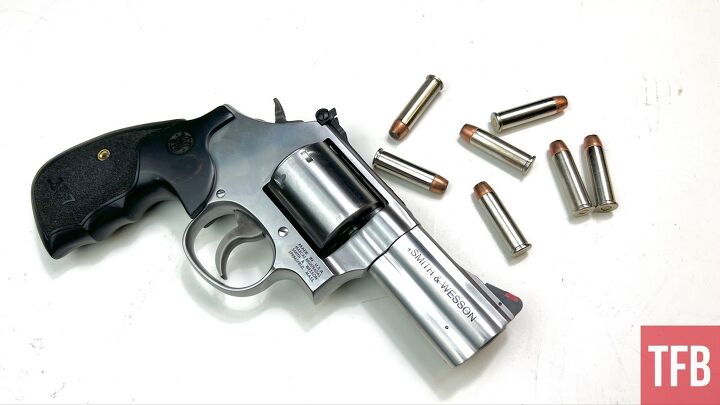
At the time, it was a huge advance in revolver durability over time, but now that we have more sophisticated metallurgy and advanced machining practices, smaller framed revolvers can handle the high-pressure magnum loads. Now we have the smallest J-frame models like the 340 PD with the ability to fire 5 shots of .357 Magnum.

In the future, we will do a breakdown of the other frames from Smith & Wesson, but I wanted to focus on the two frames that people oftentimes get confused about. These revolvers have an incredibly rich and complicated history, but allow people to see the natural progression.

Overall Thoughts
Between the K and L-frames, there are some of the most iconic and well-known models throughout the Smith & Wesson lineup. They are some of the best combat-fighting revolvers and it’s important to know the difference between the frame sizes to understand what each model was built for and what they offer.
What do you guys think about the K and L framed revolvers? Do you have a preference or favorite model? Let me know in the comments below. If you have questions about these types of revolvers or firearms in general, feel free to shoot me a message on Instagram @fridgeoperator. Stay safe out there and we will see you next week for another edition of Wheelgun Wednesday.
I'm an avid shooter and love educating whether it's at my job or in the shooting community. I'm an average joe that really loves talking with other people about firearms and other passions.I'm active on Instagram on @fridgeoperator.
More by Matt E



![[SHOT 2026] Anschutz 1727 APR: Built To Win With A Big Price Tag](https://cdn-fastly.thefirearmblog.com/media/2026/01/23/23201/post.jpg?size=350x220)





![[SHOT 2026] 4-Lb 308 Bolt Gun – The Weatherby Mark V Backcountry Capra](https://cdn-fastly.thefirearmblog.com/media/2026/01/21/13301/post.jpg?size=350x220)
Comments
Join the conversation
Yep, "Surf" nailed it. The Secret Service, which fires a lot of rounds in practice, was getting cracking in the forcing cones of their Model 19s and 66s from firing the duty 125-grain Magnums. (Federal agencies don't use "practice" or "range" ammunition; every round they fire in training or quals is a full-house duty load, for legal and other reasons.) The problem resulted in two solutions: The L-frame, which is slightly bigger and about half a pound heavier than the K-frame and doesn't have the flat in the forcing cone (It's similar in size to the GP100 and the Python; all three will fit in the same holsters), and the "Treasury load," aka the Q-load, a 110-grain .38 Special +P+ round that was about 90 percent of a .357, but not hot enough to crack a K-frame. Oddly enough, +P+ Treasury loads, in addition to being carried by almost all Federal agencies that issued .357s, were also carried by the California Highway Patrol in their proprietary Model 68s (a six-inch Model 67 that was made for CHP and LAPD, and never put on the commercial market), even though the Model 68 was only rated for .38 Special +P.
To clarify, the forcing cone cracking only happened on the .357 K-frames, and that after firing a lot of full-house Magnums. The .38 Special K-frames were unaffected. So you can shoot your Model 10s, 15s, etc., to your heart's content.