US Army SAW Program: HK23A1 and HK21A1
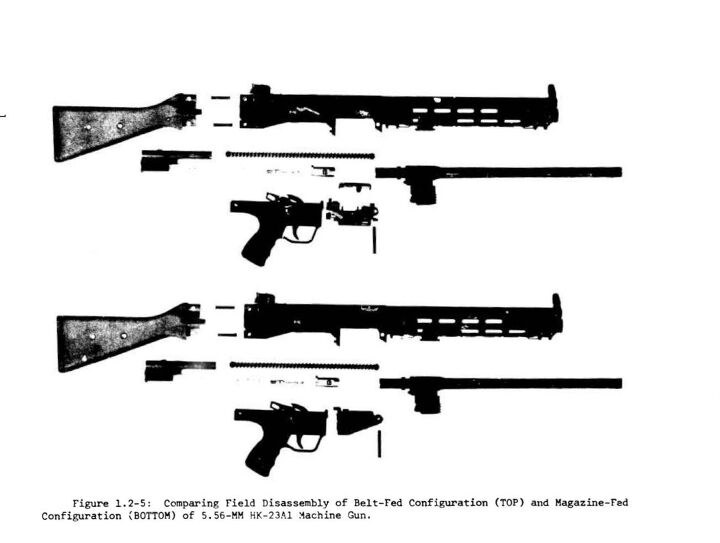
In 1957, the M14 rifle and M60 machine gun were adopted. The M14 program, which aimed to develop the M15 squad automatic rifle, was canceled in 1959. Later, the M14E2 was introduced as an interim solution to provide the infantry squads with a suitable solution. The United States Army Infantry School developed the M14E2 concept as a squad automatic weapon. This variant was issued in 1963, redesignated as M14A1 in 1966, and saw limited service during the Vietnam War. From the 1950s to the 1980s, there was no suitable replacement for the BAR (Browning Automatic Rifle), leaving infantry squads vulnerable and inadequate. During the Vietnam War, the M60 served as a company-level machine gun assigned to a platoon weapons squad.
Near the end of the Vietnam War, the US Army initiated the Squad Automatic Weapon (SAW) Program in 1972. The goal was to provide infantry squads with a lightweight weapon capable of delivering a high volume of fire. Between 1972 and 1976, the 6mm SAW program was in operation. Initially, the SAW program aimed to evaluate both 5.56mm and 6mm weapon systems. Subsequently, all 5.56mm systems were removed from the 6mm SAW evaluation and designated for testing and reporting solely for informational purposes as an engineering design test. By 1976, the Army had lost interest in the 6mm caliber and shifted direction to a 5.56mm SAW.
6mm/ 5.56 SAW
The Armament Command requested testing of foreign 5.56mm machine gun designs to assess their potential for US military use. This request was made in response to the need to enhance the lethality of infantry squads. It's important to note that every weapon undergoes various stages of development to evolve and refine its design; no weapon is perfect from its initial conceptualization. Before the U.S. Army's test in 1974, Heckler & Koch developed a smaller 5.56mm version of their 7.62x51mm HK21 machine gun, which was named the HK23. The variant submitted for testing in 1974 was designated the HK23A1.

Two weapons were procured for this evaluation: the HK23A1 and the FN Minimi. The HK23A1 was tested at Aberdeen Proving Ground in Maryland, while the FN Minimi was evaluated at the US Army Infantry Board in Fort Benning, Georgia.
The HK23A1, manufactured by Heckler & Koch of West Germany, is a lightweight, closed-bolt, roller delayed blowback, air-cooled, belt- or magazine-fed weapon. The selective fire mechanism allows delivery of fire in semiautomatic, fully automatic, and 5-round burst modes. The cyclic rate-of-fire is around 870-890 rpm.

The ammunition stated for the test included the 5.56mm M193 and M196 cartridges, the XM287 heavy ball, and the XM288 tracer. Three different barrel types were provided, each featuring a distinct twist rate in the rifling. The appropriate combinations of cartridge type, rifling twist rate, and locking-piece angle are essential for properly functioning both belt-fed and magazine-fed weapon configurations.
The HK23A1 fired 2,400 rounds during testing, including inspections, accuracy tests, and maintenance evaluations. However, the endurance test was halted due to frequent feeding failures and safety concerns. Issues included severe case-head swelling and primer ejection. Testing in extreme temperatures was canceled, and the causes of malfunctions were not identified. The mean rounds between failures were not specified, but the malfunction rate was 72 per 1,000 rounds, with seven parts requiring replacement due to stoppages.

For the endurance test, firing was conducted in 200-round cycles following test guidelines. The weapon was cooled after each cycle and scheduled to be cleaned, inspected, and relubricated after each 10 cycles. Weapon accuracy and dispersion, projectile velocity, and stability were to be checked at each maintenance interval. The cyclic rate of fire was recorded throughout testing when fired from the bipod.
Testing was terminated before the completion of the remaining 20 cycles, which would have used a firing sequence similar to that shown for the first 10 cycles. Maintenance was scheduled to be performed after each ten 200-round cycles fired. The test results are presented in four tables.
A representative sample of cartridge-case casualties during firing showed swelling of the case head and expansion of the primer pocket, with 51 cases of swelling and 36 instances of blown primers. While these changes often indicate excessive pressures in the ammunition, velocity and pressure data from the same lot do not support this as the cause. During controlled 5-round burst firings, the weapon's burst controller often malfunctioned, and other weapon stoppages obscured the frequency of this issue. There were nine recorded 4-round bursts and 11 occurrences of 6-round bursts during malfunction-free firing attempts.
Analysis of the 1974 HK23A1 machine gun test was unreliable from a performance standpoint, although the shooter readily cleared most stoppages through immediate action.
The weapon largely failed due to reliability issues, though the Army states it wasn’t ammunition-related issues. This was caused by the US Army's replacement of ammunition from the previously mentioned M193 and M196 with XM287 and XM288. This new ammunition was incompatible with the HK23A1 machine gun. Because the cartridges had thinner walls, ruptures occurred, leading to significant functioning problems, resulting in a negative assessment of the outcomes of the weapon tests. At the end of the report, the Army said the weapon design is satisfactory though improving the design would enhance the weapon's serviciability.

5.56 SAW
The second attempt was the 1978 5.56 SAW program, which involved the larger HK21A1 instead of the HK23A1 from the first test. The HK21A1 was configured for a 5.56x45mm cartridge and designated the XM262. Later, the HK21A1 would evolve into the HK21E.
Comparative testing began in 1979. The machine guns were subjected to ten months of comprehensive testing in extreme weather conditions. They were exposed to desert sand, mud, and silt. The tests included the reliability of the weapon, the probability of hitting targets at distances of up to 1,000m, the ability to quickly replace the barrel within 10 seconds, safety, durability, interchangeability of parts, firing behavior, the ability to self-ignite a cartridge left in the chamber, ease of use, and other characteristics. In total, the samples underwent 54 different types of tests.

In 1980, the SAW program concluded with a final report stating that none of the candidates fully met the evaluation criteria. However, the FN XM249 MINIMI light machine gun met most requirements. This led to the XM249 being adopted as the M249 by the US Army in 1984, and the US infantry finally had an adequate squad automatic weapon.


Lynndon Schooler is an open-source weapons intelligence professional with a background as an infantryman in the US Army. His experience includes working as a gunsmith and production manager in firearm manufacturing, as well as serving as an armorer, consultant, and instructor in nonstandard weapons. His articles have been published in Small Arms Review and the Small Arms Defence Journal. https://www.instagram.com/lynndons
More by Lynndon Schooler


![[SHOT 2026] The OG Bushmaster—the Gwinn Assault Rifle—Is Back](https://cdn-fastly.thefirearmblog.com/media/2026/01/27/18101/post.jpg?size=350x220)




Comments
Join the conversation
So, the failures of the HK23A1 were due to the experimental ammunition? Also, are there any details on how the HK21 did during trials?
Exactly. It almost looks like it was done on purpose……again.