The Soviet Union's First Flechette Assault Rifle, The AO-27
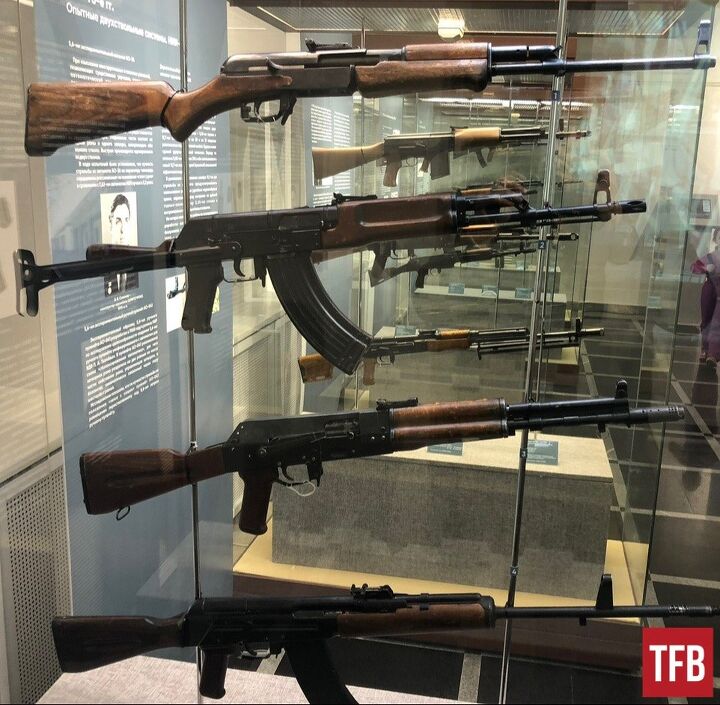
In my previous article, I discussed the PKG smoothbore Kalashnikov machine gun, which was influenced by the U.S. Special Purpose Individual Weapon (SPIW) program. The PKG was predated by the AO-27, which was the Soviet Union's first assault rifle designed for fin-stabilized discarding sabot ammunition, developed in 1961 by D. I. Shiryaev.
During the late 1950s and early 1960s, designers, including Shiryaev, focused on developing sub-caliber flechette ammunition in the Soviet Union. In 1961, Shiryaev developed the experimental AO-27 assault rifle, which was chambered for a new experimental fin-stabilized discarding sabot cartridge 7.62/3.0 mm.
The AO-27 assault rifle was the first experimental weapon created as part of the weapon cartridge with an arrow-shaped bullet complex at NII-61, now known as TsNIITOCHMASH, the Central Research Institute of Precision Engineering. Several studies have been conducted to enhance the performance of the 7.62x39mm cartridge in the AKM assault rifle. These studies revealed that reducing recoil momentum was the most effective way to improve hit probability. Consequently, it became necessary to reduce the caliber of the ammunition to extend its effective range.

The flechette armor-piercing, fin-stabilized, discarding-sabot projectiles were developed for the 100 mm anti-tank gun T-12 Rapira around the same time. This development prompted designers to create a smaller version, leading to the introduction of the fin-stabilized discarding sabot in 1960. This combination of ammunition and the AO-27 assault rifle marked the Soviet Union's first entry into using flechette technology in small arms.
The AO-27 is a select-fire, long-stroke, gas-operated rifle that features a two-lug rotating bolt. Its barrel has shallow rifling, which helps impart spin to the flechette. The ammunition consisted of a 3mm subcaliber, fin-stabilized flechette within a discarding sabot. The total cartridge weighed 162 grains (10.5 grams), with the flechette itself weighing 37 grains (2.4 grams) and measuring 2.16 inches (55 mm) in length. This ammunition has a relatively flat trajectory, achieving an initial velocity of 3,477 feet per second (1,060 meters per second).
The AO-27's recoil impulse is reported to be 35% lower than that of the 7.62x39mm AKM rifle. Additionally, the dispersal of flechette rounds from the AO-27 is significantly improved compared to the AKM, thanks to its flat trajectory and reduced recoil. However, due to the low mass of the flechette, the weapon's kinetic energy and armor-piercing capability are not optimal.

By the end of 1964, significant advancements had been made in low-impulse ammunition as part of efforts to develop a new assault rifle cartridge. Tests of the experimental 5.6mm cartridge, which evolved into the 5.45x39mm, demonstrated that it effectively met the requirements for accuracy, lethality, acceptable kinetic energy, and penetration. As a result, the conventional projectile was favored over the flechette options due to its clear advantages. Consequently, research on the 7.62/3.0mm cartridge was halted in 1965.
This work led to the development of a rifle-caliber cartridge to enhance the 7.62x54mm cartridge with a fin-stabilized discarding sabot. This request in 1964 led to the development of the 10/4.5 mm machine gun and rifle cartridge for the SVDG smoothbore sniper rifle and PKG smoothbore machine gun.
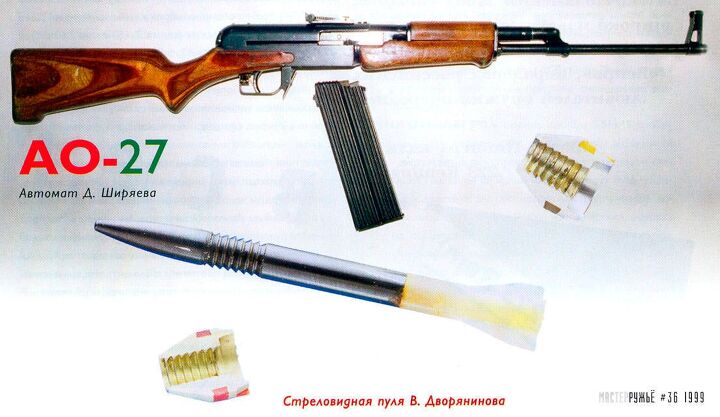
As the 5.45x39 was later adopted, it filled the role for which the fin-stabilized discarding sabot was designed, providing a low impulse high-velocity ammunition meeting the current requirements. However, the reduced mass of the flechette did not yield sufficient improvement for armor piercing and barrier penetration. This did not show enough of an improvement to justify the adoption and changing direction to the manufacturing of the fin-stabilized discarding sabot ammunition. Between 1983 and 1985, the reported manufacturing of the cartridge was not sufficiently developed. If adopted, it was necessary to refine the manufacturing technology and process to improve manufacturability. The labor of manufacturing an experimental cartridge was 1.8 times higher than that of manufacturing a standard 7.62x54 mm cartridge.

The flatter trajectory of fin-stabilized discarding sabot ammunition is undoubtedly advantageous. However, it is equally essential to ensure adequate transfer of kinetic energy, as well as effective barrier and armor penetration. During Soviet testing of the AO-27 and PKG, both showed significant improvement in hit probability but lacked impressive terminal ballistics. According to V.N. Dvoryaninov's book on small arms combat cartridges, the testing was not fully comprehensive and may not have been conducted optimally. Therefore, further exploration and improvement opportunities in this field may still exist. Mainly because the US currently uses a similar concept in the saboted light armor penetrator (SLAP) for the M2 .50 caliber heavy machine gun to defeat lightly armored targets. The M903 SLAP and the M962 SLAPT (tracer) have demonstrated the capability to provide increased penetration over that of ammunition currently fielded.
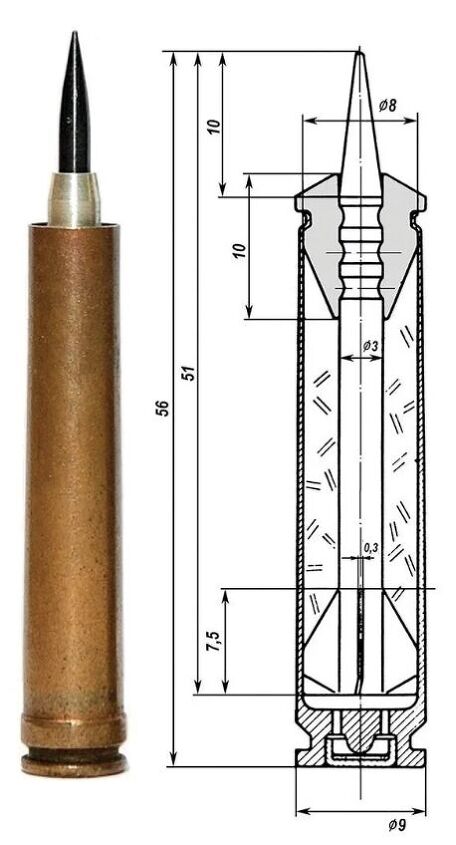
AO-27 specifications:
- Weight: 7 lbs. (3.2 kg)
- Length: 35.15 inches (893 mm)
- Barrel length: 16.3 inches (415 mm)
- Capacity: 30 rounds
- Rate of fire: 700 rounds per minute
Sources:
Monetchikov, S.B. History of the Russian Machine Gun.
V.N. Dvoryaninov. Small arms combat cartridges.

Lynndon Schooler is an open-source weapons intelligence professional with a background as an infantryman in the US Army. His experience includes working as a gunsmith and production manager in firearm manufacturing, as well as serving as an armorer, consultant, and instructor in nonstandard weapons. His articles have been published in Small Arms Review and the Small Arms Defence Journal. https://www.instagram.com/lynndons
More by Lynndon Schooler









Comments
Join the conversation
very cool article.
Russian post modern*Assault Rifles* have extensive battle field experience in mind..not plinking.not range toys..not mere elimination of swamprat stuff....*Americans want tactical equivalence and better..not some govt-approved lightweight fancy toys ..not just..""..mere ...stuff the ATF can falsely accuse decent gun owners on..*Americans can produce ..modify ..improve on tactical firearms if Only the govt --would get out of the..way...**.