The MK12 SPR: The Multi-Tool of the AR World

The AR-15 has become the most prolific modern rifle in America—and for good reason. Its modularity, accuracy, ergonomics, and proven track record make it a top choice for self-defense, competition, and professional use. But among all the possible configurations, there’s endless debate over which build is truly “best.” There is personal conjecture from both professionals and content ninjas alike. Today is an examination on the original modern-day patrol carbine, the MK12 SPR; more than a precision weapon, the SPR is the do-all shooter; the SPR is the multi-tool of ARs.

Know Thyself
In the 2A community, AR-15s are to shooters what Jeeps are to off-roaders—a proven, reliable platform that’s endlessly customizable to performance needs and personal style. Once someone owns one AR, they’re often already thinking about the next. One platform in particular stands out: the MK12 SPR (Special Purpose Rifle). Born from operational needs, it was designed to be more than just a precision weapon. The SPR is a do-all shooter—a multi-tool in rifle form—capable of bridging the gap between a designated marksman rifle and a general-purpose carbine.
This isn’t another deep dive into the MK12 as a sniper or DMR platform, nor is it a “clone-correct” build guide. Instead, we’re looking at the SPR for what it was truly meant to be—a precision-capable general-purpose rifle.
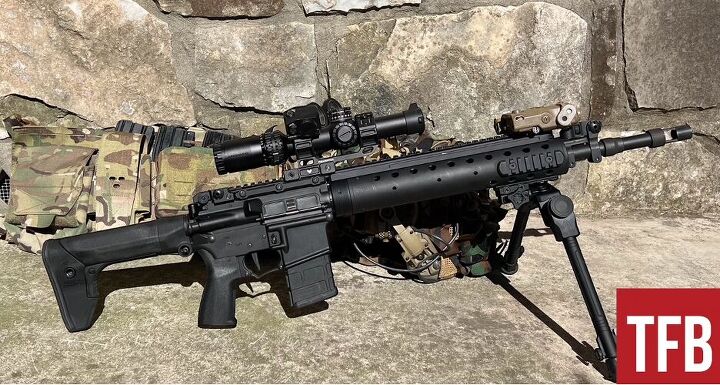
The rifle in this review runs a PRI complete upper on a Midwest Industries lower, with accessories chosen for modern availability and personal needs rather than strict GWOT-era replication. In practical terms, the SPR can fit into several categories: General Purpose Rifle (GPR), Recce Rifle, or Patrol Rifle.
Proposed Configurations:
- GPR — A longer 16–18" barrel, built for versatility, may or may not have night-fighting capability or magnified optics.
- Recce Rifle — Longer-range focus, often with a longer barrel, intended for precision at distance.
- Patrol Rifle — Shorter barrels (12.5–16"), optimized for mobility in confined or urban environments.
The SPR’s original design was meant to handle all of these roles when required. It was lightweight, precise, magazine-compatible with standard ARs, could fire any 5.56 NATO ammunition, integrate seamlessly with SOPMOD accessories, and swap between lowers in the field without issue.

The Path Less Travelled
The Special Purpose Rifle/Receiver concept was ahead of its time—combining precision capability with modular flexibility. Early models shipped with a Leupold 2.5-10× optic, which was a bold choice for the early GWOT era. Paired with an 18" match-grade barrel and optimized for the MK262 77-grain OTM round, the platform delivered impressive accuracy without sacrificing versatility.
Later iterations incorporated collapsible stocks, fully railed free-float handguards, and even shorter barrels—evolving with mission needs but never losing the original intent: precision you could carry all day in the field.

Choose Your Own Adventure
Today, the MK12 community splits into two camps:
- Clone Purists — Dedicated to building exact historical replicas.
- Pragmatists — Adapting the concept with modern parts and materials.
I lean pragmatic. With advancements in metallurgy, machining, and optics, there’s no reason not to modernize the concept to fit your environment and mission profile.
For example, a 13.7" precision barrel sacrifices some velocity but offers far better handling in tight spaces, especially if you’re running a suppressor. In my terrain—the Hill Country of Central Texas—this trade-off makes sense. The rifle remains accurate at distance while being easier to maneuver through brush, in vehicles, or inside structures.
Palmetto State Armory now offers SPR configurations in 13.7", 14.5", 16", and 18" barrels. The shorter lengths use FN cold hammer-forged barrels, while the 18" variant uses a 416R stainless match barrel with PRI components. It’s a menu that lets you tailor your rifle to your actual needs, not just historical specs.

Have It Your Way
The SPR I’m running is a PRI MK12 Mod 0 upper mated to a Midwest Industries lower, with a Midwest drop-in match trigger, Reptilia Recce Stock, and CQD grip. Optics are a Swampfox 1-10× in a Hostile Engagement mount, paired with a Kraken closed-emitter micro red dot on top.
This setup covers me from CQB distances to long-range precision, with the red dot offering heads-up and passive night-vision capability. A UTG detachable bipod mounts to the uninterrupted 12 o’clock SWAN rail, alongside an Inforce light and L3 PEQ-5 laser.
Is it heavy? Yes—especially compared to a lightweight carbine. But it’s still far lighter and handier than the belt-fed M240s and MK48s I’ve carried on patrols. A quality sling is essential for managing it over time.
For those looking to trim weight, PSA’s shorter MK12 configurations offer a great compromise. Adding a folding stock adapter like the Law Tactical or Dead Foot Arms units can make storage and transport much easier. In realistic engagement distances for a 13.7–14.5" SPR, a lower-power LPVO (1-6× or 1-8×) with a red-dot offset is an effective choice.

Intended Uses
The SPR’s real strength is its adaptability. A 13.7" SPR can handle everything from 25-meter snap shots to 500-meter precision—and farther, in capable hands. It’s at home in a patrol car, on a ranch, or as a truck gun for road trips where you might need both close-quarters readiness and stand-off capability.
If you’re committed to the concept, you could even run two uppers—one optimized for distance, the other for CQB—on a shared lower. That’s the beauty of the AR system.

Final Thoughts
This wasn’t meant to be another spreadsheet of group sizes or ammo types—there’s already a mountain of that content out there. Instead, this is a reminder that the MK12 was always more than just a precision rifle.
With the right setup, a well-built SPR—be it PRI or PSA—can be your 90% solution: capable in CQB, accurate at distance, and adaptable to almost any mission. You don’t have to clone every rivet from a GWOT armory rack. Build it to fit your needs, and you’ll have a rifle that can do just about everything you ask of it.
The MK12 broke the mold when it arrived. It proved that a rifle could be accurate, modular, and mission-flexible all at once. For many shooters, it remains the crescendo of AR-15 builds—a platform that can play any tune, from precision symphony to hard-hitting rock-and-roll.
3 decades in SOF and high threat contracting, master’s in psychology with a focus trauma, hobby farmer, and outdoors enthusiast .
More by Toby M


![[SHOT 2026] Palmetto State Armory's Fresh Crop Of New Guns](https://cdn-fastly.thefirearmblog.com/media/2026/01/24/23281/post.jpg?size=350x220)


![[SHOT 2026] FRT90 Forced Reset Trigger for PS90 from Armory of Kings](https://cdn-fastly.thefirearmblog.com/media/2026/01/28/22111/post.jpg?size=350x220)


Comments
Join the conversation
Swampfox optic? Really?
I built my SPR using a MLoc upper with 18" Wylde 223 chambered stainless steel FN barrel. Aero lower with Rock River 3.5 # varmint trigger, JP rifle enhanced recoil spring and buffer, Magpul stock. Knights Armament BUIS, 20 MOA rail and Vortex 6 to 24x VIper scope. I could have just as well used a 10x scope as the original Mk12 used but I'm older so the extra optic power helpful. I shoot 300 and 600 yds with this SPR using 77 gr hand loads that replicate the 77 gr Black Hills load. This rifle has out shot issue M12's here at Quantico. At 600 yds I shoot an 8 inch disk at 78 yrs old and have about a 60% hit success but I'm mindful of winds and pick the days for 600 yd shots. 300 yd shots...easy and any day in any weather.
The SPR is a model worth looking at if you choose to build an all around utility AR. Few of us clear buildings , need lasers etc etc. so not all features of a issue M12 are required and if you shoot suppressed, choose a barrel length as you please. Granted a "can" stuck on to a 18" barrel makes for a
Kentucky Long Rifle so there is traction to choose a shorter barrel if using a can. I shoot w/o a can and find the 18" barrel ideal and suffers no less accuracy than my Rock River M16A4 Nation Match rifle with 20" match barrel at 600 yds. If you go for shorter barrel and a can, pay attention to purchasing a top shelf barrel so you retain accuracy. Its going to cost you and there is no way around it...shorter barrel has to be top shelf quality if accuracy is mandatory. No free lunch there.
For non can shooter, do a second look at 18" barrel and SPR concept. I've found this to be ideal in all respects. Don't shoot yourself in the foot with crap optics. The 223 Wylde chamber is an advantage if you hand load.
Last shot: Buffers. The standard buffer is just fine but if your SPR is a Range Rifle as is mine, tweeking buffer weights can yield very smooth & soft operation with Very Aggressive Ammo. I have gone this route to chase
long range accuracy and smoother operation with such loads and all of that is target shooting, not for use in defensive purposes. A stock milspec AR for defense is always the answer for total performance and reliability.
Use a crappy barrel and nothing good will come of it. Think on that. A quality barrel pays for itself in expensive ammo that hits the target ,not misses target at a buck per shot. That said if shooting 100 to 300 yds, any barrel with common 55 gr 556 ammo will do if the expected accuracy is hits on a man size target . Not saying that's not a worthy standard for accuracy but why build a SPR for that...your Plain Jane M4 will do that all day long. Real accuracy...better barrel and ammo .