Front Line Friday #6: Duty Belts, Vests, and Real Load Management

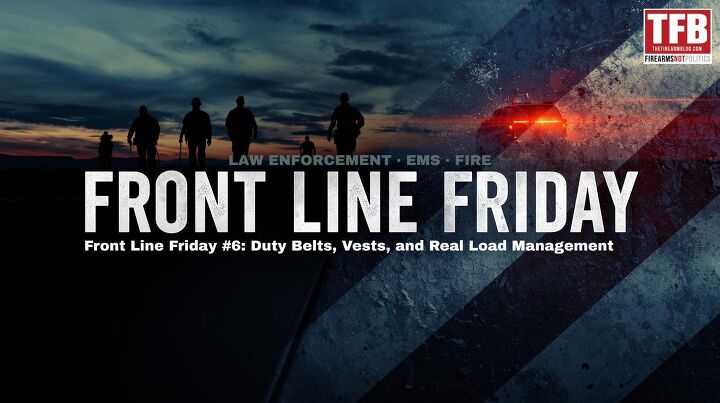
What you carry every shift, what you actually use, and what the cumulative cost looks like after a decade on the job.
Front Line Friday is a weekly column on duty-grade realities for first responders.
Welcome back to Front Line Friday. If you've worked a full shift in a duty belt and gone home with your lower back tighter than your range schedule, this week is for you. Front Line Friday is brought to you by Dead Air Silencers, whose support keeps this column running every week.

This week is about load management—not as an abstract ergonomics concept, but as a practical program decision that affects officer health, long-term retention, gear compliance, and what actually shows up on a scene versus what got left in the car because it was too uncomfortable to wear. The conversation about duty belts and vests rarely starts with injury data or retirement timelines. It usually starts with "what do we need to add?" That framing is backwards, and it costs agencies more than they usually track.
Front Line Friday @ TFB:
- Front Line Friday #1: The Reality Between Policy and Pavement
- Front Line Friday #2: Why Patrol Rifles Should Be Suppressed
- Front Line Friday #3: Stop Buying Gimmicks—Buy Time
- Front Line Friday #4: Patrol Rifle Setups to Reduce Training Burden
- Front Line Friday #5: Why Teams Fail at Simple Coordination
The Injury Problem Nobody Budgets For

Musculoskeletal injuries related to duty belt wear are among the most consistently documented occupational health issues in law enforcement. The research on this is not new and not subtle. Officers who wear traditional duty belts for extended periods over years and decades experience significantly elevated rates of lower back pain, hip problems, and sacroiliac joint dysfunction compared to the general working population. The mechanism is straightforward: a loaded duty belt sits on the iliac crest, compresses the SI joint with every step, and creates asymmetric loading when holsters, magazine pouches, and other equipment are positioned on one side.
None of this means the duty belt is inherently wrong. It means that how it's loaded, how it fits, and whether an agency has thought seriously about long-term health costs are program decisions—not just personal preference.
The injury cost is real, and it compounds:
- Workers' compensation claims for musculoskeletal injuries
- Light-duty assignments that reduce patrol coverage
- Medical separations and early retirements cost the agency training investment and institutional knowledge
- Chronic pain that affects an officer's performance and decision-making over time
Small agencies feel this cost disproportionately because they can't absorb personnel losses as easily. When a 12-officer department loses one person to a back injury, it doesn't just affect that officer—it changes how the rest of the shift runs for months.
The honest starting point for any load management conversation is not "what gear do we need?" It's "what are we willing to pay for, in every sense, to carry it?"
The "One More Thing" Problem

Duty belts grow over time. They grow because threats evolve, because policies change, because agencies add equipment after incidents that highlighted gaps, because vendors demonstrate products that solve real problems, and because nobody ever systematically removes anything.
The result is predictable. A duty belt that started as a holster, two mag pouches, a set of cuffs, and a radio eventually becomes a holster, two mag pouches, three sets of cuffs, a radio, a Taser, a second radio, an IFAK tourniquet pouch, a flashlight, a body camera controller, a pepper spray canister, a glove pouch, and a keyholder. Every one of those additions had a reason. The cumulative result is a system that weighs 20 to 30 pounds, sits entirely on the officer's hips and lower back, and is worn for 8 to 12 hours at a stretch.
The weight itself is only part of the problem. The distribution is the other part. When gear is concentrated on one side—and holsters mean it almost always is, to some degree—the asymmetric load creates a pattern of wear on joints and soft tissue that is small and ignorable in year one and genuinely limiting by year ten.
This pattern is also self-reinforcing at the agency level. Once gear is on the required equipment list, it rarely comes off it. Removing something requires a policy change, which requires a justification process, which usually means someone has to argue that an item isn't needed—and nobody wants to be the person who removed the "necessary" gear before an incident where it might have mattered.
The practical result is that most agencies are better at adding to the duty belt than managing what's already there.
What Actually Gets Used (And What Rides Along for the Career)

A useful exercise for any supervisor or training officer is to honestly audit what officers in your agency actually use on a typical shift versus what they carry because it's required or expected.
Some equipment is genuinely used with high frequency: radio, holster, restraints, primary flashlight. Some equipment is used rarely but is genuinely critical when needed: tourniquet, backup restraints, secondary magazine. Some equipment occupies real estate on the belt for years and is touched almost never, because the situation that would require it is rare, because the officer has a preferred alternative, or because it was added to policy and nobody revisited whether it's earning its weight.
This isn't an argument for stripping belts down to nothing. It's an argument for making the decision intentionally, with data, rather than by accumulation.
A few questions worth asking:
- How often is this item retrieved from the belt in an actual duty context (not training)?
- If it's rarely used, is that because the situation is rare but high-consequence—or because it's been replaced by something else?
- Does this item create a specific injury risk by its position or weight?
- Is there a configuration or placement that preserves the capability while reducing the physical cost?
Agencies that have done this audit honestly often find a small number of items that are carried daily and used regularly, a larger number that are carried daily and used occasionally, and a subset that are carried daily and rarely or never used in the field. The third category is worth examining seriously.
The Vest Question: When It Helps and When It Doesn't

Load-bearing vests, plate carriers, and outer carriers have grown in adoption as agencies look for alternatives to traditional duty belts. The premise is sound: distributing load across the torso and shoulders is ergonomically better than concentrating it on the hips and lower back. That's true as far as it goes.
What doesn't always follow is that switching to a vest automatically solves the load management problem. Vests can be overloaded just as readily as belts, and a heavy vest worn over a full duty belt is not a load management solution—it's just more weight in a different place.
The realistic case for vests:
- Distributing load across the torso reduces stress on the lumbar spine and SI joints
- Easier access to some equipment for some body types and work contexts
- Potential to integrate body armor more comfortably than a traditional outer carrier
- Better compatibility with some vehicle configurations
The realistic complications:
- Vests add cost and a separate equipment management burden
- Heat management is a significant officer comfort issue in warm climates
- Not every agency environment or vehicle is compatible with vest wear for full shifts
- Officers who wear a vest over a full traditional belt may end up with more total load, not less
- Vest adoption requires genuine training on use, fit, and maintenance—not just issuance
For agencies considering a vest program, the most common mistake is treating it as an add-on rather than a system decision. If the intent is to reduce load and improve ergonomics, the vest configuration should be designed with that goal explicitly in mind—meaning equipment on the vest should be removed from the belt, fit should be individually verified, and the program should include a realistic plan for managing wear across different body types, seasonal clothing, and vehicle configurations.

A partial vest adoption—where some officers use vests and some use belts and nothing is standardized—creates the training and sustainment burden discussed in Week 4 without delivering the full ergonomic benefit.
Holster and Accessory Position: Small Decisions With Long-Term Consequences
Within the duty belt configuration, the positioning of individual items matters more than most agencies formalize. Holster cant, ride height, cross-draw positions, and the placement of high-frequency items relative to dominant and support hands all affect how load is distributed and how wear accumulates over a career.
A few positioning principles that hold up in practice:
Holster ride height and cant: A holster set too low creates a longer draw stroke and a more extended reach that strains the shoulder and elbow over time. A holster set at the wrong cant for the officer's body type or grip style creates compensatory movement patterns that show up as wrist and shoulder issues. These aren't acute injuries—they're cumulative ones. The right holster position is one that supports a consistent, efficient draw without requiring the officer to torque the wrist, drop the shoulder, or tilt the torso.
Equipment placement relative to the body: Items that are rarely needed don't belong in prime belt real estate where they create pressure points or restrict movement. Items that are frequently accessed under stress should be in consistent, predictable positions—ideally the same across the agency, so that if an officer has to access a partner's gear in an emergency, the search isn't part of the problem.
Symmetry where possible: Perfect bilateral symmetry isn't realistic on a duty belt, but intentional load distribution—placing some items on the support side to offset the holster weight on the dominant side—reduces cumulative asymmetric loading. This is worth discussing with individual officers rather than mandating a single configuration that doesn't account for body type differences.
Fire/EMS: The Same Problem, Different Gear

The load management problem isn't unique to law enforcement. Firefighters carry significant weight in turnout gear and SCBA, and the cumulative musculoskeletal cost of that load over a career is well-documented in the fire service literature. EMS personnel carry bags, drug kits, airway equipment, and monitoring gear—often without the ergonomic support of a proper harness or load-bearing system—and back injuries are common in that population as well.
The interoperability angle matters here beyond just injury data. On multi-agency scenes, understanding how load affects movement and capability for all responding disciplines informs coordination. A firefighter in full PPE and SCBA moves differently, accesses equipment differently, and has different positional limitations than a patrol officer in a vest or an EMS provider with a bag. None of these are deficiencies—they're operational realities that affect how teams position, communicate, and hand off responsibilities on scene.

For Fire and EMS supervisors reading this column: the same load audit that applies to LE belts applies to your apparatus. What is your team carrying to every call, what gets used, and what's creating injury risk that shows up in your workers' comp data?
Common Objections + Straight Answers
"The equipment is required. We can't remove anything."
Required equipment lists exist for good reasons, and this isn't an argument for dismantling them. It's an argument for reviewing them with the same rigor applied when items were added. Most required equipment lists were built incrementally over the years without a formal subtraction process. A structured, documented review—even once every few years—can identify items that have been superseded, rarely used, or whose risk profile has changed without requiring anyone to make a reactive decision after an incident.
"Officers will configure their own belt anyway."
They often will, regardless of policy. That's an argument for better policy that reflects actual use, not evidence that policy doesn't matter. Agencies that establish clear configuration standards, explain the reasoning behind them, and conduct reasonable enforcement through supervisors and training get better compliance than agencies that issue requirements without context. Officers who understand why a configuration decision was made are more likely to follow it consistently.
"Vests are too hot/don't fit/aren't practical for our environment."
These are real constraints, not excuses. A vest program that doesn't account for climate, body type variation, and vehicle configuration will fail—not because vests are wrong, but because the implementation wasn't realistic. The solution is to design the program around the actual environment and officer population, which may mean partial adoption, seasonal protocols, or a hybrid approach. "It doesn't work for everyone" is different from "it won't work at all."
"We don't have the budget for new equipment."
Load management doesn't require buying new gear. Auditing, repositioning, and systematically reviewing what's already on the belt costs nothing except time and administrative attention. If a vest program is eventually the right move, it can be piloted with a small group first, which provides data for budget justification without requiring an all-at-once purchase.
Bottom Line / What to Do Monday
- Pull your current required equipment list and ask, honestly, when it was last reviewed for subtraction—not just addition.
- Identify two or three officers with more than five years on the job and ask them directly what on their belt they've used in the last year and what they haven't.
- Look at your workers' comp and light-duty data for musculoskeletal injuries. If you don't have that broken down by cause, start tracking it.
- For supervisors: do a brief belt check with your shift focused not on compliance but on configuration—are items in positions that make sense for the officer's body type and dominant hand?
- If your agency is considering a vest program, define the goal first (load reduction, armor integration, or both) before evaluating products. The goal shapes the selection criteria.
- Identify any equipment on the required list that overlaps in function—redundant cuffs, multiple flashlights, items that have been superseded by something else—and flag them for the next policy review.
- For Fire/EMS: review your standard carry for a typical shift. What's in the bag that hasn't been opened in six months? What's creating repetitive strain that shows up after busy shifts?
- Consider a brief load management discussion at your next in-service—not to mandate changes, but to open the conversation about what works, what doesn't, and what officers have adapted on their own.
- If holster height and cant aren't standardized, consider whether individual fitting as part of the initial equipment issue would reduce long-term complaints and improve consistency.
- Track what equipment is actually retrieved and used during a defined period. Even informal data is better than an assumption.
Sign-Off
That's Front Line Friday for this week: the goal isn't a lighter belt—it's an intentional one.
Next week: writing SOPs that survive contact with shift work—because policy that looks fine in a meeting and falls apart by day three isn't a policy, it's a wish.
Tom is a former Navy Corpsman that spent some time bumbling around the deserts of Iraq with a Marine Recon unit, kicking in tent flaps and harassing sheep. Prior to that he was a paramedic somewhere in DFW, also doing some Executive Protection work between shifts. Now that those exciting days are behind him, he teaches wilderness medicine and runs an on-demand medical staffing business. He hopes that his posts will help you find solid gear that will survive whatever you can throw at it--he is known (in certain circles) for his curse...ahem, ability...to find the breaking point of anything.You can reach him at tom.r AT thefirearmblog.com or at https://thomasrader.com
More by Tom R


![[SHOT 2026] New Sierra & Barnes Products and TrueData Ballistics App](https://cdn-fastly.thefirearmblog.com/media/2026/01/21/11571/post.jpg?size=350x220)



![[SHOT 2026] Anschutz 1727 APR: Built To Win With A Big Price Tag](https://cdn-fastly.thefirearmblog.com/media/2026/01/23/23201/post.jpg?size=350x220)





Comments
Join the conversation