Daycraft Systems FMG 7.62 Lightweight Machine Gun
If you ever had to hump a M240B medium machine gun, tripod and ammunition to an objective to support an operation or movement, you would know why weight is important. Too many times during training, I've seen infantrymen “Chuck and Bury”, meaning ditching blank ammunition to reduce their weight they have to hump to an objective, big picture, not realizing this reduces their ability to support an operation or follow-on mission. Lightweight systems not only benefit the infantrymen, but they also help the taxpayer by reducing logistic costs.

The Company
Daycraft Systems Corporation, previously called Daycraft Weapon Systems LLC, is a relatively new company that has developed medium machine guns like the FMG 7.62. Founded in 2017, it is located in Coolidge, Arizona, and specializes in engineering and manufacturing. Daycraft is a US Department of Defense-approved supplier, and the company won a $16.4M Foreign Military Sales contract in 2021 from Mexico, purchasing the FMG 7.62 machine guns for their Marines. The machine guns were seen in a military parade.

The Gun
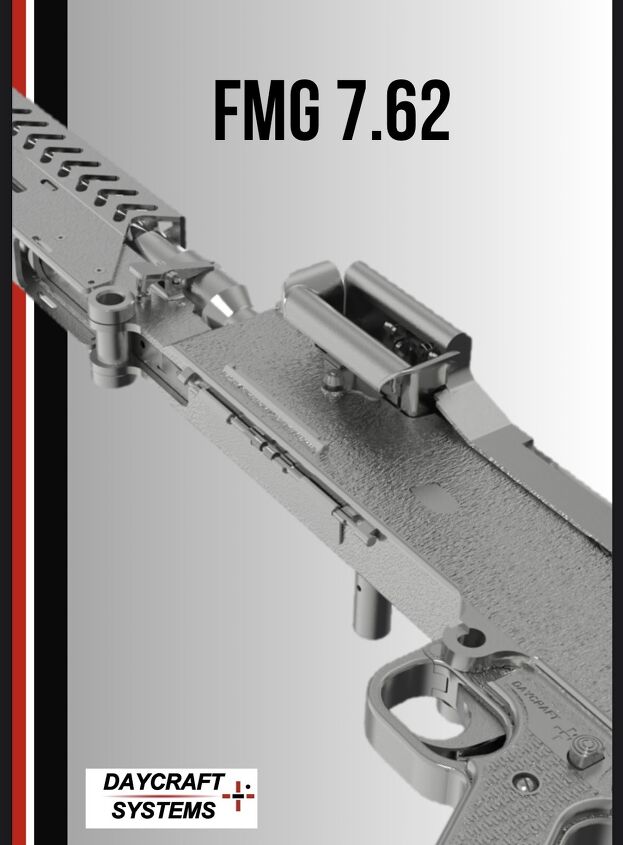
Weighing 16.8 lbs, the Daycraft Systems FMG 7.62 is a lightweight version of the M240/MAG58 machine gun. The FMG 7.62 is a solution every gun team would love, a lightweight M240. It's pretty noticeable that the receiver looks a bit different because it is a one-piece receiver with steel reinforcements. This eliminates the need to rivet multiple plates, completely modernizing the system and simplifying manufacturing. Mechanically and in terms of disassembly, nothing changes compared to the M240/MAG58, and the barrels are completely interchangeable between the two models.
The FMG also allows different calibers in a conversion kit to a few other calibers, listed on their website: FMG 556, 300 Blackout FMG 300B, 6.5 Creedmoor FMG 65C, FMG 68G, and Daycraft FMG 338 Norma.
Interesting features are the M-LOK attachment points and the heat shield, which attaches to the handguard to eliminate direct heat transfer from the barrel or gas block, as on the M240. This doesn't add an extra step of removing the handguard to replace the barrel if you need to run a heat shield. An added hole in the receiver under the chamber reduces weight but primarily allows air to flow under the trunnion and chamber.
The weapon features a lightweight feed tray and cover. The fire control group is also lightened. The bipod is similar to or the same as the Barrett bipod. Still, compared to the standard bipod, this configuration allows the real estate on the bottom of the handguard to be used, and mounting other enablers if required.
The barrel weight is said to be comparable to the standard barrel, not to compromise barrel performance. The carrying handle is reversible, forward or rearward, depending on the end user's preference or to clear optics. The stock is a lightweight, collapsible stock assembly with a hydraulic buffer. The stock is also lower, allowing better cheek weld when using iron sights.
The Daycraft FMG 7.62 is 10 lbs lighter than the 27-lb M240 while maintaining the same minimum service life cycle of 50,000 rounds as the FN M240B. Lighter is better, especially when maneuvering the gun to different firing positions and general handling. The FMG 7.62 is reported not to need a soft mount compared to the 7.62x51 FN MK48, with a 25,000-round minimum service life, which is half the service life of the M240—modernized M240/MAG58 system, utilizing modern materials and precision machining approaches. Daycraft Systems has produced a lightweight 7.62mm machine gun with 20-35% weight reductions over alternative M240 variants.
The resulting improvements from this weight reduction are significant for the soldier, as it reduces the combat load and allows for easier handling and movement of the weapon, which is a huge win for the infantrymen who have to carry it.

This weight reduction was achieved by incorporating new material and manufacturing processes, specifically using a one-piece lightweight receiver, while retaining the standard operating system components.
Other stats from the product brochure linked in the sources: “Barrel Change: 100 rpm - 10 Mins | 200 rpm - 2 Mins, Maximum Range is 3,725m. Maximum effective range is 800 m (Bipod), 1,100 m (Tripod), 1,800 m (Suppression).” This is the same data as the M240B, sustained and rapid fire, and identical ranges.
Besides the FMG 7.62, and more interestingly, they have announced on their website that they are developing a .338NM machine gun.

Thoughts
I would be interested in testing FMG 762 because it offers a lighter-weight option while still meeting the minimum service life requirements of the standard M240B. Reducing the weapon's weight is important, but the weight of the ammunition is equally crucial. Using lightweight links or polymer ammunition, the infantry gun team would reduce the overall weight they have to carry or, more likely, allow them to carry more ammunition to support operations.
How do the longevity and durability of the FMG 762 compare to the M240/MAG? There have been cases where M240 and MAG models have significantly exceeded their advertised lifespan of 50,000 rounds, with some receivers lasting several million rounds. According to the US Army TM 9-1005-313-23&P and PS Magazine, common failure issues include weak buffers, receiver cracking, and cracks developing in the bolt guide rails during dry firing. Is the new FMG 762 capable of handling these challenges? I’m also interested in whether the Mean Rounds Between Stoppages (MRBS) or Mean Rounds Between Failures (MRBF) of the FMG 762 is comparable to, better, or worse than those of its predecessors.
In any case, testing the FMG 762 is worthwhile, and I hope to have the opportunity to evaluate the weapon for further data, which would contribute to a more detailed article. Overall, the weight savings alone make it an area worth exploring, especially since the parent system has proven effective in combat and is currently used by over 100 nations.

Sources:
- https://img1.wsimg.com/blobby/go/ae988d49-8795-485c-a2cb-5ea0672718ac/downloads/Daycraft%20FMG%207.62%20Brochure.pdf?ver=1713180980690
- https://daycraftsystems.com/daycraft-home
- https://www.trngcmd.marines.mil/Portals/207/Docs/TBS/B3M4178%20M240B%20Medium%20Machine%20Gun.pdf
- https://www.defense.gov/News/Contracts/Contract/Article/2737831/
- https://www.usaspending.gov/award/CONT_AWD_W15QKN21C0060_9700_-NONE-_-NONE-
- https://www.ascrad.army.mil/News/Article/3422593/m240-machine-gun-dry-firing-can-crack-the-receiver/
- US Army TM 9-1005-313-23&P
- https://ndia.dtic.mil/wp-content/uploads/2012/armaments/Wednesday14058burkhart.pdf

Lynndon Schooler is an open-source weapons intelligence professional with a background as an infantryman in the US Army. His experience includes working as a gunsmith and production manager in firearm manufacturing, as well as serving as an armorer, consultant, and instructor in nonstandard weapons. His articles have been published in Small Arms Review and the Small Arms Defence Journal. https://www.instagram.com/lynndons
More by Lynndon Schooler


![7.62mm Lightweight Machine Gun Unveiled by Knight's Armament Company [AUSA 2017]](https://cdn-fastly.thefirearmblog.com/media/2024/05/16/14222350/7-62mm-lightweight-machine-gun-unveiled-by-knight-s-armament-company-ausa-2017.jpg?size=350x220)


![[SHOT 2026] New Diamondback Firearms Ventra Suppressor Lineup](https://cdn-fastly.thefirearmblog.com/media/2026/01/20/02411/post.jpg?size=350x220)


![[SHOT 2026] Ruger Goes All-In On *Almost* Everything](https://cdn-fastly.thefirearmblog.com/media/2026/01/22/01521/post.jpg?size=350x220)

![[SHOT 2026] Drone Round Defense Multi-Projectile Anti-Drone Ammo](https://cdn-fastly.thefirearmblog.com/media/2026/01/27/21091/post.jpg?size=350x220)
![[SHOT 2026] The Cat's Out of the Bag: Beretta's New B22 Jaguar](https://cdn-fastly.thefirearmblog.com/media/2026/01/19/00591/post.jpg?size=350x220)
Comments
Join the conversation
If the company's claims are true, this GPMG is what the M240 series should have been all along.
The best way to reduce ammunition weight would be to swap the barrels to 6.5 Creedmoor which is a lighter round than the current 7.62x51. The 6.5 also performs better out to 1,000 meters and is in use with SOCOM now for snipers. Swapping back to 7.62x51 requires only a barrel swap. Rather than a polymer case, the Shell Technologies cases offer lighter weight and higher operating pressures than brass cases and they are durable and can be loaded similar to tradition brass cased ammunition.