Weekly DTIC: An Evaluation of The Winchester LMR


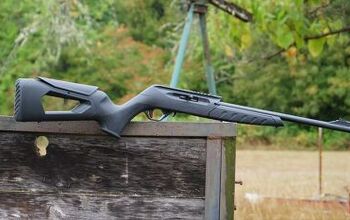
Forgotten Weapons, an excellent website for the gun history buff, posted a copy of the manual for the Winchester Light Military Rifle back in 2011. The LMR (shown in the title image) is an obscure competitor to the early AR-15, against which it competed several times in the late 1950s. A relative of the highly successful M1 Carbine, the LMR was based on the Carbine’s immediate predecessor, the Williams Carbine, which itself had designed as an alternative to the M1 Carbine.

The LMR was not unlike the later Ruger Mini-14 in design, though it differed in being far lighter (even lighter – at 4.9 pounds unloaded – than its cousin the M1 Carbine), and in being chambered for an oddball .22 caliber cartridge, the .224 caliber E2. This round had a very short, stubby 53 gr bullet fired at 3,300 ft/s muzzle velocity, but was otherwise compatible with .223 Remington (at the time .222 Remington Special) chambered weapons. For most tests before 1960, in fact, AR-15s were tested using the E2 cartridge for logistics reasons. It has been speculated that it was the short, easily stabilized bullet of the .224″ cartridge that masked the poor ability of the early AR-15’s 1-in-14″ twist barrel to stabilize the longer 55gr bullet of .223 ammunition in cold weather, until January of 1963, when the 1-in-12″ twist barrels were introduced.

The LMR was extensively tested, and found inferior to the AR-15 rifle in most respects. One such evaluation is the subject for today’s article; it was conducted in July of 1958 at Fort Benning, Georgia. Contained in the document are several interesting results, such as the Winchester LMR proving more accurate in semiautomatic and fully automatic fire both than the M14, but also somewhat less reliable and less resistant to the environment.
In the end, two major problems spelled the end of the Winchester rifle: In their mad rush for lighter weight, the Winchester engineers created a rifle that was fragile to handle (in particular, the handguard and trigger housing are cited as breaking with hard use), and the stubby bullet of the .224″ cartridge produced undesirable velocity loss over distance. The AR-15, which proved more reliable, less susceptible to parts breakage, and which possessed superior ballistics, continued in its development, eventually becoming the standard issue M16 rifle of the US Army.
Nathaniel is a history enthusiast and firearms hobbyist whose primary interest lies in military small arms technological developments beginning with the smokeless powder era. He can be reached via email at nathaniel.f@staff.thefirearmblog.com.
More by Nathaniel F

![[SHOT 2026] Kinetic Blossom MAGPIE Handheld Electric Speed Loader](https://cdn-fastly.thefirearmblog.com/media/2026/02/13/11021/post.jpg?size=350x220)





![[SHOT 2026] Spectre Builds Their First Bolt-Action Chassis For CZ 457](https://cdn-fastly.thefirearmblog.com/media/2026/01/22/17431/post.jpg?size=350x220)
![[SHOT 2026] Keeping Cool With Ambient Arms Suppressors](https://cdn-fastly.thefirearmblog.com/media/2026/01/20/00562/post.jpg?size=350x220)

![[SHOT 2026] Olympus Arms Launch New Carbine & New Ammunition](https://cdn-fastly.thefirearmblog.com/media/2026/01/26/23431/post.jpg?size=350x220)
![[SHOT 2026] GLOCK GEN 6 COA First Look](https://cdn-fastly.thefirearmblog.com/media/2026/01/21/14001/post.jpg?size=350x220)


Comments
Join the conversation
It's a Winchester AND it has an anachronistic wooden stock? I'm in love!
Trivia: Note that the test's Project Officer, Hebert P. Underwood, later ended up on the Project Manager Rifles' staff and was sent to Vietnam in late 1966 to investigate the reports of malfunctioning XM16E1.