The XM148 - America’s Early Under-Barrel Grenade Launchers in Vietnam
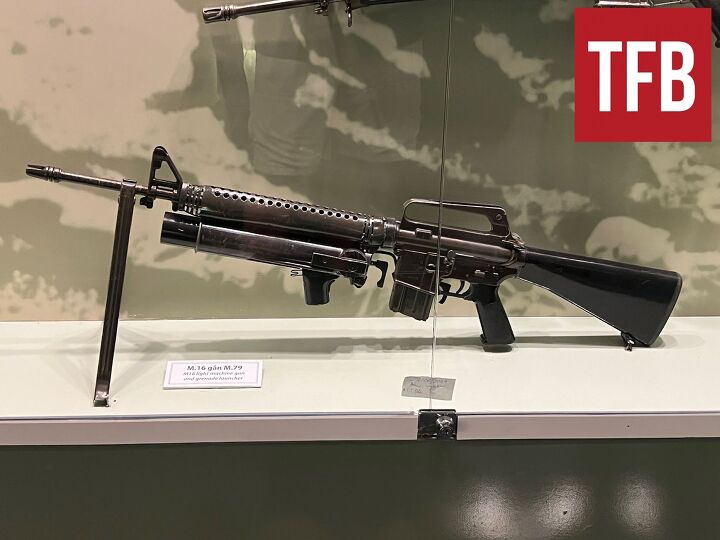
During the Vietnam War, the U.S. military quickly realized that traditional small arms didn’t always cut it in the dense jungle and close-quarters fighting they were up against. The M16 rifle was light, modern, and capable, but the infantry needed more firepower without the burden of carrying a separate grenade launcher. That’s where the XM148 came in, a weapon that tried to bridge the gap between rifle and grenade launcher, but ultimately fell a bit short.
The XM148 was one of America’s first serious attempts to attach a grenade launcher directly beneath the barrel of a standard infantry rifle. Developed by Colt in the mid-1960s, the launcher was designed to be paired with the then-new M16 assault rifle. In theory, it would give soldiers the ability to launch 40mm grenades without having to lug around a standalone weapon like the M79 “Thumper,” which was beloved by troops for its power but criticized for its single-shot limitation and inability to be paired with a rifle. Roughly 28,000 XM148 launchers were made, starting in 1966.
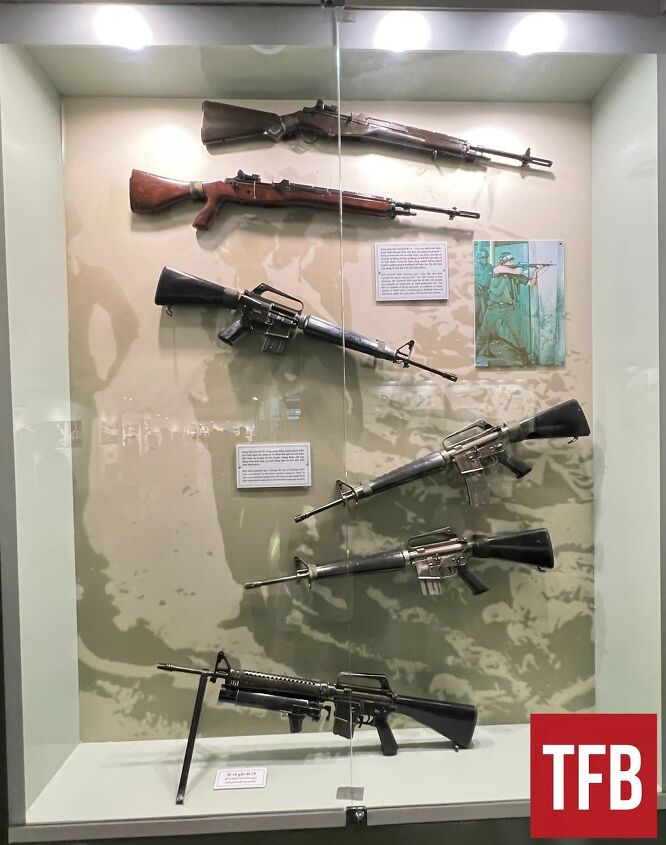
At a glance, the XM148 looked sleek and relatively well-integrated. It weighed about 3.5 pounds, had a 10.5-inch barrel, and fired the same 40x46mm low-velocity grenades as the M79. It was loaded with a break-open action like a shotgun and was manually cocked by a lever on the rear. It even featured a basic sighting system attached to the launcher's side.
From the get-go, the XM148 suffered from design issues, making it less than ideal in combat. The launcher’s exposed trigger linkage was a particular problem. The designers tried to be clever by making the trigger accessible without the soldier needing to move their firing hand off the M16 grip. Unfortunately, the XM148 had a long external linkage bar running from the trigger on the grip to the launcher’s firing mechanism. This bar could be easily snagged by brush or gear in the jungle, sometimes causing accidental discharges, which is a pretty big problem when you’re talking about explosive ordnance.
In addition, reloading the XM148 was awkward. Unlike the M79, which broke open completely for easy loading and ejection of spent shells, the XM148’s barrel pivoted forward just enough to slide in a new round under the launcher. The pistol grip controlled the sliding barrel, opening the chamber at the bottom of the launcher. The weight to charge the weapon was excessive, roughly 30 pounds.
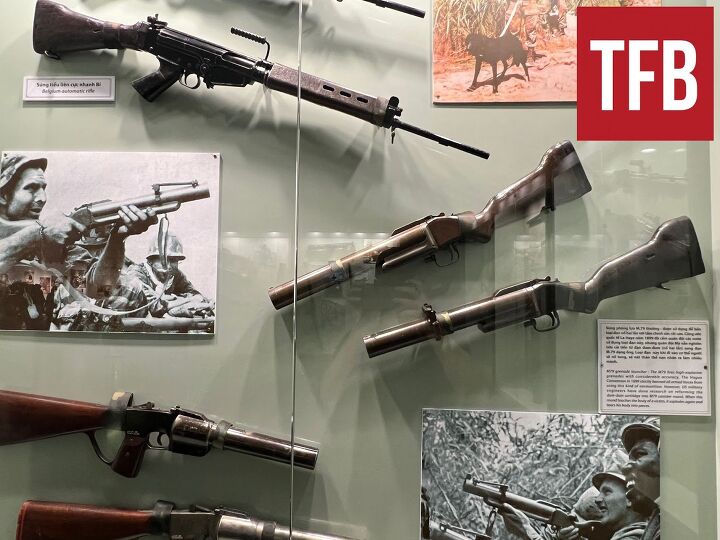
Despite all that, the XM148 was used in combat. It was fielded in relatively small numbers starting around 1966, with U.S. Army units and some Special Forces such as MACV-SOG and the Navy SEALs getting the first crack at it. Feedback was mixed, but the consensus was that while the idea of a rifle-mounted grenade launcher was sound, the execution left much to be desired.
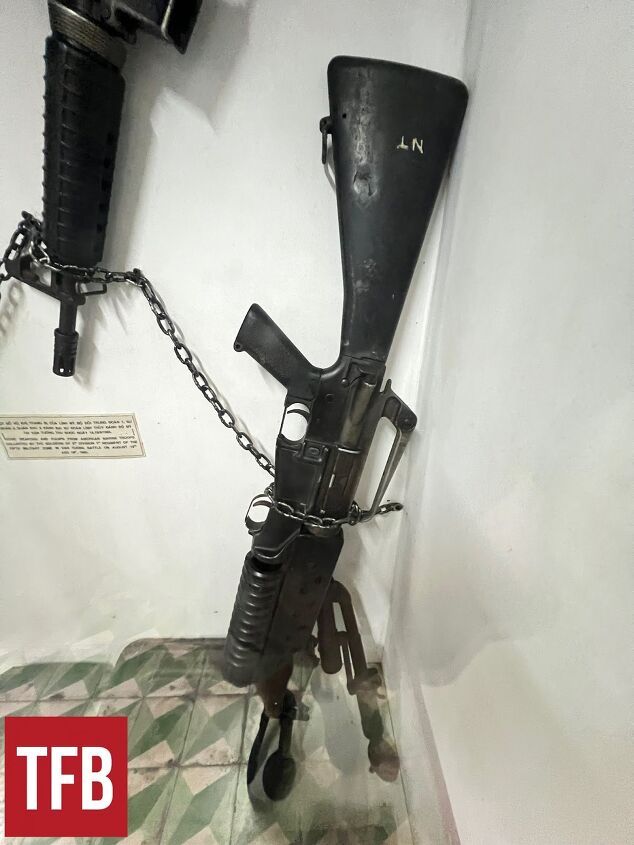
The launcher didn’t stick around for long. By 1967, the U.S. military had already started moving toward a better design, the M203. That launcher, developed by AAI Corporation, addressed many of the XM148’s shortcomings. It was safer, simpler, and more reliable. The M203 became the standard under-barrel grenade launcher for the M16 and its successors, and it remained in service for decades, even through conflicts in Iraq and Afghanistan.
In retrospect, the XM148 is a fascinating example of a “bridge” weapon, developed to meet an urgent need, but ultimately replaced by a better solution once there was time to refine the concept. It wasn’t a complete failure, but it was definitely a learning experience for military designers.

Collectors and military historians still take an interest in the XM148 today. Surviving units are relatively rare, and because they were never formally adopted on a large scale, they occupy an unusual space in the history of U.S. infantry weapons. They're often seen as a stepping stone that helped shape modern grenade launcher doctrine.
A 1992 Russian film, “To Survive” / “Red Mod,” features a captured US XM148 grenade launcher. This may have been captured during the Vietnam War and made its way to the Soviet Union for evaluation. It would be interesting to review the Soviet report on XM148.

In many ways, the XM148 mirrors the story of the Vietnam War itself: a bold but flawed attempt to apply modern American tech to a messy, complex battlefield. It shows how innovation in wartime can be fast and reactive, but not always refined or successful on the first try. Unfortunately, this rapid fielding of solutions didn’t see any light machine guns for the Big Army during the war.
Still, you have to give credit where it’s due. The XM148 paved the way for the much more successful M203 and proved that mounting a grenade launcher directly under a rifle was feasible and effective once the kinks were worked out.
So while it might not have the fame of the M16 or the fondness that many soldiers had for the M79, the XM148 deserves a nod as the awkward but necessary middle child of America’s 40mm grenade launcher evolution.

Lynndon Schooler is an open-source weapons intelligence professional with a background as an infantryman in the US Army. His experience includes working as a gunsmith and production manager in firearm manufacturing, as well as serving as an armorer, consultant, and instructor in nonstandard weapons. His articles have been published in Small Arms Review and the Small Arms Defence Journal. https://www.instagram.com/lynndons
More by Lynndon Schooler






Comments
Join the conversation
The USAF got these in large numbers and i was last issued one in 1989.
A royal PITA as it would not accept the full range on 40m rounds, some illumination and signaling rounds being too long to fit.
The trigger was always snagging on stuff and it had inferior range and accuracy compared to the M79 due to the shorter bbl and lousy sights, issues shared with the M203.
The M79 could get another 25-30 yards useful range and was much more accurate.
Hill AFB with the 729TCS.
BTW I was able to finagle a swap for M79 which were also supposed to be out of the system by then,