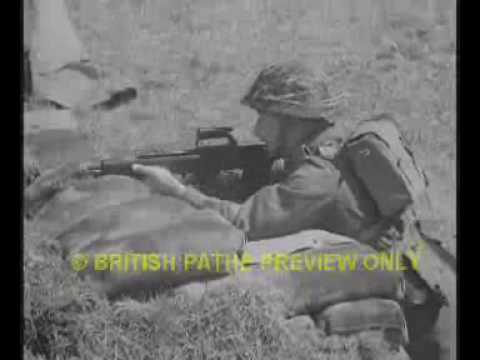
Enfield EM-2 assault rifle video

0203

The Enfield EM-2 rifle, otherwise known Rifle No. 9, remains the rifle I most want to fire, but know I am never going to have the chance. If it had been adopted who knows how modern rifle cartridges would have evolved. This video shows the EM-2 being fired …

At least one reader of the blog has actually fired a EM-2. I am so jealous!

[ Many thanks to Greg for leaving a link in the comments. ]


Steve Johnson

Founder and Dictator-In-Chief of TFB. A passionate gun owner, a shooting enthusiast and totally tacti-uncool. Favorite first date location: any gun range. Steve can be contacted here.


  • Brad

    Heck, you can reach back even farther than the EM-2 cartridge. I think an ideal cartridge for squad level small arms is the .250 Savage with a 100 grain bullet.

  • Aurelien

    Well, it’s definitely right up there with the other dead awesome projects like the german G11, the high-velocity Steyr and the original FN FALs in alternative calibers.

  • SpudGun

    Good gravy! It’s like watching footage from an alternate timeline in another dimension. As you’ve quite rightly put – ‘ If it had been adopted who knows how modern rifle cartridges would have evolved.’

    We’d probably have laser guns now.

  • James

    Interestingly this gun has just been included in Call of Duty: Black ops. It’s called the Enfield in that and while I don’t recall it in single player it’s an early assault rifle in Multi-player.

  • Robert

    I like the machine gunners lack of ear protection.

  • Chris

    I dig these vintage weapon film promotions.

    As far as exotics go, I’d love to try out the Hk G11. Or for something older, the FG42.

  • Patrick Bateman

    That, and the StG 44.

  • Vitor

    The 7×43 cartridge was really ahead of it’s time indeed. It generated about 2600 joules and it had a quite decent mass (140 grains) in a slender shape that would make it reach quite futher.

  • Jim

    Why do I feel like I’m watching a film edited to look sci-fi? How was this rifle not adopted at the time?

  • Tahoe

    I agree, the EM-2 was a missed opportunity. The 7.62/5.56 saga was definitely one of the US military’s siller mistakes, and one can only imagine what we’d be using if that hadn’t started.

  • JonMac

    Never say never. They are out there.

  • R N

    cant imagine how guns today would look iff that had been adopted

  • Lance

    The L1A1 was alot better than the EM2 by a long shot.

  • John Jackson

    When you consider that it was tested in 1950 (years before the AR), it was light years ahead of its time – and killed by the USA’s insistence on NATO adopting the 7.62. Damn shame.

  • Rob

    Its funny how they make a big deal of select fire back then.

  • Emperor Fabulous

    I wonder why nobody has tried to make a civilian legal semiauto version of the EM-2.

  • http://www.milgeek.co.uk Milgeek

    The L1A1 was better than the EM2 by a long shot? Well aside for the – presumably – unintentional pun I think you have to say that you must be joking!

    I remember using the L1A1 SLR (“Stupidly Long Rifle”) and it was a beautiful rifle, but hardly practical for anywhere except the open plains of Germany! The people I have spoke to who had to use the SLR in Ulster had a very different view of it.

    Had we adopted the EM2 then I have no doubt we would STILL be using it now, in updated form with RIS and improved optics. It would have been one of the great classic battle rifles. AND we wouldn’t have had to be adding DMRs to our inventory in Afgnaistan because the 5.56mm SA80 just can’t cut the mustard!

  • Alex Bakke

    First time commenter, hello everyone. Introductions!

    I’m a student from the UK; I’m not a soldier, I’ve only fired .22 LEs and L98A1s converted to fire .22 [L98A1 - Cadet version of L85A1].

    That being said, I read a *lot* around the subject of firearms, so when talking about them I mostly regurgitate facts.

    Anyway.

    __

    Lance – Why was the L1A1 better than the EM2?

    • http://www.thefirearmblog.com Steve

      Alex, welcome to the blog!

  • Victor Ward

    Sort of looks like the SA80 in my view

  • charles222

    As for L1A1 being better than EM2…yes, it was, simply by virtue of the issues inherent to all bullpup designs, namely delicate trigger mechanism, awkwardness in reloading, and being completely unsuited to non-strong-side firing.

    As for the 7.62 vs. 5.56 debate-I’d recommend a new phase to that, where we all criticize the craptastic concept of FMJ rounds in general. On my last deployment I saw an Iraqi civilian attempting to run a roadblock take a 7.62mm NATO round through the neck from about 75 yards away. The bullet went into soft tissue and cleanly exited on approximately the same angle (just missing his jugular and windpipe/trachea); after some application of combat gauze and medical tape he was fine and he able to drive his car away under his own power.

    ANY round with a full metal jacket is subpar, frankly. It’s pathetically primitive bullet technology that’s obsolete in the face of technology like the Mk318/316 and Mk77.

  • R.A.W.

    Found that report:

    http://www.dtic.mil/cgi-bin/GetTRDoc?AD=AD896858&Location=U2&doc=GetTRDoc.pdf

    For those of you on older computers, you may wish to download the .pdf so you don’t have to read it in a browser. The file is enormous.

  • Aurelien

    Charles222 : the FMJ rounds were developed to shoot russians wearing body armor near Fulda, Germany from 300 meters. Not to shoot some afghan guy wearing a robe as protection. Thats where the problem is.

    The issue of the L1A1 being “better” than the EM-2 is BS, simply because, had the US not jammed the .308 down NATOs throat, the FN FAL and variants and the CETME rifle (and therefor the G3 line) would have been chambered in .280 brit or 7.92mm Kurz as intended. So they could have had L1A1 SLR in .280″ had the EM-2 not been good enough.

    The problem is with the US Army who wanted THEIR round to be selected, because as the European armys were moving forward to the assault rifle concept developed by the Germans with the STG-44 with intermediate power ammo, the US Army stayed with the battle rifle concept using a full-power rifle cartridge.

    The adoption of the .308″ round suited only the US, and forced European manufacturers to re-work every rifle and MG design.

  • charles222

    That’s got nothing to do with the L1A1 as a weapon design. Hell, the early versions of the FAL were chambered in 7.92 Kurz, as you mentioned. The bottom line is that the EM2 suffered from all the same issues that have never been fully resolved with bullpups and was an inferior design to begin with to practically any other rifle of it’s time.

    I mean, seriously, shouting “THE EM2 IS BETTAR!” because of something like caliber selection (with a round that could have gone in the L1A1 anyway and not suffered from bullpup design shortcomings) is just retarded.

  • Brad

    As I recall, the EM-2 came dead last in competitive testing. Whether this was a failure of the bullpup configuration or something specific to the EM-2 I do not know, but it did fail. The FAL was not the first choice of either the British or the Americans (for obvious reasons) yet stood out in the testing and the British were probably wise to select it over the EM-2.

    That history is NOT a defense of the 7.62 caliber selected. Yes that caliber was rammed down the British throat by America, and yes the smaller British cartridge was a better choice for a selective fire type assault rifle. But that is a separate issue from the virtue of the EM-2.

  • chris vankeeffe

    I too had the great experience of firing the EM2. Roughly twenty five years ago, thanks to Blake Edwards (who wrote the definitive work on the FN and edited the EM2 concept and Design book) I was allowed to fondle and fire this
    truly innovative weapon. This particular model was the 7×51 compromise.
    I have to say that it handled flawlessly. It was ergonomically perfect.
    As for accuracy, I did have a lot of trouble adjusting to
    the optical sight, which had ranging reticules that I found were overcomplicated and confusing. Consequently my marksmanship suffered. However, when I switched to iron sights I was consistently getting I moa.
    On automatic there was very little muzzle rise or noticeable recoil as I remember. And most importantly, there was no slackness in the trigger. It broke crisp and clean every time!
    The magazines were also well made and had an ingenious stripper clip built into them that made loading very easy. It was a day on the range I will always remember. One can only wonder what that gun could have done had it been adopted.

  • chris vankeeffe

    correction!correction!correction!

    I am getting senile in my old age.
    The author of the FN volumes is of course R.Blake Stevens,
    not Blake Edwards, the director of the Pink Panther movies.
    For the full and sad story of the EM2, I recommend “EM2 Concept and design
    a rifle ahead of its time”by Thomas Dugelby, available at Collector Grade Publications

  • http://www.quarry.nildram.co.uk/ Tony Williams

    Being the member who has recently fired an EM-2 (albeit only a couple of rounds semi-auto; shooting ammo is getting short and shootable guns even more so) I can confirm that the recoil feels quite soft and I don’t doubt contemporary reports that the gun was acceptably controllable in burst fire. It is well-balanced to handle, and I was impressed by how slim and solid-feeling it is compared with modern guns. The sights were fine and I simply didn’t notice the trigger – it just worked.

    To understand the concept you have to bear in mind that as a result of WW2 battle experience, the UK (and the USA) were very keen to get rid of the plethora of different small-arms in different calibres they had acquired (this remind you of today?) and go to one, general-purpose, selective-fire rifle. So the EM-2 had to replace both the Lee Enfield .303 rifle and the 9mm Sten SMG. That meant that the ammo had to match the long-range ballistics of the .303 but also generate much less recoil to make it controllable in burst fire. The 7×43 did this, by virtue of a heavy, aerodynamic bullet at medium velocity. It also meant that the gun was given a bullpup layout as the only way to combine a long barrel for long-range work with a short gun for urban fighting (still true today). By all accounts, it worked very well, and was officially adopted for the British Army – for a few months, until US political pressure led to cancellation. Even the US Army’s own testers at Fort Benning recommended the 7×43 as a better basis for development than the new .30 cal (which became the 7.62×51 NATO), but they were overruled.

    In contrast, the key US Army individuals involved with their new “Light Rifle” project insisted on a .30 cal cartridge, with which it is impossible to combine a good long-range performance with recoil light enough for controllability. Which is also still true today (I’ve fired a SCAR-H and the recoil is far too sharp for auto fire). So the M14, which was originally supposed to replace the M1 Garand, M2 Carbine, BAR and M3 SMG, ended up only replacing the M1 Garand, and the FN FAL chosen by the British only replaced the Lee Enfield; Sterling SMGs remained in service alongside them until both were replaced by SA80.

    The 7mm EM-2 was definitely one of the big missed opportunities in small arms. As a result of its cancellation, the West lost the general-purpose rifle concept and has since been scrambling around acquiring different weapons to try to meet combat needs, desperately trying to boost the performance of the inadequate 5.56mm with new loadings, and getting new 7.62mm guns which are still too heavy and kick too hard. Sad.

    The 7×43, in a modern loading with a lighter and more streamlined bullet, would still be better than either round we have today. However, the same could be said of some other rounds in the 6.5-7mm bracket, which combine aerodynamic bullets for good long-range performance with moderate velocities to keep down ammo weight and recoil. The bottom end (in terms of size and power) for a general-purpose round would probably be represented by the 6.5mm Grendel.

    I know that bullpups are unpopular in the USA, which seems bizarre to me since there is huge pressure to get the guns as short as possible (hence the M4 replacing the M16) while at the same time trying to rectify the problems of the 5.56mm ammo (which needs all the help it can get from a long barrel). A bullpup gives you an eight inch advantage; that is, you can have a gun eight inches shorter for the same barrel length, or an eight inch longer barrel in the same length gun. That is a BIG advantage, and especially if you want to adopt one general-purpose round in the medium-powered 6.5-7mm class. All of the issues with legacy bullpups can be addressed in a new design, as I discuss in this article: http://www.quarry.nildram.co.uk/bullpups.htm

  • Aurelien

    I think the main problem people have with bullpup designs is the fact that they are mostly closed systems. The FAMAS, the L85, the AUG… They were designed to use only proprietary attachments, and getting them to accept non-proprietary accessories is time consuming and often bulky.

    To take the example of the FAMAS, it’s a good enough rifle (as one of my friends said, a “peace-time rifle”, designed to withstand staying loaded for long periods of time and being carried around), but there were no scope or light attachments built for it. Everything needs extensive work on the body of the rifle to be fitted.

  • Rusty Ray

    A point or two to add to the excellent post by Mr Williams, above.

    What is being forgotten here is the question of what weapons were being replaced by the EM-2. The bullpup design gives with one hand, and takes with the other. Every advantage the design gives is offset by a distinct disadvantage. This is a regular problem with all weapons, but where it falls short with the bullpup is the inability to fire the weapon from the left shoulder.

    But the EM-2 was replacing a bolt action rifle. Lee Enfeilds always were a problem to fire left handed. So the idea (same as today) was that south-paws would be trained to shoot left handed. In this case, swapping to the EM-2 over the LE was a definite advantage, and the claim the inability to fire it from the left shoulder is a modern problem.

    Next, a little thought for ya’ll. If the .280 British was a missed oportunity then the planned replacement for it, the 4.85mm round, was (ahem) a bullet well dodged, in my humble opinion.

    Cheers – Rusty

  • Madeleine Goddard

    I handled the EM-2 recently at a UK defence exhibition and it felt absolutely correct in the ergonomic sense, provided you were right handed. I’m ambidextrous so it was easy to try from the left shoulder and I think with a cartridge deflector that might have worked successfully. The rifle is longer than the SA-80 so the ejection port is not quite so close to the face. Where SA-80 is squat and bulky, the EM-2 is narrow and I think lighter and much better balanced. It would certainly have been suitable for women soldiers and smaller ethnic groups like the Gurhkas.

    EM-2 was extremely well made, perhaps too much a craftsman’s weapon for modern production standards, but clearly built with the WW2 experience in mind. Contrary to comments above I rather liked the sighting system, although it was non-magnifying. NATO could do a lot worse than look at a modernized version of the 7 mm round before its stars its next rifle competition. Some enterprising US arms company ought to consider buying the rights to EM-2 from BAE – I am sure an ‘EM-3′ would sell well to the civilian and police market and might even pick up military orders.

  • subase

    That’s why people don’t like bullpups, they’re not smart enough.

  • http://www.quarry.nildram.co.uk/ Tony Williams

    Aurelian – your criticisms of existing bullpup guns are valid, but on the specific issue of proprietory attachments less so than they were, as the latest versions of the Steyr AUG (the A3) and the L85A2 now have Picatinny rails all over them.

    However, I am mainly concerned with the design potential, since I don’t think that any bullpups yet address the problems in full. The IWI Tavor comes closest as the controls copy those of the AR-15 family; the only drawbacks are that converting between right and left-hand use takes a couple of minutes, and the stock length isn’t adjustable (although no-one but the US Army seems to think that this matters). However, my article linked to above suggests several ways of tackling these issues – including a variable length of pull.

    Ray – I agree with you about the British 4.85mm cartridge. It was not a clean-sheet design; the starting point was an assumption that the US 5.56×45 would probably win the NATO contest for a new round, so the British proposal was based on the 5.56mm case so that the new SA80 could easily be converted to that calibre. The reason for the reduction in calibre (actually to 5mm) was to get a long aerodynamic bullet for the best possible long-range performance for machine-gun use, and in that it apparently succeeded, with a significantly better trajectory and hit probability than 5.56mm. However, while I have no data on the terminal effectiveness, I have serious doubts!

    Madeleine – the EM-2 was in competition with the EM-1, also a bullpup but with a different mechanism and made using stampings and pressings. The EM-2 was chosen largely because its more traditional method of construction was better suited to the capabilities of British industry at that time.

  • Greg

    Wow! I didn’t know the footage and comments of a week ago were used to start a new thread. Good conversation.
    Mr. Williams, I have read a few of your articles on assault rifles and their cartridges and have enjoyed them. Tell me, or anyone else who has some info, would the 7×43 done well in the Bren or in a GPMG (the designed Taden or FN MAG)? If so, that seems to be the real lost opportunity. We could have a manageable assault/auto rifle that could knock a man down, and not have to have 2 major calibers issued to each platoon or section.
    Greg

  • Greg

    Madelaine, I would love an EM-3…I have seen some folks photo shop EM-2′s to show new metals and plastic parts.
    Greg

  • http://www.quarry.nildram.co.uk/ Tony Williams

    Greg, the 7×43 pretty much matched the ballistics of the old .303 that went through both World Wars without anyone complaining much about it, and in its last (Mk VIII) Vickers MG version it reached to over 4,000 yards.

    One of the big advantages of a long-range intermediate in the 6.5-7mm class is that it could replace both 5.56mm and 7.62mm, thereby halving the number of different weapon types to procure, support and train for.

  • Greg

    That was my thinking. Thanks Tony. To bad we cannot turn back the hands of time.

  • chrisvankeeffe

    Madelaine .
    The EM3 concept is a great idea.
    Is there anyone out there who could instigate a feasibility study to see how much it would cost to produce the gun with CNC machinery and modern materials?
    Tony Williams…any idea’s?

  • bob

    awesome !!!!!!!!!!!!!!!!!!!!!!!!!!!

  • Greg

    Of course, the question would also be which round. 6.8×43 SPC anyone?

  • http://www.quarry.nildram.co.uk/ Tony Williams

    Greg, the 6.8×43 would be a great improvement over the 5.56mm, extending the effective range from c.300m to c.500m, but it can’t match the 7.62mm which reaches to over 800m. So you’d still need two calibres to cover the small-arms combat ranges currently experienced in Afghanistan (up to 900m). A cartridge like the 6.5mm Grendel or the 7×43 can deliver just as much energy out to 1000m as the 7.62mm M80 ball, so could stand alone.

    Chris, gun design is not something I know much about, beyond the general principles and rough ideas stage, but I think we could do better than the EM-2 now, in particular in meeting the usual criticisms of bullpups, as I spell out here: http://www.quarry.nildram.co.uk/bullpups.htm

  • Greg

    OK. So 6.8×43 is not really all that similiar to 7×43 in long range performance? I saw in one of your articles about upping 6.5, 6.8 and 7 to 45mm (similar to the Nato 5.56) cartridge for more propellant.
    Sorry to sound so elementary, but I ran across these sources and this blog really just as an interest in EM2 and the 7×43. My firearms knowledge outside of M16A2, M249, M60 and TOW ( I was a Rifle and Anti-Tank PL and XO in the late 80s-early 90′s) is very limited.
    Greg

  • Madeleine Goddard

    Tony, I would not suggest that EM-2 should be put back into production as a military rifle, but I do think there could be a market for a small specialist manufacturer to produce an EM-2+, as a facsimile weapon for collectors. This might perhaps incorporate minor improvements such as an enhanced sight, but would be aimed primarily at gun buffs who would like an iconic weapon for their collection. It could be limited to semi-auto fire to get round legal restrictions. I guess this would sell at least a few hundred around the world as a limited production model (just as pen and watch makers produce limited editions) and would in time become a very collectable and potentially valuable weapon. Of course those police forces that still use the M-1 carbine or Ruger Mini 14s etc as deliberately ‘non-military style’ rifles might also be interested.

  • http://www.quarry.nildram.co.uk/ Tony Williams

    Greg, the main problem with the 6.8×43 is that it can only take relatively short bullets to keep the overall length within that of the 5.56×45 so that it can be used in modified 5.56mm gun actions. These bullets (which are also rather light) retain their velocity better than 5.56mm M855 but worse than the 7.62mm, thereby limiting their maximum effective range. For a 6.5-7mm intermediate round to match the long-range performance of the 7.62mm ball, it needs a very aerodynamic bullet, which means quite long and fairly heavy. The 6.8 can’t offer this. My suggested optimum 6.8×45 has a case only a little longer than the 6.8×43, but the overall length is significantly greater to allow for longer bullets.

    Madeleine, I’m sure there would be a small market among collectors for a replica EM-2, just as there is for the replica Stg.44 WW2 assault rifle which is being offered (at a very high price) by a German manufacturer today.

  • Greg

    OK…So that was a problem with the 6.8×43 being developed as an upgunning so to speak for M16 family and other 5.56 weapons…got it.

  • chrisvankeeffe

    Hi Tony
    I have just read you excellent dissertation on the pro’s and con’s of bullpup design. Is there any footage of someone firing the TKB-022, as it appears to me that the extreme layout of this weapon would endanger the support hand?

  • http://www.quarry.nildram.co.uk/ Tony Williams

    Sorry Chris, the only illustrations and information I have on this gun come from Max Popenker’s excellent site here: http://world.guns.ru/assault/as94-e.htm

  • http://paterzplace.blogspot.com Don Meaker

    It is not true that bullpup rifles are impossible to fire from the left shoulder. There are versions which convert quickly to eject from which ever side the rifle man selects. The other alternative is to have a downward ejection path, or like the FN-2000 a brass ejection path to the front.

    Sure, US fought WWII with 12.7×99, 7.62×63, 7.62×33, 11.4×23

    Brits fought with 7.7x57R, 9×21, and occasional 12.7×99 lend lease Brownings and Boys antitank rifles @ 13.9×99)

    Germany fought with 7.92×57, 7.92×33, 9×21 and after being exposed to true HMGs, loudly lamented their lack of an appropriate heavy machine gun They did field 20mm cannon antiaircraft guns which had good surface to surface effect. They also fielded a 7.92×94 antitank rifle.

    Italy and Japan fielded 6.5×52 and 6.5×50 Ariska rounds, and regretted it, both trying to switch to larger calibers: 7.35×51 for Italy and 7.7×58 for Japan.

    USSR fielded 7.62X54R, 7.62×25 and 12.7×10⁹ machine guns and the 14.5×114 antitank rifle.

    Germany reduced their calibers to three, and regretted it. Italy and Japan went to a “Medium” round and regretted it. Trying to put all sorts of functions into a single caliber is a recipe for missing important functions.

    I figure a good long range infantry weapon is the 120mm mortar, and it should be used to supplement HMG fires in the long range battle.

  • http://www.quarry.nildram.co.uk/ Tony Williams

    Don, I don’t think anyone is talking about large-calibre support weapons here, nor pistol/PDW ammo – they’re in separate categories – but just the ammo for the standard assault rifle and LMG/GPMG which would routinely be carried by dismounted infantry.

    Most countries had just one of those for the two world wars; the .30’06 in the USA, the .303″ in the UK, the 7.92mm in Germany, although at the end of the war Germany was transitioning to two calibres with the introduction of the 7.92×33.

    The introduction of the 7.92×33 was a game-changer in that it demonstrated the tactical advantages of automatic fire from a standard rifle. The Soviets caught on straight away with the 7.62×39 AK, but it took NATO until 1980 to catch up with the 5.56×45. Until then, they managed with just the 7.62×51 which was heavy and recoiled too hard for auto rifle fire.

    However, these assault rifles were based on the assumption that small-arms combat would be almost all within 300 metres, as had traditionally been the case. The combat in Afghanistan demonstrated the folly of that assumption, since more than half of Taliban small-arms attacks take place in the 300-900m range. So 7.62mm guns are being rushed back into the hands of the front-line troops as fast as they can be.

    The result is we now have two calibres, 5.56mm which can only reach to about 300m and has dubious effectiveness and penetration even within that, and the 7.62mm which is very heavy for man-packed MG belts and kicks too hard in rifles to be suitable for CQB weapons.

    It is entirely possible to come up with ammo which can reach out as far as 7.62mm M80 while being lighter and recoiling a lot less, and which is also more effective than 5.56mm at any range. And adopting such a long-range intermediate in the 6.5-7mm class would mean only one calibre, so only one family of weapons rather than two, and no risk of a patrol being caught out with the wrong kind of weapon if the tactical circumstances change rapidly.

    You mention the Italian and Japanese switch from 6.5mm in the 1930s, but there are some interesting stories behind that. The Italian 6.5×52 was an old round, loaded with a heavy, round-nosed bullet fired at a low velocity. This bullet did not yaw on impact and only punched neat little holes from which most victims recovered quickly unless the bullet hit a vital organ. The Italians started to developed a modern loading with a lighter, pointed bullet but then realised that they had a problem because they had huge quantities of 6.5mm guns many of which had worn-out barrels. They didn’t have the money to replace the barrels so they decide to bore them out to a larger calibre instead, and what they came up with was the 7.35×52, which actually wouldn’t have been a bad assault rifle/LMG cartridge.

    The Japanese 6.5x50SR Type 38 was a different matter, as confirmed by US medical reports in WW2. The pointed bullet yawed rapidly on impact and often fragmented, causing severe wounds. US medics commented on the way in which victims often died from what appeared to be wounds in non-critical places. The reason why they introduced the 7.7mm calibre was simply to achieve greater effectiveness in the very long-range MG fire (i.e. 2,000+ metres) which was common practice at the time. This is proven by the fact that the Japanese Army was using the 7.7mm rounds in MGs for almost a decade before introducing it in rifles, which they probably did for reasons of ammunition commonality in wartime.

    Obviously, other things being equal, big bullets are more likely to inflict severe wounds than small ones, so a 6.5mm is going to be a lot more effective than a comparable 5.56mm of only half the bullet weight. In fact, if I had to choose one round of ammo to form the basis of a family of assault rifles and LMGs, I would choose the 6.5x50SR Type 38 over any other which actually saw significant combat. We can do even better now, in terms of a more modern design, but even as it was, I think the Type 38 was better than what we have now.

  • Aurelien

    Tony, from what i have heard about the latest combats in Afghanistan your analysis is right : troops (mostly SOF) are saying that they would like an effective long-range round without all the fuss of the .308 (recoil, weight…).
    The problem they seem to be facing is ending up ‘black’ pretty fast ammo-wise with the 7.62mm platforms. That is indeed one of the reasons the .308 rifles were phased out in the first place : the ammo is pretty heavy.
    So obviously going back to it is just bringing back the old problems and it’s a temporary fix.

    Plus, when you take the brits, they now need to train the soldiers on two totally different platforms : the L85 and an AR-10 clone. That has to cost time and money.

    Both 7.62 and 5.56 are outdated calibers, created to fight a war that never came.
    I wish the French army had the balls to go back to their old “screw the yanks” ways and used their own round like they did before going 5.56 in the late 70s.
    After all, before the yanks came around with the 308, the French Army was preparing an assault rifle chambered in a .30 Carbine derivative. That assault rifle became a few years later the CETME/G3 rifle.

  • chris

    standard issue optics back then was a revolutionary concept, it would seem. im not aware of any other western army at that time that would consider a scope for normal infantry use.