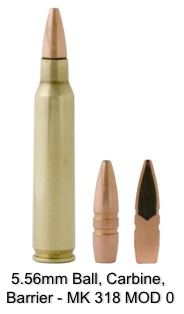
USMC adopt new 5.56mm MK318 MOD 0 ammunition
The Marine Times reports that the USMC have adopted the new SOST (Special Operations Science and Technology) 5.56mm ammunition ...
The open-tipped rounds until now have been available only to Special Operations Command troops. The first 200,000 5.56mm Special Operations Science and Technology rounds are already downrange with Marine Expeditionary Brigade-Afghanistan, said Brig. Gen. Michael Brogan, commander of Marine Corps Systems Command. Commonly known as “SOST” rounds, they were legally cleared for Marine use by the Pentagon in late January, according to Navy Department documents obtained by Marine Corps Times.
SOCom developed the new rounds for use with the Special Operations Force Combat Assault Rifle, or SCAR, which needed a more accurate bullet because its short barrel, at 13.8 inches, is less than an inch shorter than the M4 carbine’s. Using an open-tip match round design common with some sniper ammunition, SOST rounds are designed to be “barrier blind,” meaning they stay on target better than existing M855 rounds after penetrating windshields, car doors and other objects.
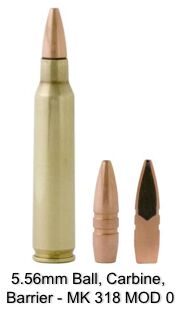
The full name and designation of the round is the MK 318 MOD 0 "Cartridge, Caliber 5.56mm Ball, Carbine, Barrier". The 62 grain bullet was designed by Federal / ATK. It features an open tip with lead at the front and a thick copper base. The lead is designed to defeat barriers and the copper to penetrate the barrier.
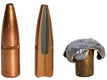
Many have said that it closely resembles the Federal Trophy Bonded Bearclaw bullet. Personally I think the similarities are superficial.
It should be noted that the bullet is open tip, not hollow point. Bartholomew Roberts explains ...
It isn't a hollow point. It is an Open-Tip Match round much like the M118LR. The jacket is drawn from the base (instead of the cheaper method of jacket drawn from the nose and an exposed lead base) to the tip of the bullet. The tiny little hole there is just a remnant from jacketing the bullet that way. It isn't designed for expansion or calculated to cause unnecessary suffering, so it doesn't violate the Hague conventions
The load has been optimized for ballistic performance and reduced muzzle flash from short barrels. From a 14" barrel is achieves 2925 fps.
A 7.62mm version of this round, the MK 319 MOD 0, has also been developed. It also has been optimized for short barrels (16") but also for reduced recoil. I have not heard of any adoption outside the special forces.
[ Many thanks to Matt Groom and Stu C. for the info. ]
UPDATE: The Marines are not dumping the standard M855 round, but will be the SOST alongside it in situations where the SOST will be more effective.
Yeah but…the USMC issue rifle is a 20 incher! Hmmm!
But the Hague convention doesn’t mention “designed for expansion” or “calculated to cause unneccessary suffering”, if I’m reading in the right place.
It states:
“The Contracting Parties agree to abstain from the use of bullets which expand or flatten easily in the human body, such as bullets with a hard envelope which does not entirely cover the core, or is pierced with incisions.”
http://avalon.law.yale.edu/19th_century/dec99-03.asp
Thus, nothing about intent or calculation, but rather what the bullets actually do.
Now, I don’t know whether these bullets expand or flatten easily in the human body or not. I’m sure it would be straightforward to test though.
Technically, I suspect the lead in the front is intended to move the center of mass further forward and make the projectile less susceptible to yaw.
Mike, yep, thats true.
Carl, well spotted. I doubt it would mushroom much more.
It’s about time a branch of the Military got a good 5.56 round that will turn someone’s head into a canoe!
USMC still issues the 20″ M16A4, but the MSOR (USMC component in SOCOM) issues the M4A1 with 14″, 11.5″ and 10.5″ barrels to their troops. The Mk318 being intended for use by the SOCOM, I would say the Marines using this new ammo are MSOR.
I appreciate the coverage on whether this violates the Hague or not.
Carl, you are correct, it will be less susceptible to yaw. It is intended to track better through light mediums like windshields and light metal. I believe the only reason the hague convention is mentioned is because a few years ago a camp commander in Iraq(can’t remember her rank or service) had all the snipers turn in their ammo. She thought it was a hollowpoint and designed to expand. She forced the snipers to use standard ball ammo ( which they could probably get away with for a little while, but why would you put 83 octane in a ferrari). There was a big hullaballoo about it i think she got relieved, I don’t know. I think thats the only reason they mention it at all, the ignorance of a few is the bane of the many.
Interesting. One of the few adoptions by the military that i actually agree with. Even with hollow points and open tipped ammunition, the underpowered 5.56mm round becomes effective, even from shorter barrels such as that from the M4. Hopefully the army follows the bandwagon.
I recall something about the Hague Convention only applying to formal uniformed combatants and the US not being a full signor but rather some other stipulation. I could be wrong.
Well I read the full article and It says the Corps will NOT get rid of M-855 ball anytime soon it was adopted for Marines who use the M-4 carbine since they have continued problums with heavy FMJ over penatrating opponets in close courters battles.
From the article Steve
“Brogan said the Corps has no plans to remove the M855 from the service’s inventory at this time. However, the service has determined it “does not meet USMC performance requirements” in an operational environment in which insurgents often lack personal body armor, but engage troops through “intermediate barriers” such as windshields and car doors at security checkpoints.”
So M-855 isnt going away but in none convetional wars might be suppamented by better law enforcement style ammo.
Also
“The original plan called for the SOST round to be used specifically within the M4 carbine, which has a 14½-inch barrel and is used by tens of thousands of Marines in military occupational specialties such as motor vehicle operator where the M16A4’s longer barrel can be cumbersome. Given its benefits, however, Marine officials decided also to adopt SOST for the M16A4, which has a 20-inch barrel and is used by most of the infantry.”
So I guess the main reason to go with hollow tiped ammo (its accually hollow point) is to acomadate short barrled carbines.
I also think that when the BIG MEDIA find out they’ll put a stop to this since the dogooder liberals will push that this is a hollow point. Just wait another media battle like last months Trijicon scandel.
Finaly, they are doing something about the 5.56×45. I wonder why they didn’t make it a heavier grain though?
I think the reduced recoil loads for the 7.62×51 are quite interesting. If you were to design a rifle designed to shoot these, could it be the same size as a rifle that was shooting an intermediate cartridge?
I would like to Know the minimum piercing level IIIA body armor vellocity of this round , compared to the SS109 . Is this an overall better round , or a better killer and soft barrier round? Would the SS109 be a better round for use against an enemy wearing body armor? Or this is a “magic” do everything better round?
I wonder what weapon they are using this in, if it is the 20 inch issue rifle it would be very interesting. Would I be correct in assuming that this round will give greater range (and hitting power?) at longer ranges? If so it would fit with the need for greater reach in Afghanistan.
Bob, yes, it does not apply to the US. Saying that, the rules it specifies are respected by the DoD.
Lance, well spotted. I will update the article.
Jay-Mac, already posted!
Ermac, they aim for 10% reduced recoil.
prodromos,
From experience at the range I would wager the round is not nearly as effective as SS109 and penetrating light armor ( Level III is still considred light)
SS109 was designed to defeat light armor and the current conflict does not play to its strengths at all.
For those wondering why a heavier round wasn’t chosen I would guess it is that the ballistics closely match the current M855 round so that range calibrations on optics did not need to be changed.
I think they stayed with 62 grains so they wouldnt have to swap out the thousands of scopes they already have for the weapons already issued. Supposedly this was intended for use in nothing but short barrels ( the SCAR-L’s being only 13.8in.) but it should be just as effective out of a 20 incher. The m855 is definitely here to stay as long as potential enemies issue body armor(although none come readily to mind). As far as the big media is concerned the USMC is pretty good about telling them to shove off.
And yes this is intended for Marine Special Operations Battalions, as far as I know, but they are very good at sharing the wealth.
“Technically, I suspect the lead in the front is intended to move the center of mass further forward and make the projectile less susceptible to yaw.“
Slowing the yaw cycle is the worst thing one could do WRT the wounding potential of the 5.56mm round, which is entirely dependent on a rapid yaw cycle and concomitant fragmentation for its lethality.
Hague convention more or less is a gentlemen agreement. The majority of countries that signed the treaty do not exist anymore. Two world wars took care of that. The US did not sign the treaty.
Rifle HP bullet will not expand unless it is design to expand. The cavity is too small for reliable expansion. HP bullet increase the accuracy of the rifle bullet. That is the main purpose.
Is there any relation between this and the M855 LFS mentioned here:
http://www.m4carbine.net/showthread.php?t=22379
jdun1911, yea “gentlemans agreement” is the best way to describe it.
But really, switching to hollowpoint would (I think) reduce effectiveness against barriers and bullet proof vests (and helmets). I doubt they would switch to them anyway.
I agree with Earl with this. This Mk 318 is for Afghan theater of operations only. In a war like Vietnam or Post 2003 Iraq and Afghanistan. When fighting insergent the use of more Law Enforcement rounds is better when your fighting enemys with small arms and normal Civilan vehicles as weapons much like SWAT team here going against gangs. I know in Iraq of some men getting to use left over M-193 ammo for use in Iraq and was preferd over M-855. Light bullets and HP have there place. However theres potental conflicts like war with Iran, Syria, Cuba and Chevez’s country (try to spell it, I cant), or North Korea or China, where there troops will be wearing level 3 or 4 body armor. Then the M-855 bal round will be far better than Mk318 or M-193 ammo.
I bet after knowing this and after some use or mk318s, rebels will get body armor and try to use it aginst us in combat.
I seem to recall reading that details remain vague on the Hague agreement and who agreed to what, etc., but that subsequent treaties were agreed to with stipulations that the affirming parties agreed to abide by earlier agreements that they did not sign (or something to that effect). I also recall reading something that led me to believe that the use of expanding bullets would not be limited to only uniformed soldiers.
Either way, it seems it would be a moot point with regards to these rounds. As the article said, it’s not a hollow point round. It looks like the match grade ammunition I’ve used. The tiny opening at the end is a byproduct of the (more expensive) process used to form the jacket. If the objective of this round is to better penetrate windshields and car doors, a soft-tip or hollow point bullet seems like it would be a poor choice anyway.
Hague conventions say flatten or expand, they didn’t say squat about fragmenting. He he.
“Slowing the yaw cycle is the worst thing one could do WRT the wounding potential of the 5.56mm round,”
But the idea with this round was to improve the ballistics *after* going through a barrier. Ie make sure it will fly straight after going through something like a windshield. At least that’s the impression I got.
I can assure you Steve that the rifle HP bullets will penetrate softbody armor (IIIA and below) or ballistic helmet without problems. Will it penetrate less then M855? Yes it will because the M855 bullets are steel core. It will maintain it shape better then lead core bullets. The M855 will not penetrate lvl III or above body armor.
On a side note there are some internet shops that advertised the M855 as AP which is incorrect at best or an outright lie at worst. More like outright lie, IMO.
jdun1911, I stand corrected.
I also dont think a HP bullet can penatrate level 3 armor unless the jacket is make of some tungston Steel. But that would ruin barrels.
No worries about using hollow points or open tip ammunition in Iraq and Afghanistan because of our enemy’s lack of the use of PPE (body armor and helmets). Even if the enemy acquired body armor, it is not dragon skin. It wouldn’t provide any surmountable advantage protecting its wearer against Mk318 (everybody knows that body armor can only take one shot before its protective abilities are compromised and the effect is cumulative for each shot taken).
Indeed, it would be safe to assume that larger armies like North Korea, Venezuela, and Iran would equip elite units with body armor, so this ammunition most likely will remain “afghan exclusive”.
Is this the same as the optimised “brown tip” ammo I’ve heard about?
Does anyone know what the powder load that federal loads for the MK318?
Just to clarify a bit about USMC weapons for Aurelien et al:
My armory is about 75-80% M4s, and we’re definitely not SOCOM-types.
The standard *rifle* in Marine Corps armories is the M-16A4 with AN/PVQ-31A (Trijicon TA-31) scope with a BDC for 20-inch barrels.
The standard carbine is the M4 with AN/PVQ-31B and a 16″bbl. This weapon is issued to all Staff NCOs and above (E-6 & up) as well as many infantrymen, vehicle crews, etc. for the entire Marine Corps – not just MSOBs. For example, each Assault Amphibian Battalion has gone to M4s as the standard for all ranks as of the past 2-3 years.
Destroyer: I’d be very surprised if this ammo stays in Afghanistan only. Aside from improved carbine accuracy, the “barrier blind” performance is a large part of why it was adopted – shooting through windshields (which we do a lot of) and not defeating body armor (which we do rarely).
I dont think so echo6delta
The fact is all other services use M-855 and the logistics of each ervice having there own round would be a major head ach for logistics and industry. Strange there still USMC units with M-16A2s and the Corps isnt dumping the A4 for a all M-4 service like the army. The carbine has its place for NCOs and vehicle crews but is not as good in open combat as a A4.
And no hollow point can out penatrate steel core ammo.
If any of you are thinking “Hey! I want an SBR Optimized load for the .223″:
(Max charge, work down 10% and go up 0.1gr at a time, COAL 2.260″, thanks to Marty ter Weeme for modeling this in QL for me)
77 grain SMK pill
19.0 IMR-4198 (max!)
Rem 7 1/2 BR primers
Rem .223 brass
Should be good for 2000 ft/sec from a 7.5″ barrel, ~90% burn
I have not chronied it, but I intend to sometime this spring.
I am not responsible, nor is Marty, if you blow your gun up with this. I have tested it in my Noveske Diplomat and my 16″ LWRC M6A2 w/o issue or signs of excessive pressure. It suppresses very well in the latter and has very little muzzle flash in the former. IMR-4198 is a little bit of a pain to work with in that it does not meter well through the powder measure.
Steve,
HP and OTM rifle rounds like Mk318 would not have a problem with soft body armor up to Lv IIIA. However, M855 can penetrate helmets and soft armor at longer ranges than lead core bullets including mk318. For example, “M855 will penetrate the US army steel helmet at 1100 meters”. http://www.remtek.com/arms/fn/minimi/
M855 is still a Lv3 threat but there are some types of lv3 armor that cannot stop M855. http://www.armoredmobility.com/products_sapi3.php
JDUN1911,
You are correct that M855 is not an AP round. M855 is more like a semi-AP or enhanced penetration round because it has a steel tip (partial steel core) and lead slug. M855 was originally designed to penetrate Soviet soft body armor at extended ranges when fired from the M249 SAW. True AP rounds either have a hardened steel core or a tungsten carbide core.
Dave, thanks for the info.
I am a US Marine corporal who just returened from Marjeh afghanistan and my Battalion was the first to be issued the new Barrier rounds and i must say as a marine and as an avid shooter in the civilian world that this new round is outstanding i used it extensively throught my tour with great accuracy and success.I used it in an M4 carbine with the 14.5 in barrel but almost all of my marines aside from our SAW gunners used it with success and that includes with the 20 in standard M16.I was one of the first marines to test it and it is much more accurate than the standard green tip.When you fire it, it is a much higher pitched sound and almost a ring to it.If anyone has any questions please fell free to ask me. thanks for the articles i was curious about the components of the round.