Space gun idea revived

300px_big_babylon_sections_at_fort_nelson-tfb

Last year I blogged about NASA’s incredibly powerful hybrid/air gun used for simulating impacts from meteor and space debris. Quicklaunch is taking the concept even further. PopSci reports on their proposed cannon which could be used to launch fuel, supplies and satellites into space.

The Quicklaunch cannon would float at sea at the equator. The proposed firing system works by burning natural gas inside a heat exchanger. The heat from the burning natural gas is used to heat hydrogen gas. The hydrogen gas expands quickly and pushes the projectile out of the barrel. Release valves prevent over pressure inside the barrel. There is a photo at the PopSci website.

The idea of launching objects into space from a cannon is not new. In the 1960s Canada and the United States attempted to develop a Space Gun as part of the High Altitude Research (HARP) Project. The most infamous attempt at building a Space Gun was Saddam Hussein’s Babylon Project which fortunately never came to fruition before the project was dismantled following the fist Gulf War.
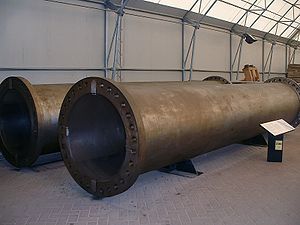
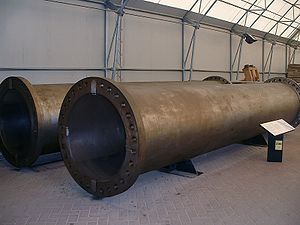
Barrel sections of Iraqi supergun Big Babylon at the Imperial War Museum

[ Many thanks to root for emailing me the link. ]


Steve Johnson

Founder and Dictator-In-Chief of TFB. A passionate gun owner, a shooting enthusiast and totally tacti-uncool. Favorite first date location: any gun range. Steve can be contacted here.


  • http://leisureguy.wordpress.com Leisureguy

    The idea dates back even further: a “space cannon” was used in Jules Verne’s 1865 novel From the Earth to the Moon.

    • http://www.thefirearmblog.com Steve

      Leisureguy, Jim and B Woodman: interesting!

  • http://ElCasaDePwnage.org Black

    Seems pretty cost-effective.

  • War Wolf

    Wasn’t that the Bull Super-Gun? I seem to recall that Mossad iced Gerald Bull on his way back to his apartment because Saddam expressed intentions to use the super-gun on Israel. I saw a movie about him once and they think he was put to bed with a .22 to the melon by Mossad.

  • Jim

    Not new? You’re not kidding. Jules Verne wrote about it in 1865. For anyone interested, it’s a tremendous book that definitely deserves a read. Very funny and interesting for anyone into guns, space or science in general.

    http://en.wikipedia.org/wiki/From_the_Earth_to_the_Moon

  • http://texan-in-wisconsin.blogspot.com Bob Davis

    Don’t forget the book “Bull’s Eye” about Gerald Bull, the assassinated inventor of the Super Gun. No story about launching into space via gun would be complete without that great book.

    http://www.amazon.com/o/ASIN/0812920090?tag=betteraddons-20

    Great website!

    TIW

  • Carl

    Here’s the Google tech talk on the Quicklaunch space gun:

  • jdun1911

    Saddam Hussein’s Babylon Project was a big Artillery cannon. Even if operational, at most it will fire 10 shots before it gets destroy because the cannon was a big unmovable target. It was also a big waste of money that could have spent on other needed project in the Iraqi military.

    With that said a big gun that launch supplies into space is durable as long as it isn’t developed by NASA or any government agencies.

  • B Woodman

    Yes. I was thinking of Saddam’s super cannon as I read this.
    I also remembered H G Well’s “From the Earth to the Moon”, where the space capsule was launched from a giant cannon/gun barrel (with gunpowder?) from what is now Cape Kennedy in Florida.

    But really, is this feasible, will this launch a payload into orbit? If so, then this may just reduce the work load on the shuttle.

  • Brad

    Thanx for the story! I’m a big space fan as well as a gun fan and I might have missed this story if you hadn’t pointed it out.

    The article seems to be missing important details however. The stated muzzle velocity is 13,000 mph which is way below orbital velocity, especially when taking into account air drag on the projectile. Typically such gun-launch space flight schemes include a rocket in the projectile for (at the very least) circularizing orbit, otherwise the projectile’s orbit will intersect the Earth! In this case the rocket probably also fills the gap between the space-gun’s muzzle velocity and minimum orbital velocity.

    Another factor the article does not mentions is recoil control. True enough a kilometer long gun space-gun will be massive indeed compared to it’s small projectile, but recoil will still disturb and possible damage that huge apparatus. Will compression of the water behind the gun serve to absorb the recoil, as a sort of watery mortar baseplate? Or will some recoil compensation, perhaps like a recoilless gun back-blast, be used?

    Also, how is the projectile loaded into proper position for firing? Will the massive gun tilt up to provide breech loading? Or will the space-gun be the worlds largest muzzle loader?

    In a way this project resembles off shore oil drilling, and I imagine the final product will very much resemble (or perhaps even use!) an off shore oil platform. Partnership with a company experienced in off shore oil drilling might be very useful to the success of the space-gun project, I’m guessing.

  • Vak

    Just read the article about the Big Babylon project. This really sounded like something a James Bond Villain would do.

  • RLG

    RE: the POPSCI launcher

    This concept is amazing. Now understand, I am neither a scientist nor a mathematician. Out of curiousity, I tried to extrapolate the specifics from the website in order to put them into terms that we shooters could appreciate.
    The site said: 1/2 ton payload propelled at 13,000 miles per hour muzzle velocity. According to my rudimentary calculations, that equates to a muzzle energy of 5,652,017,709.09 ft.lbs. OMFG!! That’s over 5 and a half BILLION ft. lbs. of muzzle energy .
    Putting it into perspective, let’s take common rifle cartridges. Many popular rifle rounds are rated at 3000 ft.lbs. of muzzle energy. Therefore, it is the equivalent of 1,884,005.903 (yes, 1.8 MILLION) of these rounds going off at the same time. I guess my 30-06 looks pretty wimpy now! It only holds 5!
    While I would love to touch off the “trigger” on this beast, I would want at least a 20 mile trip cord.

  • EzGoingKev

    I wonder if it will be piston or DI…….

  • Saif Katana

    “Rockets and Cannons not Politics”
    Just like father of the Nazi V2 and one of the most important minds behind US Space Program Werner von Braun was obsessed with the science & engineering regardless of the politics, so was Gerald Bull.

  • Mu

    All these gun concepts forget the 6-6-6 rule of space launch. Going mach 6 at 60,000 ft you got just 6% of the energy you need to get into orbit. Going any faster at lower altitudes won’t fly either, unless you like to produce a “from the ground-up” meteor; air friction will destroy your vessel before you get out of the atmosphere. Big problem for high speed interceptor missiles in missile-defense scenarios.

  • http://www.thorgdg.com Max R.

    thumbs up for space guns.

  • http://multigun.wordpress.com jbomultigun

    Gerald Bull’s single-mindedness of building superguns regardless of who his clients were got him killed, and with his death it seemed like his ideas ceased as well.

    Good to see someone’s trying to give this concept another go-around, as it seems to hold some promise for cheaply putting small payloads into orbit.

  • Whatever

    I would think it would be more efficient to heat water and make it change phase than heating Hydrogen. That is how they cold launch ICBMs, a small rocket motor is aimed at a pool of water which vaporizes that water with the ICBM being the piston in the cylinder.

    To make this work, the barrel would have to somehow close off parts after the projectile passed through it. It would have to try to keep the effective volume to a reasonable level rather than trying to expand the gas in all 1600 feet of that barrel. Or it would have to have multiple projectiles stacked one on top of another with the one at the top moving the fastest and each one below moving a bit slower. Only the top one would be able to make it into orbit.

  • Brad

    Whatever

    The reason hydrogen gas is used for space-gun propellant instead of water vapor is to improve muzzle velocity. Water vapor propellant would require nine times as much energy in the gun to achieve the same muzzle velocity as hydrogen.

    That’s why conventional tank cannon systems are limited to muzzle velocities of less than 2 km/second. Conventional gunpowder produces only so much energy compared to the molecular weight of the gas produced. No matter how light the cannon projectile is, that projectile cannot exceed the velocity of the gas speed limit. The space-gun breaks this speed limit by using available energy to heat a gas with the lightest possible molecular weight, hydrogen gas. That’s how the space-gun achieves the high muzzle velocity of more than 5.7 km/second.

    This same principal is how the NERVA nuclear rocket engine designs of the 1960′s acheived a higher exhaust velocity (and therefore rocket efficiency) than conventional liquid hydrogen burning rocket engines, such as the J-2 engines of the Saturn moon rockets. Even though the NERVA operated at a lower temperature, it’s lightweight hydrogen gas exhaust had double the exhaust velocity of the water vapor exhaust of the J-2 engine.

    That’s also why hydrogen burning engines like the J-2 or Space Shuttle Main Engines (SSME) dump excess hydrogen into the fuel mixture, so that not all the hydrogen is burned. The excess hydrogen reduces the average molecular weight of the exhaust gasses faster than it cools the exhaust (up to a point). That technique increases the exhaust velocity by 25%!

    It might seem weird, but that’s the way it works.

  • http://tech.groups.yahoo.com/group/nsecc/ Bert

    This might be a great way to launch the 40,000 km of cable required for a starter orbital ring space elevator system

    Cheers,
    Bert

    Space Gun
    http://www.popsci.com/technology/article/2010-01/cannon-shooting-supplies-space

    Paul Birch’s Orbital Ring/Space Elevator
    http://www.paulbirch.net/OrbitalRings-I.pdf

  • sully

    What we need is a viable way to transport nuclear waste off this rock, this may work but if it fails even if only once it becomes a huge and deadly artillery piece.

    Very cool nontheless.