
British adopting AR-10 style sharpshooter rifle

The British Army will be receiving AR-10 style rifles to help them engage the Taliban at distances beyond the range of their 5.56mm L85 rifles. The new L129A1 will be used in a designated marksmen role. Janes reports ...

In a USD2.5 million deal the UK Ministry of Defence (MoD) has contracted Law Enforcement International (LEI) to supply 440 LM7 semi-automatic rifles.

...

To be redesignated the L129A1, the gas-operated weapon carries a 20-round magazine, is 945 mm long and weighs 5 kg. It will be manufactured by Lewis Machine & Tool Company in the United States, with deliveries expected to begin in early 2010.

Features of the weapon include a single-piece upper receiver and free-floating, quick-change barrels available in 305 mm, 406 mm and 508 mm. It has four Picatinny rails with a 540 mm top rail for night vision, thermal and image intensifying optics. Stock options include fixed or retractable versions.
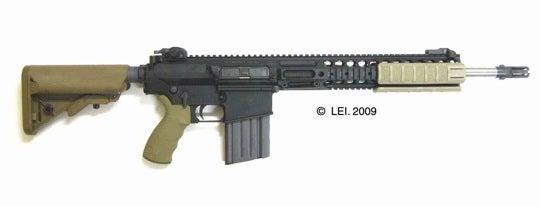
The L129A1

I wonder why they did not pull FALs out of storage as an interim solution as US forces have done with the M14.

[Hat Tip: Soldier Systems]

Related Posts

Steve Jan 3rd 2010 rifles Tags: 52 Comments


52 Responses to “British adopting AR-10 style sharpshooter rifle”

  1. Bradon 03 Jan 2010 at 9:41 pm link comment

    “I wonder why they did not pull FALs out of storage as an interim solution as US forces have done with the M14.”

    Why no FAL? My guess is the limitations of the FAL when it comes to mounting optic sight enhancements. The L129A1 one-piece upper receiver is a much more flexible and sturdy base for mounting optic devices.

  2. Milgeekon 03 Jan 2010 at 10:59 pm link comment

    As to why no updated L1A1 SLR in designated marksman mode – well Brad makes a very good point, but the US company DSA Arms have a good solution for that.

    In truth the Brit SLRs are probably in rather poor condition now generally – they were last used in anger by British Territorial units during the First Gulf War – having seen decades of very hard usage, culminating in the Falklands War.

    But also, the L1A1 (and I believe the FAL) was somewhat renown for poor reliability in sandy conditions…Such as Afghanistan.

    And besides this, there is something of a political touchiness in the UK about the quality of equipment used by our troops – it is likely that the British media would have made much of pulling ‘obsolete’ rifles out of mothballs because of a urgent need at the front. Much better to buy brand new kit.

    (I am not an expert or serving soldier, so this is all just supposition.)

  3. Colinon 04 Jan 2010 at 12:08 am link comment

    Limited stock would also be a problem, as most L1′s were either sold or scrapped…

    Also, as Milgeek said they had a very hard life – compared to the M14, which had a short service life before being replaced by the M16

  4. Milgeekon 04 Jan 2010 at 12:41 am link comment

    I guess if we play a bit of ‘what if?’ – here’s what a DMR-ized L1A1 *might* have looked like…

    > http://www.dsarms.com/SA58-SPR-Special-Purpose-Rifle-308-Cal—-SA58SPR/productinfo/SA58SPR/

    This is the American DSA Arms SA58 SPR. These are wonderful re-manfactured Belgian FN FALs made for the sporting and law enforcement market in the US.

    (Apologies – I just love looking at FN FALs! But more seriously, I can just hear the old soldiers on forums like AARSE – who have always bemoaned the demise of the L1A1 – saying ‘we told you so!’)

  5. Aurélienon 04 Jan 2010 at 1:12 am link comment

    Well that goes with the french Gendarmerie being issued G3A3 H&K/Manurhin Rifles for their time in Afghanistan, to shoot farther away than their G36Ks.

    As for the FAL, the first batches were known for a poor relibility in sandy terrain, but that was improved by the addition of sand cuts, allowing them to work well in every condition.

    The L1A1 was used non-stop from 1954 to 1991 (it was phased out in 1985 but the L85 did not get everywhere until late 1991). The less battered rifles were sold to african country (mostly Sierra Leone), the rest was destroyed.

    Its funny to see that 2009 has been the year of the 308.
    Everybody and his mom is now building a semi-auto rifle chambered for the 7.62 NATO round.

  6. Milgeekon 04 Jan 2010 at 1:25 am link comment

    “Its funny to see that 2009 has been the year of the 308.
    Everybody and his mom is now building a semi-auto rifle chambered for the 7.62 NATO round.”

    Absolutely, Aurélien. I just wish the US and UK military would grab the bull by the horns and address the real issue here – that the 5.56mm NATO cartridge is not powerful enough!

    Instead of adding smatterings of semi-auto 7.62mm DMRs to our units the powers that be should be making the decision about whether a 6.5/6.8mm calibre should replace the 5.56/7.62 fudge.

    Sorry – I know this is slightly off-topic.

  7. Johnnyon 04 Jan 2010 at 2:53 am link comment

    There have been several purchases of Diemaco AR type rifles and my expectation would be that there’s more experience, overall, in the current British Military with AR type rifles than the FAL (which have all been disposed of any in case, along with any spare parts and armourer’s tools etc.). Plus, the direct gas style rifles have more intrinsic accuracy.

  8. Milgeekon 04 Jan 2010 at 2:56 am link comment

    [First of all, apologies to Steve for bombarding his blog with my meanderings on this issue...]

    I just discovered something very interesting in light of my prior comments regarding 6.5/6.8mm cartridges.

    Soldiersystems.net briefly mentions – tantalizingly – the competing rifles that The British Army investigated before choosing the AR-10 (L129A1) – these were the HK417, the SCAR (presumably ‘H’ version) and an unnamed rifle by Sabre Defence.

    Interestingly, if you go to the Sabre Defence site and look through it’s inventory to try and identify which of their range they *may* have put forward as a contender as the DMR the most likely model is their ‘PMR’ (Precision Marksman Rifle)…

    This comes in two calibres, 5.56mm and 6.5 Grendle!

    http://www.sabredefence.com/commercial.php

    This begs the question – or flight of fancy – in so much as how close did the British Army come to adopting the 6.5mm calibre for it’s DMR (and more importantly, if it was considered why was it ruled out)?

    Again – apologies to Steve for my brainstorming clutter.

  9. DaveP.on 04 Jan 2010 at 3:38 am link comment

    “I wonder why they did not pull FALs out of storage as an interim solution as US forces have done with the M14.”

    …Because doing so would mean admitting that the “ISW”/L85 was a mistake in the first place.

  10. MikeSon 04 Jan 2010 at 3:53 am link comment

    What I find interesting is that no-one is commenting that the weapon is chambered in .308 and not NATO 7.62…

  11. Gutaoon 04 Jan 2010 at 4:05 am link comment

    is the AR DI gas system more reliable on sand enviroment than the piston operated FAL? i always heard that those guns,even on sand were really reliable.

    ( my suggestion: put a .308 saiga with a scope on it, it should be reliable enough.)

  12. The Phantomon 04 Jan 2010 at 4:13 am link comment

    I was trained on the FN-C1A1 and C2A1 in the 1970′s. Canadian Forces reserves, not reg force. I also owned an FAL for some years when I was privileged to live in the USA, all variants of the FN-FAL get you jail time here in Canada these days. People’s Republic of Canuckistan, you know.

    The FAL has two great downfalls for high accuracy shooting IMHO, that is the hinge joining the butt stock group to the receiver, and the joint between the barrel and the receiver.

    The hinge while strong and reliable is not particularly tight, and allows the stock mounted rear sight to wander slightly between shots. High Power competitors mitigate this problem by stuffing tinfoil in between the two parts, closing the action and leaving it that way. The foil jams the stock to the receiver. Not recommended for field work, its hard on the closure latch. Mounting a scope on the receiver obviates this issue.

    The barrel joint includes a crush washer and screws into the receiver, which is threaded. The problem I had with it was using a sling attached to the barrel mounted sling swivel. As you pull on the sling you deflect the barrel at the joint, which of course degrades accuracy. Also if the crush washer wasn’t installed -perfectly-, which is a non-trivial operation, the joint will become loose and eventually fails. Then your receiver threads are pooched, game over.

    Its also 10 lbs empty, which is a lot of rifle to hump.

    On the plus side, the rifle is very robust and can absorb dog’s abuse, witness its success in lots of third world conscript armies. The Brits issued FALs in Desert Storm to replace their Enfield bullpups which couldn’t handle the sand. FALs with proper sand cuts in the bolt carrier can eat sand all day. They can also withstand ridiculous numbers of rounds being fired through them due to the falling breech block design and massive construction. You can shoot them red hot and they don’t jam.

    So all things considered, the FAL is a kick ass rifle for general usage, but difficult to make accurate enough for sniper work.

    I also agree with Milgeek about the Great Powers suddenly discovering .308. .223 is fine for close quarters and hosing down grass shacks, great for police too where over-penetration is a major concern. Soldiers engaging targets beyond 100-200 yards or with hard cover need a full power cartridge.

    Were it me, I’d be looking at 8mm Mauser out of an AK-style setup, like the Valmet/Galil. Fewest parts, simplest strongest construction, biggest bang for your buck. Go whole hog. Put a muzzle brake on there too, so the kids don’t develop a flinch.

  13. Aurélienon 04 Jan 2010 at 4:47 am link comment

    Well the problem is, you need the weight of the 5.56NATO, the punch of the 7.62NATO, not too much overpenetration to reduce collateral damage, not too much recoil so soldiers can easily control full-auto fire, and it needs to shoot pretty straight so its easy to correct your fire.
    And needs to work in a M16-like setup so you dont have to train soldiers on a new weapon.

    Easy peasy.

  14. jdun1911on 04 Jan 2010 at 8:11 am link comment

    Milgeek,

    What is the trade off for the bigger caliber?
    1. Lower magazine size.
    2. Uncontrollable full/burst auto.
    3. Heavier rifle
    4. Less ammo that can be carried.
    5. Bigger rifle

    These are just the top of my head.

  15. Ermacon 04 Jan 2010 at 9:04 am link comment

    Looks like they are following the suit of the United States and Russia by having a DM rifle.

  16. Carlon 04 Jan 2010 at 9:24 am link comment

    It will be manufactured by Lewis Machine & Tool Company in the United States,

    Good for the British that they (as far as I can tell) choose not to limit their weapons purchases to any particular market (like the UK or EU market).

    This gives them the possibility to obtain the very best weapon for the job available in the world rather than being limited to one particular market.

  17. SpudGunon 04 Jan 2010 at 9:41 am link comment

    Before we begin hailing the return of the .308 on front line service, it’s only 440 rifles out of roughly 8,500 troops and is a DMR. The Brits won’t be throwing their L85s or L96s in the trash any time soon.

    The probable reasoning behind caliber is that the .308 Win / 7.62 NATO is readily available to British troops and has a better range then the 6.5 / 6.8 varieties.

    I would be interested to know in what capacity the DMRs will be used – what does it do that a Browning M2 or an L96 cannot at distance? And obviously the L85 would seem preferable for CQB.

    They’ve ordered them, so there must be a reason.

  18. El Duderinoon 04 Jan 2010 at 9:50 am link comment

    I’m very proud! This is 100% due to a strong CIVILIAN arms industry in the United States. Individuals do not wait decades to switch over to the lowest-bidder rifle that meets specs. We buy the best for our needs and wallet, today. Most of us don’t care too much about nationality/origin of the weapon.

    All the Brits did is make a individual-type choice and it looks like a good one. AR-10s are very accurate when cared for and you can stick all kinds of accessories on them.

    This is much like when the Brits bought up Thompson SMGs in the early days of WWII as it was the best weapon to meet their immediate needs. Of course they went on to make inferior (but much, much cheaper) Sten guns later.

  19. Ewanon 04 Jan 2010 at 9:52 am link comment

    I think the option of using belt 7.62 in an emergency is more pressing than going with another cartridge. No mention of the optics to be used with it either.

  20. Aurélienon 04 Jan 2010 at 10:40 am link comment

    “Good for the British that they (as far as I can tell) choose not to limit their weapons purchases to any particular market (like the UK or EU market).”

    Good thing they dont make them themselves. Brits manufacturers are known to wreck any design they touch, and be even worse with the ones they build themselves. They managed to make G3 variants that jammed after a couple shots. Like they say on Top Gear : ‘built by some fat bloke in a shack that said – that will do’

    “This is much like when the Brits bought up Thompson SMGs in the early days of WWII as it was the best weapon to meet their immediate needs. Of course they went on to make inferior (but much, much cheaper) Sten guns later.”

    They did not by any of those. They were bought by the french army to replace the ill-designed MAS-38 SMG and its weak 7.65 browning SR ammunition. The MAS-38 SMG proved inadequate to fight the germans armed with MP-38 SMGs in Narvik, so the army bought loads of M1928A1 from the Yanks. The Tommys did not make it before the German offesive was over, so the guns went to the brits.

  21. jdun1911on 04 Jan 2010 at 12:12 pm link comment

    The British destroyed the own small arms industries. There is a general lack of knowledge to produce and manufacture firearms in the country. They are now completely dependent on other countries to supplied their small arms.

    LMT makes good products but I’m not a locco fanboys like some on AR15.com.

    I’m wondering what type of magazine will it takes. The now standard SR25 or the Armalite AR10 magazine.

  22. Matt Groomon 04 Jan 2010 at 2:46 pm link comment

    My comments were going to be about FAL Accuracy, but I believe Phantom has covered the issue quite well above. I’m sure that somebody somewhere at some point used the FAL in a Sniper Rifle role, but they certainly didn’t do it for very long. I believe the Israelis used their HB FAL variants in this role but found them unsatisfactory.

    There is a belief that the tilting bolt mechanism can never be as accurate as a rotating bolt system, but this has not been my experience. It is my belief, however, that piston driven systems cannot be as accurate as a DGI system due to barrel harmonics.

    Also, having built an FAL from a parts kit a while back, I can tell you they are EXTREMELY difficult to work on in my opinion, especially compared to the AR style platform.

    And finally, I assume the reason they bought guns from an American company is because it was the cheapest competitor that met all the essential criteria. As far as I know, there IS NO UK firearms industry to speak of anymore. The anti-civil rights types have seen to that. I heard that the UK Military has to buy all of their military ammo from companies overseas because there isn’t anybody who can do it in the UK, even with an exclusive contract from the government, and still turn a profit. Too much red tape. And all I have to say about British manufacturing in the late 20th century is “British Leyland”. Nuff said.

  23. El Duderinoon 04 Jan 2010 at 2:47 pm link comment

    Both France and Great Britain ordered Thompsons, the Brits did order soon after and wanted many more than the French. You’re correct that the French never took delivery of their order — so the Brits did get those Thompsons meant for the French as they were next in line. Even the Aussies looked to order some. but came up with the Owen SMG. Shotgun News had a great article on the Owen recently BTW. What was stunning is some US troops preferred it over the Tommy; I’d read the same about the MP-40.

    The Skorpion is about the only SMG I’d ever want in .32 ACP/7.65mm. Pathetic in a full-sized weapon.

    Thompson history: http://www.nfatoys.com/tsmg/

  24. Flashmanon 04 Jan 2010 at 6:39 pm link comment

    I seem to remember a thread on here some months ago which involved a number of staunch folk arguing that the 5.56mm was a perfectly OK calibre for Afghanistan……and vigorously chastising those of us who contended that the 7.62mm was urgently needed in the hands of Allied infantrymen rotated into that hellhole.

    Agreed – what merit can there be in a Western democracy willfully destroying the intellectual and financial capital invested over a period of two-plus centuries in its small arms industry?

  25. Lanceon 04 Jan 2010 at 6:50 pm link comment

    The British FALs where very accurate for a FAL rilfe. And they may have some in storage in good condition. But many L1A1s where destoried by the anti-gun British governmant in the 1990s. Theres too few FALs left in England to use. I dont get the AR-10 though its not as durable as ether the M-14 or HK G3 which are still being made in verious accurised models. Several countries like Colombia and Sierra Leone still use FALs for some jobs and it works well still. Most of the recent British gun buys havent been for regular troops but for SAS and ect. Many o which have bought C-7 and C-8 and now AR-10s. Most of these will be swolloed up bu elit troops before regular grunts get any.

    Personally I think England sould by FALs from DSA and forget about haveing so many 7.62mm weapons for each service.

  26. Whateveron 04 Jan 2010 at 7:51 pm link comment

    Is a quick change barrel really necessary in a rifle that sounds like it will be used in designated marksman role?

  27. Aurélienon 04 Jan 2010 at 7:52 pm link comment

    “The Skorpion is about the only SMG I’d ever want in .32 ACP/7.65mm. Pathetic in a full-sized weapon.”

    The MAS-38 was well known for its crazy precision for a weapon that small, and its technically advanced design (like the fact you could disassemble it without tools).
    The Germans even issued some to their troops as the MP-722(f). But it was more a police SMG than a military one.

  28. Dangermouseon 05 Jan 2010 at 12:34 am link comment

    MikeS

    I wonder if this article in Decembers Target Shooter (free British on line mag http://www.targetshooter.co.uk/) answers your question re why .308 and not 7.62.

    DM

    5.56 and 7.62mm ‘Outlawed’
    A perennial question is about the difference if
    any between 7.62X51mm and .308 Winchester (or
    5.56 X45mm and .223 Remington). And while there are
    small differences primarily in the chamber and barrel
    throat forms, they are so nearly indistinguishable that
    the UK national police firearms licensing computer uses
    both terminologies together either side of an oblique to
    avoid problems if an FAC variation is for one, but the
    firearm is marked and proof-tested for the other. This
    applies particularly to British and Commonwealth TR
    (‘Target Rifle’) rifles that were classed as 7.62mm until
    recently, although current builds or recently rebarrelled
    examples now bear the .308 Winchester description.
    None of this would be of any great import if it weren’t
    for the United Nations having started a crusade against
    international movements of military smallarms and
    ammunition except on a government to government
    basis. The problem is that 5.56 and 7.62mm are
    classified as ‘military’ period, no matter that it’s a
    single-shot target rifle and your pride and joy. This is
    a particular problem for anybody travelling across
    international boundaries as an early result has been
    airlines, through their international regulator IATA,
    accepting these rules and refusing to carry anything
    so marked or documented, even if on a dual basis as
    in ‘7.62mm / .308 Winchester’. The next worry is that
    as countries sign up to the various UN accords on this
    issue, we’ll suddenly discover that somebody has done
    this for the UK and unwittingly made ownership of
    every .308 Win rifle in the country illegal as our FACs
    invariable use the dual title in listing the weapons
    held. In any event ICFRA, the international target
    shooting body which regulates fullbore rifle including our
    ‘Target Rifle’ and F-Class, has deleted all reference to the
    metric versions of the two cartridges in its rules and
    documentation, and I imagine that applies to our NRA
    too.
    Firearms law researcher and writer Colin Greenwood
    has been investigating this UN process and his
    findings must be deeply unsettling for all sporting
    and recreational firearms users. The sub-committees
    tasked with producing reports and recommendations
    that are often accepted by the UN with little or no
    debate are secretive, refusing to disclose their
    membership or the remits they are working to. They
    will not divulge the basis of ‘facts’ contained in their
    reports, how research was carried out and where, who
    was interviewed and so on. One fact that is clear
    are that they will NOT make any distinction between
    civilian sporting arms, (even shotguns), and military
    weapons, and that they believe that arms ownership
    is a bad thing per se. Greenwood is convinced that
    this is a movement towards international civilian arms
    control via the back door under the cloak of keeping AKs
    and RPGs out of the hands of African child soldiers or
    guerrillas.
    Things may get ‘worse’ too in that the proposed
    conventions seek to ban the manufacture of arms
    and ammunition of any type and any calibre, except
    by government licensed concerns which must be
    closely regulated. Quite right too you might think, but
    remember that your gunsmith is an ‘arms constructor’,
    and you are an ‘ammunition manufacturer’ if you
    handload. Until now, the US government has been
    a bastion against this sort of undemocratic backdoor
    control by routinely telling the UN to naff off! Not so now
    under Barak Obama, the State Department allegedly
    signalling a change of policy here, its first move being
    to announce that export licenses will not be issued for
    any barrel chambered for 5.56 or 7.62 NATO destined
    for a commercial end-user.
    Don’t try and take anything marked 7.62mm
    abroad or you’ll be regarded as an international
    arms smuggler”.

  29. HK_USP_45on 05 Jan 2010 at 1:30 am link comment

    MikeS,
    You said:
    “What I find interesting is that no-one is commenting that the weapon is chambered in .308 and not NATO 7.62…”

    .308 and 7.62 NATO are the exact same thing. 7.62×51 is just the NATO designation of the .308

  30. Scotton 05 Jan 2010 at 10:52 am link comment

    “Were it me, I’d be looking at 8mm Mauser out of an AK-style setup, like the Valmet/Galil. Fewest parts, simplest strongest construction, biggest bang for your buck. Go whole hog. Put a muzzle brake on there too, so the kids don’t develop a flinch.”

    You are in luck they already have one. It is called the Zastava M76 DMR made by the Serbs for decades.

    http://world.guns.ru/sniper/sn65-e.htm

  31. Daniel E. Watterson 05 Jan 2010 at 10:52 am link comment

    FWIW: The French 7.65x20mm was essentially a copy of the cartridge used by the Pedersen Device. It is not the 7.65x17mm/.32 ACP.

  32. vtbon 05 Jan 2010 at 1:02 pm link comment

    Well.. I just wonder

    - is this new rifle is sub-MOA capable?
    - will two rifles with same barrel lenght maintain accuracy if they’ll be dis-assembled and re-assembled from the parts mix?
    - does it accept supressor and does it loose it’s point of impact with supressor?
    - and the main question – 5kg weight – does it with Optics or with-out?

    because it’s a plenty of weight for plain rifle….

    PS
    the main comment – when the country rejects it’s people right to bear arms it comes to the moment the better rifles are done elsewhere….

    Honestly i haven’t seen the main thing at the contract description – how many armorers will be taught over at LM&T to support these guns at the field?

  33. El Duderinoon 05 Jan 2010 at 4:49 pm link comment

    FWIW: The French 7.65×20mm was essentially a copy of the cartridge used by the Pedersen Device. It is not the 7.65×17mm/.32 ACP.

    My mistake! When I see 7.65mm from Euro guns I assume .32 ACP.

  34. Gileson 06 Jan 2010 at 11:44 pm link comment

    Way back in the days when I served the newly issued SA80 LSW was frequently described as a designated marksman’s weapon. Certainly, I never thought it much cop for the Support role, but it was extremely accurate for an off the shelf piece of kit.

    I’d love to know what the selection criteria were.

  35. MikeSon 11 Jan 2010 at 1:56 am link comment

    To HK_USP_45, .308 & the NATO 7.62×51 are not the exact same round, while the same dimensions, they exert different pressures within the chamber & are not both able to be utilized in a weapon chambered in .308, but they are in a weapon chambered 7.62. I think dangermouse offered a plausible explanation…

  36. Hard Righton 13 Jan 2010 at 2:41 pm link comment

    The .308 and 7.62×51 are not the same cartridge. As stated one is likely to create a higher presssure (.308), but IIRC the NATO case walls are thicker too. Commercial brass being thinner, may not have enough material to be able to stretch as needed for various 7.62×51 chambers and rupture.

    Here’s a link that explains it all.
    http://www.thegunzone.com/30cal.html

  37. HK_USP_45on 14 Jan 2010 at 3:16 am link comment

    You’re right, but I guess what I meant to say is they’re the same cartridge, But, technically there are differences. Correct me if I’m wrong, but wasn’t the .308 at the higher pressure was the original round that was developed for the US military, and then when NATO adopted it it wanted it to operate at a lower pressure, which is the 7.62 NATO.

    But you could say that about just about any military round. There’s a huge difference between early and late .30-06. But we don’t differentiate between .30-06 (which could be because there is nothing to differentiate between the two, such as a NATO designation, such as in 7.62 NATO vs .308 Win) rounds. Any M1 Garand owner is familiar with this. Same with the 9mm. When 9mm first became popular in the US during the 70/80s, the only thing available was the lower powered NATO stuff. Which is why it performed so poorly when LE started using it in the departments. And that’s also why the first M9s had problems with slides shooting off, because they were designed to shoot the 9mm NATO, but we started fielding it with the 9mm stuff made here.

  38. Claymoreon 20 Jan 2010 at 11:18 pm link comment

    You give a squaddie any automatic weapon, marksmanship goes out the window along with a lot of wasted ammo. “Spray and pray” may be alright for the US but here in third world UK our despotic government will soon be taxing each shot a soldier takes so a return to accurate, shoot to kill marksmanship should revived as was required with the good old SLR.

  39. tai_son 21 Jan 2010 at 1:16 am link comment

    jdun1911: I thought that Britain was a leading weapons manufacturer, along with FN herstal in Belgium, France and the US, we are (according to various) NGOs responsible for most carnage…I also think it is high time we dumped the SA80! Having trained on that thing, it was a joy to have a go on some of the kit the police use here in Brazil…mostly they use FN models ass well as FALS, and even some ancient Madsen MG´s…but even their police are equiped with AR10´s complete with Acog…plus the options for mounting other systems are much more extensive. And the police here get plenty of practice, they kill over a 1000 men aged between 18-21 each year in Rio, not saying it´s a good thing, but I reckon they get more trigger time than your average Brit squaddie.

  40. UKHABUon 10 Feb 2010 at 4:37 am link comment

    It’s chambered in 7.62 nato – probably because we still use the
    FN GPMG in the same round as a squad automatic weapon – they have been trying to get rid of the GPMG since the Falklands war but the actual users wouldn’t let them go!!!
    Logistics would also play a role as we already shunt 7.62 Nato around the theatre.
    it is equipped as standard with a 6X ACOG sight – which has a red-dot
    “snapshot” sight mounted on top.
    It has a Quad Picatinney rail so any current UK Optical/Thermal and IR Sight and or attachment can be fitted.
    The reason that it has a replaceble barrel facility is that the trials team complained that the Stainless-Steel barrel needed cleaning after 100 roundsso the manufacturer offered a “Quick-change” barrel for use in the heat of battle so they didn’t need to clean it.
    It’s equiped as standard with a forward mounted vertical grip (Plastic bipod-type – as now fitted to the SA80A2) – referred to as a “Gangsta Grip” by the troops as well as a conventional Harris bipod.
    The Designated Marksmen had/are equipped with the SA80 LSW which proved usless as a Squad Machine Gun but as it had a longer stronger barrel was extremely accurate (as is the SA80A2) – the continued use of the GPMG in the Squad role in conjunction with the 5.56mm FN Minimi (US M243 SAW?) made the LSW redundant.
    With the issuing of the Accuracy International .338 Lapua (L115A3 in UK Speak) to TRAINED SNIPERS not Designated Marksmen – a BIG difference in UK parlance. Thier previous weapons – Accuracy International 7.62 Nato
    (Usually Arctic Warfare AW models L96A/1/2/3) were passed onto the DM’sbut it was found that thier bolt actions although great for a Sniper were not so usful within a Squad when it was also your Individual Weapon as well as the Squad’s immediate sniper weapon.
    Why the never went for the HK417 I do not know as we (SF) already use them.
    The Enfield Bullpup mentioned never went into production and was NEVER used in ANY war! The UK SA80 was based on the defunct AR14 and was basically adopted for a political descion when they Privatised the Enfield Factory (ie sold off) together with a juicy upcoming UK Army contract as a carrot.
    The UK DOES still have a rifle manufacturing capability the fact that USA Special Forces (when allowed!) choose accuracy International rifles speaks volumes when you consider the plethora of USA manufacturers.
    We still have a Royal Ordance factory (not sure of it’s current title) that until recenly owned Heckler & Koch who undertook the re-manufacture of the A2 version of the SA80.
    As far as the military is concerned the .308 IS the same as the 7.62mm for the reasons given ire brass characteristics.
    same as the 5.56mm/.223.
    It’s really about time you Yanks adopted a modern, accurate measuring system!!!
    To think I used to speak in 7/16 ths and 15/32 nds type speak ;-)

  41. UKHABUon 10 Feb 2010 at 4:48 am link comment

    btw.
    The UK never had FAL Rifles (apart from some SAS/SBS/Int 14 usage in N.Ireland after the Falklands war post 1982)
    We had FN SLR’s 7.62mm (L1A1 UK designation).
    The FN stands for Fabrique Nationale and they were manufactured (mainly in Belgium). SLR = Self Loading Rifle to diferentiate from the older bolt action
    Lee Enfield Mk 4′s then in service from WWII era.

    The FAL designation comes from South America – and (I think) is used in the USA as a common name – it was never used in the UK (Except for the SAS/SBS weapons as they were captured Argentinian weapons)
    afaik We regard the FAL as having a folding stock – the L1A1 never did.
    The L1A1 also was useless to mount an accurate optic/IR/Thermal sight on because of the thin metal receiver top on)

  42. HK_USP_45on 10 Feb 2010 at 9:39 am link comment

    UKHABU, close, it’s M249 SAW. Good to read your comments. You obviously know what you’re talking about. And…we use the crappy measuring system we inherited from you Brits.

    What do you mean that the FAL designation comes from South America — Fusil Automatique Leger is Belgian (or French to be more exact). The FARA 83 in 5.56 was the south american derivative. They also had the FAP I think you might be thinking of a south american band of freedom fighters during the 70s-80s called the FAL (I Think).

    Also, the L1A1 IS the FAL. It’s the British manufactured version of it, using the standard (inch) measuring system (there you go…), and in semi-auto only. The original FN FAL did have a folding stock, but there were many variations produced, the L1A1 did not. You can call it what you want, but it’s still the FAL. Just like us Yanks call the Kalashnikov the AK-47 while pretty much the rest of the world calls it the Kalashnikov (not sure where you Brits fall on that) or the M-16 is the military designation for the AR-15.

  43. UKHABUon 11 Feb 2010 at 4:04 am link comment

    Yeah my typo M249 is correct – typing ahead of me brain!
    We never called it the FAL in the UK it was always termed an “SLR”
    (Self Loading Rifle) or FN SLR as in Fabrique Nationale.
    But you are absolutely correct in that the FN SLR and the FAL were the same beast – we just called it something else.
    Funnily enough the captured Argentinian FAL’s were ALWAYS referred to as FAL’s!!1 – go figure!
    btw the L1A1 COULD be made to fire automatically – all it required was a piece of paper/card placed strategically and it fired on auto – BUT firing a 7.62mm on AUTO with that length of barrel was/is basically as effective as throwing the rounds at the enemy by hand!!!
    I have since learnt that the L129A1 actually beat the HK417 in the trials in terms of accuracy and reliability and just also happened to be cheaper but that WASN’T the over-riding reason – please re-read the first part of the sentence!
    Also I reported a mis-rumour that the L129A1 needed cleaning after 100 rounds and the barrel change option was given to counter this – this is emphatically un-true. The barrel change option was designed in from the start basically so that IF YOU WANTED TO you could change the standard 20″ barrel for a 16″ for CQB use. In fact in testing it went through SEVERAL THOUSAND ROUNDS without fouling and no loss of zero.
    Probably helped by the fact that it is a fully floating barrel(the gas tube on top is PART of the barrel) secured into a solid machined aluminum billet upper-reciever – which has a substantial heat-sink effect also increasing it’s accuracy – 800m from a 20″ barrel is some going.
    Another correction – it’s not the plastic grip that turns into a bipod as now used on the SA80A2 – it doesn’t have the bipod in it – you have a proper Harris one in front of the down grip as I said earlier.

  44. UKHABUon 11 Feb 2010 at 4:10 am link comment

    Funnily enough the mention of automatic weapons and “Spray and Pray” philosphy was being discussed the other day.
    Basically in modern warfare it takes 20,000 rounds per killed enemy – that is NOT a typo I really mean 20,000. Makes you think when a sniper will guarantee a first round kill at 600 m ?

  45. Clive Sinclairon 08 Mar 2010 at 5:56 am link comment

    So funny this story. The British Army got rid of the L1A1 7.62mm and replaced with a 5.56mm piece of junk – that no one liked (this happened during my 20yrs of service). Now we have gone full circle, wasted a lot of money…. to get back to 7.6mm. Good old Politicians, Civil servant and senior military officers – still no idea what the troops need or WANT.

  46. Milgeekon 08 Mar 2010 at 8:56 pm link comment

    @Clive…

    While I respect your view-point as an ex-serviceman, really you have totally grasped the wrong end of the stick here.

    The new DMR is exactly that – a ‘Designated Marksman Rifle’, it is in no way intended to replace the standard infantry rifle, just add extra flexibility.

    The fact is we are past the whole Cold War ‘one rifle to rule them all’ theory and are now adopting a far more pragmatic horses for courses strategy.

    I *know* the SA80 series is unpopular but the plain fact is that is now just as good as many of the 5.56mm service rifles out there, in performance, reliability and accuracy. For every instance of complaint against the SA80 in the field I can categorically site a similar case of malfeasance in *ANY* military service rifle you care to mention…

    In actual fact the SA80′s history has followed a rather similar roller-coaster of misfortune as did the Armalite, which *still* divides opinion amng service personnel in the USA.

    The plain fact is that there is NO magic rifle – not one. Name *ANY* rifle and I can dig up some descenting opinion about it.

    As a Brit you must read the ARRSE forum – and if you do you know that within 5 minutes of reading you will be faced with a cacophony of counter and counter-counter arguments about what is the better *potential* rifle that should replace the SA80 series…

    7.62mm is NOT perfect and was NOT suitable for all – which is exactly why the MoD replaced it. The L1A1 was ‘stupidly long’ – and the SA80 was just a product of Cold War, BAOR-centric, mobile infantry thinking which sadly came to fruition *after* the Cold War ended.

    There is an excellent thread on this Blog about the potential replacement for the US carbine, and this is far more relevant to the future of the possible British infantry rifle than rose-tinted nostalgia about the 7.62mm…

    That is yesterday’s argument.

  47. HK_USP_45on 09 Mar 2010 at 12:55 am link comment

    Milgeek,

    I agree with you, and am glad the military is being more flexible with the weapons it has fielded. And you’re also correct, in that all service weapons have gone through growing pains. And everyone in recent times has also been very controversial. I think a lot of the controversies are due to the fact that military matters of this nature — ESPECIALLY weapons and gear procurement — have become VERY political in nature, and whenever politics is involved it will always be an “us VS. them” affair.

    I will give you a couple of examples of near-perfect battle rifles. I think your own SMLE Mk 4 was close to perfection IN ITS DAY. I also think the M1 Garand was close to perfection in its day. Of course, as you pointed out, nothing is perfect, and neither of those rifles was perfect. With the Garand the obvious deficiency is the feed system, with it’s 8-round clip that you couldn’t reload until all 8 rounds were used. A box magazine would have made it perfect, and hence the M14 (perfect?)

  48. claymoreon 10 Mar 2010 at 12:15 am link comment

    Milgeek

    With reference to the L1A1 being “stupidly long” – the SA8) is stupidly short and if you are going to get up close and personal with bayonets fixed (something that the Brits still do, unlike some others) the one with the longest has got the advantage. Ask L/cpl Jones – he reckoned “they don’t like it up them”.

    The Enfield No. 4 was in its time close to perfection and was improved further when revamped to take the 7.62mm round.

    I agree there is no magic rifle but I am convinced constant training and practice with any firearm to improve marksmanship is of the highest priority which sadly in the UK is restricted like everything else by cost and budgetry controls.

  49. Milgeekon 10 Mar 2010 at 8:01 pm link comment

    @ Claymore

    Hi Claymore…

    The SA80 series is ‘stupidly short’ for a reason – it was born of the need for a infantry rifle ideal for use with mobile armoured infantry – the war we *thought* we would be fighting. Add to this the conflict we were heavily involved with at the time – N. Ireland – and the very negative experiences soldiers had in the narrow alleyways with the L1A1 SLR (Stupidly Long Rifle) and the need for a bullpup became clear.

    People tend to forget, because of all the negativity about the SA80 series, that the bullpup does seem like the ideal solution between a compact frame AND potential range. And, indeed, those other nations who use bullpups – Austria, Australia, France and Israel to name a few – are very happy with them.

    British soldiers are indeed – from both a standpoint of tradition and practicality – a ‘Bayonet-centric’ fighting force. BUT there is a train of thought that the shorter SA80 is ideal for practical bayonet fighting BECAUSE of it’s compact size, in that in a confind environment the shorter arc of swing that the SA80 provides mean not only being able to utilise a bayonet strick inside narrower areas but also the British soldier can make his stick inside the toe-to-toe envelope of close proximity engagements.

    Finally – It’s nice both Americans and British gun fans have such a faithful admiration for their relative classic war rifles – the Garand and the Lee Enfield – but the fact is that they are NOT ideal in a basic and very practical sense for the modern battlefield…

    Calibre aside – because both systems could be re-engineered for whatever calibre (and in fact the Enfield has been) – the ergonomics, length and mechanics of, let’s say, the M14 mean that it lacks the versatility and ubiquitousness required to make a modern mass produced infantry rifle where low care and maintenance are the reality in the field and where a wide range of temperate environments exact their toll.

    In short, the M14 is in some way TOO GOOD a rifle!

    Sadly, as you say, Claymore – budgetary requirements means that the average infantry soldier is being pushed through basic training as fast as they can with the most scant of firearms training. Americans are luckier here as they have a tradition whereby recruits are more likely to have handled firearms than their British counterpart – and are also likely to have received a grounding in the appropriate care and use of a firearm.

    There is a reason that the AK47 is the most popular infantry weapon in the world………It can be given to a 12 year old illiterate with no idea how the thing functions and it will still do the stuff!

  50. HK_USP_45on 11 Mar 2010 at 1:05 am link comment

    @Milgeek,

    I didn’t say the Garand and the Lee Enfield are ideal for the modern battle field. I said they were near-perfect in the battlefield IN THEIR DAY. I stress, IN THEIR DAY. There’s a big difference. Who would infer that a modern army should be armed with a bolt action as their standard issue weapon? I can see snipers and designated marksman having a turn gun, but not the main force.

Leave a Comment

Facebook


Top Posts


M27 Infantry Automatic Rifle

AK-200 rifle: The 21st Century AK

Ruger LCR 357

New Remington 1911 R1

Bushmaster ACR launched!

ATI GSG Kalashnikov .22 AK-47

Ruger LCR: New .38 Special revolver