Double feed in SKS kills operator: A warning to all of us
Travis, an attorney, is suing Norinco and the importer of a Norinco SKS after a person was killed while operating one.
The scenario was as follows. A chambered round failed to fired. The user pulled back the bolt but the round failed to ejected. The user then dropped the rifle to the side of their body in order to inspect the action. The detachable 30 round magazine had not been removed and the bolt was let go. The second round slammed into and ignited the primer causing the chambered round’s casing to explode. It sent the bullet down range and a piece of the casing into the users stomach, causing death.

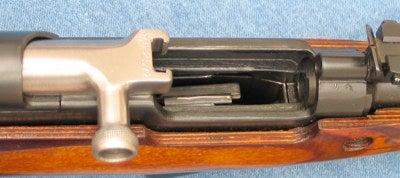
The SKS action with bolt held open. (not the SKS mentioned above, for illustration only).
Photo from Kywon.
This is an incredibly sad story. If you have been following this blog, youtube, or shooting magazines over the years you will have seen many photos and videos of gun being utterly demolished by a variety of mishaps, without causing any injury whatsoever to the user. The sad reality in this above scenarios is that guns are generally designed to fail without causing injury. In this case the user was holding the rifle action close the the body, not how it was designed to be held, which is at the shoulder.
I think this is a warning to all of us, complacency can be fatal!
Travis’s comments are below:
I am an attorney. A shooter had a misfire. He did not remove the magazine prior to working the action. He tried to inspect the breech and the action slipped out of his hand. This allowed the tip of the round from the magazine to act as a firing pin and discharge the round in the chamber. He was killed when part of the casing of the round in the chamber went into his chest. This could have been avoided if he had dropped the clip prior to pulling the action back to inspect. Some of the manuals you have on this site explain that one should remove the magazine prior to pulling the action back. I am trying to find a manual that was produced with the sale of an SKS. You have great manuals but they should accompany the sale to inform the user of this risk and how to avoid the risk. The shooter in my case had earplugs. He put the safey on. He had the gun pointer down range. Does anyone have an knowledge of this happening, i.e. a round from the magazine striking a round in the chamber and creating an accidental discharge?
I asked for clarification on the position of the rifle when the bolt was cycled and the injury sustained. His response:
User had a thirty round magazine in the SKS and had fired two rounds. The third round did not fire. We do not know why. Apparently the action did not close or the ejector did not work because the round was not ejected when he pulled the action back to inspect the breech. User had dropped the gun to his side holding it where he could inspect to clear the misfire keeping the barrel pointed down range. He pulled the action back to inspect and the action slipped out of his hand according to the eye witness. The round was in the chamber and was not ejected. The next round from the magazine entered the breech when he pulled the action back. When the action went forward after if slipped out of his hand, it drove the point of round two into the primer of first round and it went off. Round two was pushed back into the actiion and has been recovered. Round three bullet went down range, but the casing of the round entered the left side of his stomach about four inches above his belt and traveled upward inside his chest. I have a doctors deposition and x-rays showing the casing inside the deceased.
The casing traveled eight to twelve inches upward into the chest cavity after penetration. The area where the cartridge exploded is open to allow stripper clips to fed from the top. The leaves the shooter exposed when he has dropped the gun to his side to inspect for a problem. The tip of the full metal jacket ammo can substitute for the firing pin.
Is anyone aware of this? The SKS in my case was from China and was made by Norinco. They are a defendant in my case. I will explain to you or others the name of the importer and the wholesaler, but do not want to create problems with the trial date which is set for November, 2009.
Would you allow me to put my address and office phone number on this site. It would be more appropriate for me to visit personally with those who may have information that will help bring this matter to a conclusion. Once the case in concluded, I will go public with the result. I am sure there are those who agree and disagree. I enjoy guns. Many users by instinct will work the action automatically when faced with a misfire. Many users enjoy using a 30 round clip. That is the two things the defendants say my client did wrong.
Dont do that without first dropping the clip.
This is a serious problem. One should always drop the magazine or remove the live rounds from the magazine prior to inspecting the breech after a misfire. There are manuals that say this but I am trying to locate a manual provided with the SKS at the time of sale. It is necessary to warn of these types of risk. It is also necessary to explain to the user how to avoid the risk.
Maybe someone will learn from this. Maybe someone can help me determine what I need to do.
As far as whether I think an importer or manufacturer should be liable if a gun manual does not warn the user about a particular scenario, this is my view on the matter: I don’t think gun manuals should even be required to be sold with a gun, nor do I believe they should have to cover every single scenario. I believe it is up to the owner to learn how their weapon works. Guns are dangerous.
Regardless of you opinion about a gun importer being sued, remember the comment rules: civility is expected and uncivil comments will be deleted.
UPDATE: Just to clarify my own opinion, I do not think this is a Norinco specific fault at all.
I wasn’t going to add my 2 cents to this discussion since this thread is so old, but, after reading through the comments it seemed to me that many of the writers were either WAY overthinking the issue or did not have much real world world experience with the SKS rifle.
I first became familiar with the SKS in the 80′s when I came across a catalog from Navy Arms, which offered them as the “Cowboy Companion” scabbard rifle. It was an SKS “Paratrooper” short barreled version with the bayonet lug removed. Since I had my FFL I ordered one, and a few days later UPS delivered it to my front door. Sweet looking rifle. I bought a few boxes of surplus 7.62 ammo, went out to the range, and I was hooked.
I looked up several companies that were importing them and bought a couple for my collection. Being an avid customizer, I was interested to see how this little rifle could be modded and, after looking through a few more catalogs, I ordered up the full range of goodies available then for the SKS. At that time you could easily find a whole array of custon SKS parts. You could even order 75-100 round drum magazines! Soon I had a custom shooter with a bedded folding stock, detachable 30 round mag, extended mag release, fully adjustable rear peep sight, fiber optic front sight, see through scope mount w/variable scope and a combo muzzle brake/flash supressor. Back out the range and it was a tack driver out to 100 yards. The only weak link was the magazines. The were steel with the extended “duckbill” front and they would fail to feed every 15 or 20 rounds, usually with the round jamming into the backside of the chamber.
After ordering and trying several magazines from different manufacturers I discoverd that COBRAY had developed detachable zytel mags in 20, 30 and 40 round capacities that actually worked very well. In testing them I put so many rounds through the weapon (with nary a misfeed or jam) that when I set it on the shooting bench to change targets, it caught the bench rest on fire. The Rangemaster didn’t appreciate that too much, but he commented that I had one of the best modded SKS’s he had ever seen. I actually built this same setup for several people who had seen and shot mine and wanted one for themselves.
Then Patrick Purdy went on his little rampage, and as politicians are want to do, they decided to blame the gun and not the nutcase, and the “assault weapon” gun ban made owning these fine weapons a crime when simularly modded out.
All that being said, I completely believe that the fatal malfunction mentioned not only could, but probably did occur as described. Imported steel cased 7.62×39 rounds have been known to misfire and even break in the chamber. They even make a broken/jammed shell extractor specifically for the SKS because this has occured often enough to create a need for it. The deceased shooter may have had had a misfire due to a jammed firing pin. Some SKS’s have an un-sprung “floating” firing pin which can jam when dirty. If it jams while recessed you can have misfires. If it jams while extended you will experience an SKS on full auto until the magazine is empty or the firing pin un-jams itself. For whatever reason, he had a misfire with a live round in the chamber which may or may not have been stuck. In order to investigate the cause, and IMHO being unfamiliar with the weapon, resting the weapon on his hip, he pulled the bolt fully back, (possibly thinking it would lock) but the bolt slipped from his grasp causing it to (properly) try to chamber another round, which in this case being 7.62×39 meant it had a pointed FMC bullet which doubles nicely as a firing pin. But ooops, there was already a live round in the chamber.
Once struck, the steel case round which was unsupported because the bolt was driving another one forward, either fractured, and/or the chamber pressure blew the round or its remnants out of the receiver at a high enough velocity to pierce his abdomen and up into his chest killing him. Freak accident yes… but more due to user error than manufacturer error.
If you have a misfire on a STOCK SKS, the proper procedure would be to engage the safety, then POINTING THE MUZZLE IN A SAFE DIRECTION, set it down and wait a few minutes in case the round cooks off. Then, STILL KEEPING THE MUZZLE POINTED IN A SAFE DIRECTION, release the magazine catch to open the mag and dump all the rounds. Then you would close the mag and pull the bolt all the way back, which the bolt catch would now lock open. You can then extract the misfired round. This is not as easily done with a loaded 20, 30, or 40 round detachable magazine as it is locked in place and cannot be removed with the bolt fully forward, BUT IT IS DOABLE with a little knowledge and practice.
If you are familiar with the weapon, you know you can pull the bolt fully rearward, then pull up the internal bolt stop with you finger. This will hold the bolt open and the magazine can be removed. But, if the bolt did happen to slip or the catch didn’t engage, you would risk chambering another round. After trial and error, the way that I accomplish this, which only works if you have an extended magazine release installed, (see second COBRAY link below) is to 1: Engage the safety. 2: Grip the weapon by the magazine with your left hand, placing the side/back of your pinky finger against the extended mag release. 3: Resting the buttstock of the weapon against your leg or the bench while pointing the muzzle in a SAFE direction, SLOWLY begin pulling the bolt back with your other hand while simultaneously pushing the mag release rearward and rotating the the magazine down and forward. When the bolt is about halfway back, the magazine will release and you can remove it (and all the rounds) from the weapon. You can then either release the bolt, or pull it all the way back and flip up the internal bolt catch with you finger. It sounds more complicated that it actually is, but like anything else, with practice it becomes second nature.
Also, as a side thought, when using the COBRAY type zytel mags, which have a slot machined in the side for a cartridge assist button to help pull the follower and spring down as you load it, (pictured in the 2nd link when you scroll down) and you want to put a full mag into you SKS without jacking one into the chamber, you can proceed as follows. 1: Pull and lock the bolt back as described above. 2: Engage the safety. 3: Insert and lock the magazine into the receiver. 4: Insert the assist button into the cutout slot a few rounds from the top. 5: Pointing the muzzle in a safe direction, grip the weapon by the magazine, placing your thumb on the top of the assist button. 6: SLOWLY pull the button down with your thumb while observing the rounds in through the receiver, which will start to drop. 7: Gripping the bolt firmly, pull it back slightly to release the catch and SLOWLY slide it forward, holding pressure on the mag button and making sure a round is not extracted from the magazine till the bolt is fully closed. 8: POINTING THE MUZZLE IN A SAFE DIRECTION, disengage the safety and release the hammer with the trigger.
Anyway, those are my thought’s on the matter, simply my opinion. I hope it has added some insight to the issue. Iv’e included some links below for those who are interested:
COBRAY 30RND SKS Magazine:
http://www.keepshooting.com/sks-magazine-30rd-detachable.html
COBRAY Non front Tab Mag conversion Kit photo showing “assist button and extended magazine release:
http://www.sksboards.com/smf/index.php?topic=77127.15
GUNBROKER.COM SKS Parts Auction Board featuring an SKS drum magazine:
http://www.gunbroker.com/Auction/Browse.aspx?Cat=3042&PurgedItem=true
Webmaster… When you moderate this in the paragraph containing the instructions on how to change out a removable magazine after a misfire, please change “thumb” to “pinky finger”. It was late and I was a pit punchy when I wrote that.
Thanks!!!
I wasn’t going to add my 2 cents to this discussion since this thread is so old, but, after reading through the comments it seemed to me that many of the writers were either WAY overthinking the issue or did not have much real world world experience with the SKS rifle.
I first became familiar with the SKS in the 80′s when I came across a catalog from Navy Arms, which offered them as the “Cowboy Companion” scabbard rifle. It was an SKS “Paratrooper” short barreled version with the bayonet lug removed. Since I had my FFL I ordered one, and a few days later UPS delivered it to my front door. Sweet looking rifle. I bought a few boxes of surplus 7.62 ammo, went out to the range, and I was hooked.
I looked up several companies that were importing them and bought a couple for my collection. Being an avid customizer, I was interested to see how this little rifle could be modded and, after looking through a few more catalogs, I ordered up the full range of goodies available then for the SKS. At that time you could easily find a whole array of custon SKS parts. You could even order 75-100 round drum magazines! Soon I had a custom shooter with a bedded folding stock, detachable 30 round mag, extended mag release, fully adjustable rear peep sight, fiber optic front sight, see through scope mount w/variable scope and a combo muzzle brake/flash supressor. Back out the range and it was a tack driver out to 100 yards. The only weak link was the magazines. The were steel with the extended “duckbill” front and they would fail to feed every 15 or 20 rounds, usually with the round jamming into the backside of the chamber.
After ordering and trying several magazines from different manufacturers I discoverd that COBRAY had developed detachable zytel mags in 20, 30 and 40 round capacities that actually worked very well. In testing them I put so many rounds through the weapon (with nary a missfeed or jam) that when I set it on the shooting bench to change targets, it caught the bench rest on fire. The Rangemaster didn’t appreciate that too much, but he commented that I had one of the best modded SKS’s he had ever seen. I actually built this same setup for several people who had seen and shot mine and wanted one for themselves.
Then Patrick Purdy went on his little rampage, and as politicians are want to do, they decided to blame the gun and not the nutcase, and the “assault weapon” gun ban made owning these fine weapons a crime when simularly modded out.
All that being said, I completely believe that the fatal malfunction mentioned not only could, but probably did occur as described. Imported steel cased 7.62×39 rounds have been known to misfire and even break in the chamber. They even make a broken/jammed shell extractor specifically for the SKS because this has occured often enough to create a need for it. The deceased shooter may have had had a misfire due to a jammed firing pin. Some SKS’s have an un-sprung “floating” firing pin which can jam when dirty. If it jams while recessed you can have misfires. If it jams while extended you will experience an SKS on full auto until the magazine is empty or the firing pin un-jams itself. For whatever reason, he had a misfire with a live round in the chamber which may or may not have been stuck. In order to investigate the cause, and IMHO being unfamiliar with the weapon, resting the weapon on his hip, he pulled the bolt fully back, (possibly thinking it would lock) but the bolt slipped from his grasp causing it to (properly) try to chamber another round, which in this case being 7.62×39 meant it had a pointed FMC bullet which doubles nicely as a firing pin. But ooops, there was already a live round in the chamber.
Once struck, the steel case round which was unsupported because the bolt was driving another one forward, either fractured, and/or the chamber pressure blew the round or its remnants out of the receiver at a high enough velocity to pierce his abdomen and up into his chest killing him. Freak accident yes… but more due to user error than manufacturer error.
If you have a misfire on a STOCK SKS, the proper procedure would be to engage the safety, then POINTING THE MUZZLE IN A SAFE DIRECTION, set it down and wait a few minutes in case the round cooks off. Then, STILL KEEPING THE MUZZLE POINTED IN A SAFE DIRECTION, release the magazine catch to open the mag and dump all the rounds. Then you would close the mag and pull the bolt all the way back, which the bolt catch would now lock open. You can then extract the misfired round. This is not as easily done with a loaded 20, 30, or 40 round detachable magazine as it is locked in place and cannot be removed with the bolt fully forward, BUT IT IS DOABLE with a little knowledge and practice.
If you are familiar with the weapon, you know you can pull the bolt fully rearward, then pull up the internal bolt stop with you finger. This will hold the bolt open and the magazine can be removed. But, if the bolt did happen to slip or the catch didn’t engage, you would risk chambering another round. After trial and error the way that I accomplish this, which only works if you have an extended magazine release installed, (see second COBRAY link below) is to 1: Engage the safety. 2: Grip the weapon by the magazine with your left hand, placing the side/back of your thumb against the extended mag release. 3: Resting the buttstock of the weapon against your leg or the bench while pointing the muzzle in a SAFE direction, SLOWLY begin pulling the bolt back while simultaneously pushing the mag release rearward and rotating the the magazine down and forward. When the bolt is about halfway back, the magazine will release and you can remove it (and all the rounds) from the weapon. You can then either release the bolt, or pull it all the way back and flip up the internal bolt catch with you finger. It sounds more complicated that it actually is, but like anything else, with practice it becomes second nature.
Also, as a side thought, when using the COBRAY type zytel mags, which have a slot machined in the side for a cartridge assist button to help pull the follower and spring down as you load it, (pictured in the 2nd link when you scroll down) and you want to put a full mag into you SKS without jacking one into the chamber, you can proceed as follows. 1: Pull and lock the bolt back as described above. 2: Engage the safety. 3: Insert and lock the magazine into the receiver. 4: Insert the assist button into the cutout slot a few rounds from the top. 5: Pointing the muzzle in a safe direction, grip the weapon by the magazine, placing your thumb on the top of the assist button. 6: SLOWLY pull the button down with your thumb while observing the rounds in through the receiver, which will start to drop. 7: Gripping the bolt firmly, pull it back slightly to release the catch and SLOWLY slide it forward, holding pressure on the mag button and making sure a round is not extracted from the magazine till the bolt is fully closed. 8: POINTING THE MUZZLE IN A SAFE DIRECTION, disengage the safety and release the hammer with the trigger.
Anyway, those are my thought’s on the matter, simply my opinion. I hope it has added some insight to the issue. Iv’e included some links below for those who are interested:
COBRAY 30RND SKS Magazine:
http://www.keepshooting.com/sks-magazine-30rd-detachable.html
COBRAY Non front Tab Mag conversion Kit photo showing “assist button and extended magazine release:
http://www.sksboards.com/smf/index.php?topic=77127.15
GUNBROKER.COM SKS Parts Auction Board featuring an SKS drum magazine:
http://www.gunbroker.com/Auction/Browse.aspx?Cat=3042&PurgedItem=true
The fact that the SKS uses both detachable magazines and clips, and the fact that people keep interchanging them is getting confusing
Any update or source to this story?
I remember this guy posting on THR and ARFcom and just about every major gun forum. You can usually tell its a troll/fake when a one-post-wonder registers that day and simply disappears the next without ever replying.
Honestly, what kind of self-respecting ‘lawyer’ goes onto messageboards to get advice from random strangers on the internet? And I have a hardtime believe a piece of steel casing or even a whole steel casing would kill you. Not saying it hasn’t happened, but this whole story just screams fake to me.
My sks is to good and it’s a ak47, it shoots a 223 so it has not enough power to kill, that guy should have got an sks 223 ak like me, delete this message u peice of shot, if the bullet exploded and all the gas went into the air how was there any pressure behind the bullet to send it down range? I read the first three comments before angrily scrolling down to call bs. or the bullet is still in the barrel and the next person to shot is gonna be a lol on YouTube, again my ak 223 sks is the best handgun ever made pwned!!
the manual that shows the factory produced 30 rnd detachable mag rifle, also known as an “SKK”, explains no bolt hold open catch & safety unload instructions & the direction that the manual should “be transferred with it upon change of ownership” is at:
http://www.scribd.com/doc/21564844/China-Sports-Incorporated-instruction-Manual-for-China-Sports-Sks-Semi-Automatic-Sporting-Rifle
I realise this is an old post but there seems to be a lot of misunderstanding here both with the rifle type & commonsense, safety & that shit happens….
If anyone wants to get rid of their defective SKS’s I’ll send you a bolt action Chinese T-53 Mosin Nagant as a replacement. It has “slight wear”.
The plaintiff lawyer should refer to Steven’s post above before proceeding with the case. If it is not a SKS-D or SKS-M model, manufacturer is then fully off the hook. The same thing always applies to modified cars when claiming warranty work.
Mr. Blah makes the point which I tried to make in my earlier long-winded post.
The after-market magazine could not be removed with the bolt closed! Because of that, it was impossible for the operator to use ordinary safe gun handling practices; which is to remove the magazine first.
I have read the basic synopsis of the event and I am left with a question: how did the third round go down range? Was it a slam fire or was the shooter on the trigger?
i have a bit of a law background although a tradgedy this is a lost cause the senerio discribed can happen with any pump,lever or bolt gun should a live round unfire in the chamber and fail to extract and the person operating it is in a big hurry for example it would be in human nature to rapidly try a follow up shot on a game animal should the gun not fire first try,the round stays in the chamber and the next slams into the primer ALL firearm companies give explicit instructions for a dead round all recommend a waiting period before trying to extract and all recommend removal of magazines,i hate to say this but this person made a mistake that cost him his life…..it happens,he was responsible for his own death,not the rifle or ammo
you cannot remove an after market detachable clip from an sks rifle while the bolt is closed, unless if the lower bolt has been modified to prevent from being catch by the remove able clip, also Tapco USA makes an after market Bolt to prevent from having to open the bolt carrier to remove the clip while keeping the bolt carrier closed, how ever as said, in order to remove the clip the bolt and carrier have to be open, what your article is referring to is that he should have removed the clip prior to opening the bolt/carrier how ever that cannot be done with an sks that has been changed to use removable clips, I’m interested in what the out come was of the case ? did they mention what i have just mentioned ?
I don’t necessarily see it as a phony story cooked up by lawyers as much as a phony story cooked up by gun haters and the corporate control fanatics that are worried about the gun toteing out of work middle class pulling them out of their beds at night and settling the score for ruining the economy and flooding the country with Scareface wannabes.
This is a hoot, I just tried to email Norinco in China to see what the status was and AOL can’t send email there.
I wonder how discovery came out hahahahahahaha
I will be sure to let everyone know what is happening with the case when I hear anything.
Well where is this big terrible case being heard? It is November 2009 and the gun loving lawyer hasn’t obtained any support from this website.
We haven’t heard any more from the gun loving lawyer either.
If somebody hears anything let us “inquiring minds” know what happened.
This is a PHONY story. Its been cooked up by a law firm in Texas that is trying to hit pay dirt by stirring the pot to see if people will come forward about Norinco’s SKS misfiring. The goal is to gain “evidence”, ie, enough witnesses to successfully threaten Norinco into settling a monetary compensation agreement based on the threat that that the law firm has evidence that Norinco’s SKS caused damage to someone who had a run of the mill “Bubba” accident caused by his own inexperience with firearms. What the heck is up with people? Don’t you realize this is a freaking BLOG?? Its all opinion and “here say.”
This story doesn‘t quite make sense. My question is; Why did the case explode? So what if the ‘double feed round’ ignited the primer of the chambered round? So let’s get this straight; the bullet traveled out the barrel, the gasses push the piston backwards but they don’t contact the Bolt Carrier (BC) which is at this time retracted, and so the case simply stays put having the ‘double feed round’ holding the rear, and the throat holding the front. I mean, casings don’t explode when the chamber is closed, they fire the bullet then the piston cycles the BC and the extractor flings the intact casing out of the chamber. Cartridge casings are designed to have explosions happen inside of them without turning into shrapnel bombs; otherwise you’d fire one shot and the inside of the chamber would be destroyed by exploding casings. Also, I’ve never seen “tons of videos on YouTube about firearm malfunctions that cause explosion”; firearms just don’t catastrophically malfunction that easily at all. However, if this is a confirmed case, then it’s very sad and simply a freak accident; but Norinco can’t be held responsible since the operator used an aftermarket piece on his rifle. The aftermarket piece is the 30 round magazine being used. The SKS is built to use the 10 round attached internal magazine, not the junky aftermarket detachable magazines that companies sell. So using an untested and uncertified product on a firearm pretty much voids any fault that Norinco could be blamed with, for neglectful manufacturing or design. And finally, double feeds like the one explained here are common and happen from time to time with firearms, yet there’s no history of bullet tips igniting primers and sending shrapnel into the user. There are many methods to clearing double feeds, and they include cycling the action and/or opening the chamber.
It’s been some time since I’ve owned an SKS but I’ve always considered it to be one of the most reliable weapons that I ever owned.
I find it strange that a bolt, which had gone into proper “battery” postion on a properly chambered round ,both failed to fire and then eject the round when the bolt was pulled back manually. The odds against both things happening are rather large.
That then begs the question, “Did the bolt in fact achieve “battery position” on the chambered round and if not, why not? The obvious theory would be that the “chambered” round was defective for some reason and did not fully enter the chamber (had this round maybe fallen on the ground and was then stepped on, thus bludging the case; picked up and placed in the magazine, the mishaped casing then not able to fully enter the chamber, etc.?”) That would explain the failure to fire, and too the extractor may not have slipped over the rim of the mispositioned round for any number of reasons under such circumstances.
It would appear that the operator pulled the bolt back manually but failed to first clear the loaded rounds from the magazine, as should be done. Unfortunately the bolt handle slipped from his grasp and bolt stripped the next round in the magazine.
An alternative plot would be that a properly chamber round failed to fire for reasons unknown. The operator slowly pulled the bolt back and took control of the previously chambered round. After inspection he simply dropped it back into the chamber and then let the bolt fly forward, not thinking that the magazione was loaded.
Condolences to the man killed and his family, indeed sad. But as many have mentioned, and my career as an officer of the court, I see no case here. Everyone who owns a firearm should know how to handle it in case of a misfire, especially the part about keeping the bolt open and dropping the magazine, whether he was issued an instruction manual or not. Someone mentioned above that the SKS was not made for regular usage as it was just slapped together. That is not the case, the SKS saw front line service in 2 major wars, Korea & Vietnam and performed nearly as well as they AK, the reason the AK is the weapon of choice for most is that it had a detachable magazine + full automatic, and of course we know that SKS’s were not designed, originally, for that sort of thing. The SKS is a fine weapon, I own several, Chinese, Russian, Yugo and am going to buy a Romanian, they are absolutely fabulous, I also own an AK, and My weapon of choice for sheer accuracy is anyone of my SKS’ by a long shot. For quickness of course the AK. My M1A and AR are much better weapons, but to downgrade the SKS as cheap or something is nonsense, they are awesome guns that every rifle lover should own…
Again, my condolences to the family.
I have a hard time believing the nose of a spitzer style bullet triggered the chambered shell.Consider the imprint depth the firing pin implaces into the primer of a properly fired casing.Now consider the type of imprint the nose of the bullet would had to make to have enough penetration depth/damage to the primer to cause it to fire.It would almost surly have to hit the primer dead-on with shear perfection without sliding around or off the primer as the bolt slammes forward.(round pointed bullet might graze across the primer,but by the time the full pressure of the bolt hits its going to be jammed up on the casing head not the primer)This depth, is a safty mechinism of the primer,but isn’t fool proof.However,what ammo was used?Even foreign ammo would have this same safty trait for the same reason.TAKE THE CASING,AND SAME PRIMERS AND PUT THEM TOGETHER(WITHOUT BULLET OR GUN POWDER) AND IN A CONTROLLED EXPERMENT FIND OUT HOW MUCH PRESSURE IT TAKES TO IGNITE THE PRIMER WITH A BULLET HEAD! I bet it takes an insanely impossible amount especially after the boltslam force is compared to the findings.Lastly I wouldn’t be surprized that when enough press.is put to the primer with a bullet tip to ignite the primer,the primer is so damaged it fires both directions out the casing.I don’t know call me crazy,but have fun with this one attorney!
Winchester,Remington,Henry,and others all had the same probems around the Civl War Era when the first lever action tubular magazine fed rifles were put on the market. Cowboys and soldiers were the first to buy these famous rifles that one could “Load on Sunday and Shoot until Saturday Night.” The first problem all of them ran into was bullets pointed on the end acting as firing pins on the cartridge in tubular magazine stored in front of it. A chain reaction sometimes occured in the rifle scabbard as a soldier galloped across rough terrain. This is well documented and I have seen it mentioned several times in literature and video footage of the histories of these companies and their firearms.
I absolutely agree with the authors observations that the bullet from the offending cartridge had to have ended up in the ground near the victim for the casing to have been blown into the fellas thorax area. Perhaps the writer just hurried through the observations in a zeal for getting to the thesis statement or crux of the article. Common sense has to dictate for the weapon to “backblast” the cartridge base into the victims chest the rifle’s muzzle would have to be pointed at the ground nearby.
I don’t believe the Bush weapons ban had as much to do with the SKS rifles as much as Bill Clinton’s efforts. I remember a ship load of Norinco rifles being seized off the western coast of the U.S.A. during the Clinton years. At the time the sale of Chinese SKS rifles in the semi-auto format were robust. Upon examining the cargo from China on the offending ship thousands of full auto AK_47s were found in the shipment of SKS rifles.Norinco was banned at that time from the U.S.A…. To my knowledge the SKS was never produced in the full auto format. I have heard people brag about having a full auto SKS,but I believe these are rifles running with a broken sear or malfunctioning component in the firing control group of the weapon.
SKS rifles were manufactured by Russia,China,and all of the Communist block countries. The stocks on the Chinese military versions tend to be shorter due to the stature of the Chinese soldier. Norinco(owned by the Chinese Red Army) produced a civilian model for sale in the U.S.A. with a longer stock. Th Americanized rifle was first sold as “The Navy” rifle by Norinco. Many versions can be bought today. I joined my fellow sand miners in the mid 80s(I was working at a sand mine in South Carolina at the time) and we all bought the fixed 10 shot mag version Chinese rifles for around $100. A box of 20 rounds of Chinese ammo cost about $3. I have recently seen under the title SURVIVAL FIREARMS on YouTube.com a version of SKS that sells for about$700 from Eastern Europe that has a detachable 30 round magazine that can be swapped with the AK-47 mag. Many of the $100 Chinese rifles are being sold across the country now during hard economic times for $200-$250.
This is BS, how did the round go “down range” when he had the gun at his side tilted in a way that would be the perfect angle for the back of the shell to fly into his stomach and up into his chest?
If he was holding the rifle at his side and trying to clear the jam and this accident did happen, causing the back of the shell in the chamber to fly up into his stomach then the bullet that exited the muzzle would have hit the ground in front of him and not went “down range”
I also find it VERY HARD to believe this story, if the bullet did go down range after the accidental discharge that would mean the rifle was pointed down range like the user was firing from the hip, so the back of the shell casing flew at a 45 degree angle with enough force to penetrate skin 4 inches above the belt line, change its direction and travel upwards into the chest cavity 8-12 inches? umm ok
and besides a few LAPD officers already tried suing Norinco after getting shot in the North Hollywood Shootout and I dont think they got anything, after all china is a communist country who sells us lead tainted toys and poison dog food, a lawyer should be the FIRST person to know that American laws DO NOT APPLY in other countries, ESPECIALLY COMMUNIST ONES……DERP
The Comblock ammo (steel cased for the most part) has a lacquer coating and eventually the chambers get coated/sticky. Chambers have to be big for their ammo.
I know Ruger had problems with Comblock ammo in their rifles chambered for it but US brass case ammo gave none.
There is another possibility here in that it may have been reloaded ammo with one a overload or two a high primer which will cause a round to fire if the bolt velocity is high enough.
Be assured there is enough energy in some weapon systems to achieve a chambered round ignition (as outlined) and this is why the off center feed is built in.
I still feel we don’t have the whole story here.
I had a malfunction investigator tell me he was in court and the firm he worked for was getting ready to pay out big bucks because a gun blew up.
It struck him as funny as the bolt was locked solid and no one had thought to force it open to see what the case looked like. He told the attorneys to get court’s permission to hammer the bolt open and it was given. Bolt was opened and it was a reloaded round and the case was not even made by the manufacturer being sued.
So basically this guy found a lawyer who figured they would settle out of court and all would be happy but this investigator did his job and saved them big bucks.
I have 2 Norinco SKS’s, ATF tacticool and bone stock out of the box.
I have had them jam after running lots of rounds through them in the desert. With the action smoking hot. Breach hanging I guess this is Stovepiping, the breach ramp gets gummed up when hot and “dirty”.
Step one always always, first throw the safety on.
Step two keep it down range, the SKS open bolt design right away you know the round is not chambered right.
Step three drop the rounds, dump the mag, release the clip do whatever you need to do without “WITHOUT” touching the bolt handle.
Step four with the butt of the rifle on your hip and the muzzle down range, left hand on the forestock, rotate the weapon 90 degrees, open breach side facing down and pull the bolt back and let the round drop to the ground.
Now if the round fully chambered and you get a click and no bang, you have to worry about a slow fire or something else. Since you know you pulled the trigger and can assume the firing pin engaged the primer on the case.
You want to keep the weapon pointed down range and wait and wait, 30 seconds is usually enough time if nothing happens, drop the ammo from the normal firing position “breach up” and wait then while retaining a normal down range firing position rack the bolt back and look for the round to eject.
In the fatality example the round in the breach could not have been fully seated, upon pulling the bolt back the unfired round would have been ejected and a new round loaded instead.
Instead what happened “my guess” is the round fired, the ejector missed the rim of the case, causing it to be left in the breach, either a bent ejector or bad ammo case rim, bent case, BUT the bolt came back and partially cycled forward engaging the next round and pushing it forward until the nose of the bullet stopped at the case end of the un-ejected spent case.
User then looked, saw bolt in the open position but failed to account for the un-ejected case still in the breach, and did not place the weapon on safety. He then rotated the breach to him to directly observe the round “stuck” holding the bolt open, he then racked the bolt back “thus fully engaging the firing pin” and let go of it thinking it would ram home the round into the breach, since the weapon was on fire and now since the round is in the open breach the firing pin is not at its usual position being held by the trigger sear when the bolt went forward the firing pin engaged the soft primer of the case in the exposed breach and BANG the primer ignited the bullet was stopped by the un-ejected case and BOOM the case exploded causing the fatal injury.
The only way this fatality could have happened was the failure of the extractor to eject either the spent case or the unfired round that was already in the breach along with the attempt force loading of the next round.
The user did not properly clear the weapon before operating the bolt.
The user would have had a clear indication that a round was “stuck” and the bolt being held open in a non-normal-operation of the weapon.
The fatality could not have been caused by the round being “set off” after being striked by the tip of the next round, the SKS breach and the breach of any normal weapon is not big enough for this to happen, because the round being struck, would have to be fully seated inside the breach and chambered, that bullet would be free and clear to fly down range thus reducing the chance of the case exploding, if there was an unfired round in the breach, click no bang “lets assume slow fire round” user pulled bolt back, exctractor failed to eject said round, bolt pulled all the way back past mag well, next round picked up by bolt face pushed forward engaging the unfired round in the breach which now ignites “slow fire” causing the case to recoil back pushing the now open breached round to slam back against the open bolt and partially exposed firing pin thus causing the round to ignite and the bullet of round 2 to be blocked by round 1 in the breach, overpressure bursts the case and boom we get shrapnel…..
A chain of events statistically so narrow that the odds say that there was probably only one NVA that was killed due to this series of events. Out of the millions of rounds fired through SKS’s during Nam….
Glad to have helped and I just touched on the highlights of what is involved. We had a M60 MG blow up in Alaska. There was two soldiers unconscious in ICU. My office got a heads up and chief replied back asking whether the local commander wanted on site malfunction investigation.
As it turned out the local commander was “advised”by the local JAG type that he had authorization to conduct his own investigation and not get the techies involved and this is what he did.
As it turned out one of them died within hours of us being told to mind our own beeswax and then the local commander got to thinking it will not look good on his career so he then asked for our support. Chief wrote him back and basically told him under that reg he had taken control, it was his.
Had the local commander been wise he would have said come on and we would have had three guys out on command plane within hours and there would have been one guy sitting between the hospital beds 24 hours a day hoping one of them regained consciousness as we wanted to ask them one question.
That question was, “did you open the bolt on a misfire?”
The other died and we never knew but that is the nature of some military commanders. They don’t want anything on their records.
Once you have fired 150 to 200 rounds depending on firing schedule you will get the barrel to about 410°F. At that temperature the round sitting in the barrel has an internal temperature rise and when it gets to about that it cranks up and blam.
Thusly if you get one and you get this scenario . “well Elmer, what should be do, “I don’t know Fred”. ” Me either Elmer” “Maybe we should ask the sergeant.” “Yeah that is what we will do.” Counting nose picking, head scratching you are in the ten second plus range and as some have pointed out you have a small grenade in the making. You unlock the bolt and now the bolt and parts there of has become shrapnel.
Basically the rule of thumb is if you don’t open in five seconds, DON’T for thirty minutes. Sandbag it and keep it pointing down range for 30 minutes and keep everyone from in front of it.
We had stuff come in all the time and not one time had the “EXSPURTS” in the field do the preliminary work right. Never was the failed cartridge case sent in. This is critical to see the case.
While there I was called for jury duty on a major lawsuit wherein a hotel had burned to the ground five years before I arrived. They called 200 jurors in a town of 1200 and a county of 15,000. I did not know anyone or anything about it or what was involved and after the lawyers got through asking disqualifying questions all they had left was 12 women who had never worked outside the home. I was in the last six that got the axe. It was clear if you looked like you could walk and chew gun they did not want you.
With the experience I have gained since retiring as a firefighter I would have been one of the first to get the axe as that was about the third question they asked.
Several things to keep in mind. Assuming the ammo has been properly cared for a misfire is the fault of the weapon 99.99999% of the time. Either a design flaw, tired springs or operator modification or operator error which by the description seems to fit here.
There was a firm in the northeast that specialized in supply of EXSPURT witnesses in cases against manufacturers of various things. They had this idea to have all weapons have a device installed that did a certain thing and I got sent there to evaluate it. It was absolutely rediculous and would have made weapons have a reliability to fire severely degraded. It was tantamount to sewing the ripcord on a parachute down so it wouldn’t be lost. Never mind you couldn’t pull the rip cord till you cut the threads ! ! ! ! ! Same level of stupidity.
They wanted me to sign off on their stupid idea and I refused to even consider it. They had enough whores there already and I wasn’t in that business.
Having done malfunction investigations for the gov’t several things come to mind, some of which have been touched on and others have not.
1. Semi auto and full auto weapons are “generally” designed to feed follow on rounds so that nose of second round strikes the edge of the chamber (i.e. M14 barrel has scallops at 5:00 and 7:00) so that this is less likely to occur. I don’t have access to SKS to have a looksee, sorry.
2. I have not seen any evidence that the second round actually ignited the first round and is just assumed to have happened. I would need to see the case of the round that fired from open chamber. The condition of the primer will tell volumes of what may or may not have happened.
3. Chicom ammo is known for poor quality and reliability and it could have been a hang fire. ie. rifle goes click, bolt is opened, rifle goes bang.
4. These systems generally have a very deep and somewhat large striker indent and the chances of a second hit igniting a misfire is extremely remote. In my experience a second strike on a misfire rarely results in ignition though I have had several what I refer to as “click-bangs”.
5. The weapon apparently has been modified by the insertion of a non standard magazine which the design of which may have caused the follow on round to be directed to the center of the chamber rather than the edge. Again assuming this even happened has indicated is questionable as 99.9999% of the time these things happen a experienced malfunction investigator is not there and what people think happened doesn’t happen.
6. I question ability of the SKS from the open bolt position (with I assume another 27 rounds left in a 30 round mag) to achieve sufficient bolt velocity to achieve a ignition sequence. Primers must be struck with VELOCITY and ENERGY. Remove/reduce one of them and you will not get ignition.
http://www.eotacforum.com/viewtopic.php?f=15&t=46502&p=403633&hilit=it+don%27t+go+bang%2C+fires+misfires#p403633
A full magazine will require much higher velocity to strip a round from the compressed stack column and not slow the bolt assembly appreciably as it goes forward. As many have stated it is designed for a on board 10 round ammo capacity which will have much less compression related problems than will be evident in a 30 round uploaded to near capacity.
Readers having fired M1As, carbines, ARs, 9MM handguns etc will readily agree the weight of the slide eased down on the next round in the load sequence will not cause the round to strip from under the mag lips.
Thus in my experience your problem of proving negligence is going to be somewhat hard because if they bring in who I think they will bring in to defend them he is not only going to know this but was responsible for developing the methodology. To my knowledge the gov’t has never lost a case due to negligence in a design they have adopted.
First off you are going to need to get a complete set of engineering drawings from the manufacturer. Same for the manufacturer of the ammo and the after market magazine. Then you are going to have to get a ordnance engineer to examine them. AHHHHHHHHHH I don’t know ANY ordnance engineers that read, speak or know any Chinese except for menus. Next I rather doubt a discovery order issued by a US judge is not going to carry much water offshore???? If you get this you are going to have a stack of drawings estimated at four inches thick to go through.
If it were me I would buy at least 100 of the same make, model, brand of rifle and ammo certified to be the exact same as the one he had and using proper safety procedures see if you can duplicate the “reported” problem.
I would photograph each test with high speed photography that when run a normal speed will show the bolt closing very slowly to where it takes maybe fifteen seconds from bolt to the rear being released, stripping the next round and driving it into the primer of a chambered round. This is going to have to be fired in a ballistic Lexan proof rig to boot.
Now here is where it is going to get expensive, you need to conduct the test with misfired ammo to fully duplicate the condition. Don’t know what the Chicom ignition reliability is but US ammo only allows for one in a million misfires that is not traceable to the weapon.
By “certified” I mean the same lot number of ammo he was shooting. Different lot numbers may or may not have an effect.
You are also going to have to get coppers and a copper holder for 7.62X39 to determine just how much energy is available on the system. Copper holders are available from Pacific Tool and Gage. Coppers are available from Winchester. The holder and a carton of coppers are going to run an estimated $700.00.
As others have pointed out, your victim violated some inherent and published safety principles, i.e. failed to remove mag on a misfire being number one on the hit parade before doing anything else.
Don’t know if you have ever noticed but there are alot of after market spring kits floating around. If the guy changed ANY of the springs all bets are off. Since he changed the feed sequence for a cheap after market knock off to get more firepower that gives you a real big problem.
My gut level feeling based on your description is he (deceased) contributed to his own demise due to ignorance of the system he was operating and assuming you are going to front the test effort you are looking at a monumental outlay of capital.
Hummer, thanks for the informative comment.
SKS’s were not designed to have removable magazines therefore the user violated the terms of agreement with the manufacturer when the user operated a machine that was altered from its original intent of operation. THEREFOR! the user is 100% at fault for the injuries that happened to his personal self.
Moral of the story, you decide your own fate. Don’t be stupid, think before you act!
I’ve seen similar things happen to M1911 and ARs.
Fire some rounds out of the clip. One round was a misfire. (No powder? Can happen in reloading but also factory. Seen it before.) The primer fired and put the bullet into the barrel. Yanked the action and seated the next shell. BOOM! The M1911 usually just busts the barrel and jams the action. Blows a little gas in your face. I’ve heard of it blowing the side off of an AR.
Either way, I don’t sue Ford because it allows me to drive off of a cliff or go so fast around a curve that I slide off the road and hit a telephone pole.
This is a sad story but the people that are suing are making it SADDER! Stop it! Read the directions. YOU and YOU ALONE are responsible for your actions.
So how does one get hold of Travis the attorney? I have a manual that came at purchase time with my SKS in 1992 or thereabouts. It doesn’t have Norinco’s name on it anywhere, but it clearly says “In case of failure to fire, always keep the muzzle pointed in a safe direction and hold the firearm in this position for 30 seconds. After 30 seconds, REMOVE THE MAGAZINE, open the action, and retrieve the cartridge.”
R.I.P., guy.
Freak accidents happen.
Let us use the correct termanology…especially in a court room,trial,or meeting where scientific or engineering principles are discussed. A magazine is usually what most semi-automatic weapons will hold bullets in when placed within the firearm. A clip is usually used to load a magazine. In most cases a magazine is removable from the firearm. In some cases they are a fixed part of the weapon. The sks rifle has both a fixed magazine(That is loaded with a 10 rd. stripper clip) and newer models have a removable magazine. The m1 Garand had a fixed magazine within the rifle that was loaded with an 8 round clip. The m-16 rifle uses a magazine that was first issued in a size that held 20 rounds. The m-16 magazine in the military at that time was usually loaded with two 10 round clips. I hope this makes sense and that I am not being seen as being a nit picker. It may help people understand firearms technology a little better. I am by no means an expert when it comes to firearms. I do believe this information is correct…..Also rifles and pistols fire bullets….Shotguns fire shells…..hehehe
Tragic? Absolutely. Avoidable? Absolutely. I am also a lawyer and gun enthusiast. I find it highly distasteful and threatening to the 2nd Amendment to blame a gun for user error. Here, the user modified the weapon by putting a detachable magazine on a weapon designed for a fixed magazine. The could have been part of the problem for feeding or firing; and he HAD the option of removing the magazine before fixing the problem. If he had only removed the magazine, he would still be alive. USER error. Had he been more careful in pulling the bolt back ONLY partly, or not letting it slip, a second round from the magazine (he failed to remove) would not have fed and ignited the stuck round. USER error. Finally, anyone that owns an SKS knows that it came with a fixed magazine and they are advised to not put on a detachable mag. No manual would have corrected this persons mistakes, which are elementary for all shooters.
Look, guns go bang. If you use them, there are inherent risks. If you’re not competant to fix one when it doesn’t go bang, set it down and get help.
A lawsuit here is based on greed and pointing blame away from the deceased. And this lawsuit could likely draw negative press to firearms, the SKS (which I adore), high capacity magazines, detachable magazines, and “high powered” rifles, and “assault” rifles. For the interest of ALL gun owners the plaintiff should withdraw this suit so that others can continue to enjoy the sport of shooting.
I got in the habit decades ago of not pulling the bolt all the way back to check the chamber, no matter what type of action. Not only would that have prevented this shooters death, but it prevents more complicated jams. Even picking up a weapon with a closed chamber, I’d give it a half-cycle check to confirm the status of the chamber and magazine.
I think what everyone is missing in this case, is that an unfired round failed to extract/eject. The situation could have been caused by a failure of the bolt and extractor to fully engage the round in the chamber. This would prevent the firing pin from striking the primer, and allow for the extraction failure as well. Many rifles don’t have a battery safety mechanism that would prevent such a situation, and I’ll bet SKS’ are in that category.
Double feed cartridge injurys have been around since the adoption of the 1888 Comission Rifle by Germany. The problem finally resulted in the long mauser extractor for a controled cartridge feed.
The concept that Norinco did not put it in the manual is nonsense.
No firearms manual I’ve read warns that putting the barrel of a loaded firearm into your mouth and pulling the trigger is hazarhous to you health.
No car manufacture warns that driving into tree at 100 mph is not a good idea either.
Individual responsibility; requires the time and effort to understand the things you use. Failure to do so can be blaimed on nobody but yourself.
The other main problem in this type of case, is the lawers who are out to make work for themselver and dsoing so, abuse the justice system.
Brad
You explained perfectly what I was talking about. The after market 30 rd mag that I brought was just like the one pictured from Midway. It didn’t work nearly half as good as you explain. I couldn’t stand the thing. Now I removed the factory and fitted the 30 rd removable mag to my gun and all the tuning and tinkering wasn’t going to leave it a functioning or safe rifle, so I put the factory back on and it still shoots great. Part of my problem also could have been trying to fit an american magazine built for a Chinese SKS onto my Russian SKS. It would be nice to know in this situation if a gun smith did this conversion, an importer or the victim. I’m not too bad when it comes to guns but I’m not a gun smith and I could tell that my setup wasn’t going to work safely for very long.
Wow. I am very sorry to hear of this incident.
I have had a lot of experience handling various models of the SKS rifle, including aftermarket extended capacity magazines of various designs and the Chinese made so-called “SKS sporter” with a bobbed 16 inch barrel which used AK magazines. (Sadly the state of California forced me to give up my “SKS sporter”. Such is gun politics in commiefornia.) Because of this experience I might be able to help explain what might have happened.
First some background on SKS operation and handling.
The standard SKS rifle has a fixed 10 round capacity magazine, with the ammunition guide rails integral with the lower receiver. The floorplate of the magazine is hinged at it’s front and has a latch at the rear (near the trigger guard). Pulling back on the latch allows the floorplate to swing away, opening the magazine and unloading all the ammunition contained in the magazine.
When loading an empty SKS rifle, the magazine follower pushed up a bolt-stop, so that if the bolt carrier is pulled back far enough (or the last cartridge fired) the bolt stop will hold the bolt in the rear position. With the action thus held open by the bolt stop, the magazine can be loaded with single cartridges. Or a 10 round charger (some call a ‘stripper clip’) can be placed in the charger guide which is integral with the bolt-carrier, and the cartridges slid from the charger into the magazine with one smooth motion, after which the the empty charger is pulled from the charger guide.
(In actual practice SKS chargers are not easy to use. Sometimes a cartridge or two will slip off the end of the charger. And because of the curvature of a fully loaded charger, it is tricky to load all 10 rounds. It’s usually easier to just leave only 8 rounds on charger instead.)
It is Important to note that the bolt-stop is not manually actuated (unlike many other weapons which also have bolt-stops). There is no external lever or button to actuate or release the bolt-stop on an SKS. The only manual way to release the stop is by pulling back the bolt-carrier until the stop drops away and frees the bolt to move forward; which is the normal method of chambering the first cartridge into the barrel from a freshly loaded magazine.
Now some rare SKS rifles (such as the previously mentioned ‘SKS sporter’) made in China for export to the American market back in the late 1980′s and early 1990′s were modified to use detachable AK magazines instead of the normal feed mechanism. These SKS rifles operated much like an AK when loading or unloading.
Now here is where it gets tricky, and possibly dangerous.
The SKS rifles redesigned to use detachable AK magazines were banned from importation almost as soon as they first became available. But market demand was not swayed by that ban. Into that gap stormed the aftermarket magazine makers who made a bewildering variety of sizes and types of higher capacity magazines for the standard SKS rifle, and those aftermarket products sort of worked.
I was familiar with ones made under the “USA Mag” brand, but they pretty much all looked like this…
http://www.midwayusa.com/eproductpage.exe/showproduct?saleitemid=574069
Even though the product worked, it was a real bastardized design and probably not safe, and I’ll tell you why.
These products all worked by replacing the floorplate of a standard SKS rifle with the bastardized magazine. Some of these magazines were “fixed” as in the rifle had to be disassembled to remove them, and others were “detachable” though barely. The problem lay in the feed lips of these aftermarket magazines, because unless the bolt was fully retracted it locked these magazines to the rifle. If the SKS was functioning normally this was not much of a problem. The problem came during non normal functioning.
Let’s say you have a fully loaded SKS and for whatever reason (maybe a misfire) you want to unload the rifle. With an ordinary SKS this is simple: first put on the safety, then open the magazine floorplate to dump out the cartridges in the magazine, then pull the bolt open to remove the last cartridge sitting in the barrel. Not really much different from unloading an old bolt action Mauser.
But if you are trying to unload an SKS equipped with one of the bastardized “detachable” magazines, then things get complicated. Removing the so-called detachable magazine was really a three-hand operation: one hand to retract the bolt, another hand to pull the latch to release the magazine, and a third hand to actually pull the magazine away from the receiver. In any case it is impossible to remove the magazine without pulling back on the bolt first, which is not the safest practice especially in the case of a malfunction.
Anyway, I hope my long winded explanation is helpful and makes sense to you. Good luck.
Brad, thanks for the explination. I personally have not used those mag fed SKSs. I have never liked the idea. An SKS is not an AK!
^ +1 retDAC. Maybe when you say it like that, it makes the jury think, maybe the gun wasn’t as well-maintained as it should have been?
Anyhow, I played air-rifle for a moment to evaluate what *I* would do if I had a fail-to-fire in my SKS. It depends:
At the range: first, did the hammer fall? If so, wait a minute then pull the bolt all the way back but SLOWLY so the unfired round wouldn’t eject halfway down the firing lane. Tip it out onto the bench. Ride the bolt forward and set the safety ON, then inspect the cartridge. If it has a good primer strike it’s a dud, if not I’d probably try to fire one more round and then take the rifle out of service whether or not the next round fired, until I figured out what happened.
During action drills, it would get a tap on the charging handle and another trigger pull. By the time that’s done, the probability of a hang fire is rapidly diminishing, and it’d get a rack/tap/pull. That would send the unfired casing flying a safe distance in *my* rifle. In *that guy’s* rifle (allegedly) I would have had an impressive KB right in front of my face, maybe testing my shooting glasses.
I can’t think of a circumstance that has the rifle’s butt off *my* shoulder, but then, some people do the darnedest things.
I stated my other conclusions before. In prep for some general questions about this blog, I happened to reread this above the photo: “… It sent the bullet down range and a piece of the casing into the users stomach, causing death.”
What I noticed this time was the bullet going “down range”. If the bore is very badly worn, maybe there wasn’t enough friction to stop the bullet clearing it. But in a decent bore, with most of the pressure alledgedly forcing the case out at high speed, how would a bullet clear barrel more than a little, if at all?
Makes me now wonder if this incident truly is as reported.
Well this was a tragic example of operator error. the gun is an inanimate object. I believe this is a frivolous suit. There was at least one model Norinco put out that actually comes with and was designed for standard 30rnd AK mags. It is the Norinco Sporter. A fantastic weapon.
Excuse my French/Russian….
But what the heck does it matter if it was a 30 round magazine or a 5 round magazine.
This would still have happened!
I read the above comments. If this incident truly happened as stated, it is a genuine tragedy and I would feel sympthetic toward the deceased and his family.
It seems physically possible that the case from chambered round fired in this mannner could somehow enter the body in such a manner as to cause death. Highly unlikely, though. This would appear to be a “one in a billion” chance.
Please forgive any redundancy if I missed it but there is a point I did not see in the comments. Technically one should unload/remove a magazine before inspecting the chamber (even a chambered round). Remember some magazines can’t be removed.
Most people in CASUAL shooting would simply pull the bolt/slide to the rear and look in the chamber for a round/fired case. If present then examine the primer. Then decide what to do next: Either lower mag and let bolt go home for a second strike if round is present. Or lock open the bolt/slide and remove round/fired case.
In the latter instance, where no lock is available, then one had better remove/open the box mag. Tube mag: at least remove the round on the lifter before addressing the round