
Weight of combat gear taking its toll on troops
The US troops deployed in Afghanistan have to carry a serious load on high altitude rugged terrain and it is taking its toll. The Washington Post reports:
Army leaders and experts say the injuries — linked to the stress of bearing heavy loads during repeated 12- or 15-month combat tours — have increased the number of soldiers categorized as “non-deployable.” Army personnel reported 257,000 acute orthopedic injuries in 2007, up from 247,000 the previous year.
…
Individual Marine combat loads — including protective gear, weapons, ammunition, water, food and communications gear — range from 97 to 135 pounds, well over the recommended 50 pounds, a 2007 Navy study found.
In Afghanistan, soldiers routinely carry loads of 130 to 150 pounds for three-day missions, said Jim Stone, acting director of the soldier requirements division at the Army Infantry Center at Fort Benning, Ga. In Iraq, where patrols are more likely to use vehicles, loads range from 60 to nearly 100 pounds, he said.
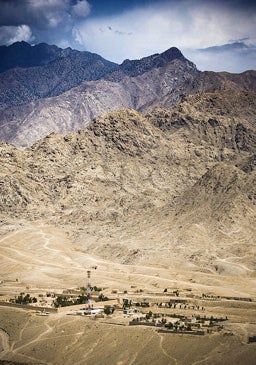
Emphasis mine. I will be thinking twice before complaining next time I am out on a hunt carrying a 9 lbs rifle. The below photo is a village at the base of the Hindu Kush Mountain Range in Laghman Province, Afghanistan. That is some nasty terrain.
There is a discussion about the article at ar15.com.
Thanks to Jay for the links.

thank you all
Combat loads typically has more than just 35 pounds of armor including weapons, communications gear, ammunition and other important fighting gears. We need to push forward with plans of cutting this weight and researching for more lighter ammunition, a better pack and gear that could improve agility and combat preparedness.
Not all joints are created equal. Adding weight to such a degree will express these differences, as the injury reports are showing. The military is always ready to win the last war? Well, hopefully this one will result in logistical changes to how we get supplies to troops and what those are made of (ie, lighter weight materials).
@Vote For David
Walking tall is great when you’re on a date.
But not when you’re trekking through mountain ranges loaded with Afghan snipers and .50 cal rifles.
Just sayin.
Keep in mind also, that 100lb loadout might as well be 200lb when at altitudes that average 6000 feet above sealevel. Afghanistan ranges between 4k and 20k above. At 6k, your oxygen intake can be reduced by 25% which adds greatly to muscle fatigue.
I see above that jdun1911 stated that average load for a compat troop in Vietnam was 40 lbs. I was in the 9th Infantry in the Mekong Delta, as an infantry soldeier, and I personally carried close to 80 lbs. most times. We worked hard to keep our loads low in weight, but necessity most times made us carry well over 40 lbs. At the least, my load consisted of an M-16, 24 mags, 2 canteens, radio, extra battery, long antenna for radio, machete, 5 to 6 smoke grenades, suspenders, hunting knife, flak vest, helmet, some food, poncho, liner, D-link (2), rope, flashlite, and any personal items you might want to carry.
Frank, I have a lot of respect for you!
Weight will depend alot on the unit SOPs. By our second month there, we had gotten rid of the IOTV and started wearing plate carriers, our helmets were replaced by ball caps and we never carried more than we needed. It still sucked to be the gun team, but those mountains arent bad in danner hiking boots and a plate hanger.
I agree with many of the posters- my wish, as a 6 year Infantryman and Fister (Forward Observer) for the last 2 years is to go to plate carriers. The ballistic lining that heavies up the IBA/IOTV isnt really needed, imo. The plates and side plates Ill carry… The new IOTV is awesome- it includes the side plates and feels like it weighs less than the IBA, but its about the same weight… I’d love to go to plate carriers to shed a couple of pounds though- as an FO I carry two radios, batteries for each, bullets, food, water, minimal personal gear (socks, etc.), laser range finder and batteries, bino’s- M22′s and M24′s, and a couple of 60mm mortar rounds. My RTO’s pack mimics mine for the most part, minus the Laser range finder, but he adds a few batteries.
Btw, Im in Afghanistan now.
The armor is heavy (20 lbs with plates), but the main thing is the ammo, radio batts & water. When you get in a firefight one SAW can go through 1000 rds easily. So you carry lots of extra. Sure 5.56 is lighter, but it adds up. Add in 60mm mortar rounds, AT4s and that is where you get 130lbs.
I was on an M240 team and my ruck was 110lbs, and this was in training. Iraq we averaged about 85lbs each – with the bare essentials. But the weight was mainly ammo.
Vote for David – get real man – posture has little to do with the injuries you get with humping a 110 lb ruck. A bigger factor is that guys get nagging injuries and keep going so as not to let the team down. A small problem turns into a crippling injury down the road.
When I was a Chinook crew chief in Afghanistan in ’02 almost every time a soldier had to step up the 1 foot onto the ramp to get into the helicopter he’d have a hell of a time. Especially the mortar guys.
It’s ridiculous the amount of gear that the grunts have to carry.
In Iraq we had to wear our entire IBA just to stand in a guard tower. After 4 hours into an 8 hour torture shift my shoulders and neck would be throbbing with pain from carrying that crap.
I’m so glad to be a civilian now.
Huah Sean,
But It comes down to a force protection issue. I would rather soldiers carry body army and make it home, then take a round and have to write their wives or parents. Been there done that, worst job in the Army.
We carried every piece of body armor we had in Baghdad, but there is a significant difference in the terrain of Iraq and Afghanistan.
Now with that said, there are ways to lighten the load, ODA teams wear different body armor that offers comparable protection with less weight. They also patrol with out their Kevlar helmet. Good luck gettting a line commander to okay that though..
Units could also plan missions differently, resupply by air, link-up operations to conduct LOGPACs just to name a few.
The list goes on and on, the bottom line is, BODY ARMOR SAVES LIVES, its heavy, hot, and it sucks to wear it everywhere, but I wouldn’t patrol without it and I wouldn’t let my soldiers either.
There are always two sides to every story. Just my two cents.
V/R
C_S
http://www.tsk.mil.tr/1_TSK_HAKKINDA/1_8_Video_Goruntuleri/video8.htm
http://haber.mynet.com/detail_news/?type=Actuel&id=X1197288382468&date=10Aralik2007
http://www.ntvmsnbc.com/news/436996.asp
http://img148.imageshack.us/img148/7296/eirdirkulenh9.jpg
http://en.wikipedia.org/wiki/Bivouac
http://www.msrgear.com/stoves/xgkex.asp
http://www.youtube.com/watch?v=n5iPKJAkdcE
Turkish army conducts mt ops for 2 decades and lots of lessons are learned many is waiting to be learned also.Truth is when a real mountaineer comes to military service you have a lot to learn from him;walking sticks(collapsible)oil cookers(msr xgk-whisperlite-dragon fly)bivouac,internal frame backpacks,correct usage of sleeping bags,correct usage of polar and goretex and their maintanance,tents,keeping your equipment dry,cooking up,melt the snow,fight hypothermia,test avalanche.Smugglers,mt villagers worldwide use castrated mules who are huge to haul large loads and animals have incredible capabilities like memorizing the terrain and sensing land mines.Our last offensive into northern iraq our soldiers carried huge backpacks many kgs belonged to just camping equipment,canned food etc(which proved useless).Latest youtube entry is from a retired commander who is a real patton style commander with incredible mobility tactics in mt areas,and he proved very successful results,politicians retired him prematurely to prevent a crossborder iran intervention who were supporting pkk at that time.Turkish textile industry supplies any kind of goretex,impatex,symapex,to any armies worldwide,while our infantry carry %100 nylon outerwear into ops and sweat into hypothermia or gtx outerwear maintained with normal detergents and lose their evaporation capabilities,useless in the end.At least microfiber with wool inside could change a lot.Last words;logistics,right training,mobility and learning from even villagers,mteers,and praying for preventing good commanders to serve longer who are like real father to his men;they are the hardest to be found.
I agree with you Sean, 100%.
I just wanted to point out that even with equipments that doesn’t weight much will effect you in the long run.
it’s the armor that’s the thing. IBA with AP plates weighs about 40 lbs by itself. plus about 10 for helmet, 20-30 for MOLLE vest and rounds, and then you can start thinking about weaponry. and that’s not even counting the water, food, and extra rounds you carry in an assault pack, probably another 15-20 lbs. as a grenadier i carried 20-ish lbs worth of 203 rounds at roughly .5 lbs each. and the poor gun team: the AG has a 25 pound tripod and 10 lbs worth of spare barrels, the gunner’s M240B weighs 25lbs, and the ammo bearer carries a couple of cans of ammo at probably 15 lbs each (estimates all).
i was 10th mtn, and it’s always kinda funny that people have this perception of us as “alpine troops.” we’re totally not, at least not right now; the most training i had with skis was familiarization on our battalion’s “mandatory fun day”, and we never did anything with ropes or climbing, never not once. too busy with the other stuff. we do have a higher degree of familiarity with being ridiculously cold, being in upstate new york, but that’s it.
we used donkeys to cart stuff up to op’s, but that’s it. there’s no getting them to hurry anywhere, and they are therefore somewhat useless during a mission, even a foot patrol. the only way to lighten loads for infantrymen is to drop the armor, but there’s no political or institutional will to do that.
The current weight that US infantry have to carry is ridiculous. US GI in WWII IIRC carried less then 30lbs. In Vietnam less then 40lbs. In Afghanistan/Iraq in some cases over 100lbs.
That’s why I advocate people not to put junk on AR15/rifles and only carry what they have too. More ounces = more pain. Weight kills.
You should only carry 1/3 of your body weight in the field.
i remember our co got these side plates delivered to the FOB that he was supposed to issue out, and he pretty much just said “no.” he had our supply sergeant lock them up in a conex and that was that.
in afghanistan, we’re not really combat effective because we can’t chase after these dudes carrying that much weight. as an infantryman, i’ll tell you right now that the majority of us would prefer to drop the armor and take the chance of taking one in the chest in order to have an actual shot at getting these dudes. but because the political leadership at the time was so risk-averse, just interested in maintaining the status quo, we couldn’t. hopefully that’ll change.
Sounds like, UC Berkley needs to hurry and and finish their exo skeleton
http://bleex.me.berkeley.edu/bleex.htm
I hate to mention it because it’s sure to bring the hate, but. . .
Nobody tells little boys to “stand up straight, chest out, shoulders back, chin up” anymore. Basic training only goes so far. Proper posture goes a long way toward reducing injuries from carrying too much. Those with musculoskeletal dysfunction will be well advised to read (and heed) Pain Free by Pete Egoscue before going on LLD because they are gimped up, and definitely before undergoing surgery of any kind.
Of course, if the Big Dog project would get sped up a little bit, this discussion would be irrelevant.
http://www.bostondynamics.com/content/sec.php?section=BigDog
In Romania mules to carry military loads into high altitudes were trained,some kind of imitation of Italian Mt troop mules which had snow shoes but with smaller sizes,they are forgotten in time;but I think everybody on the field knows mules are hard animals some even have 6th sense of evading mines,carry enormous payloads,they are battle worthy.Robotic mules are nothing more than money trap sci fiction pieces only in games only on youtube.Many mountain divisions around the world have different equipment,different angles.Soviets had mi26 helis to hover and capture high altitudes,they also trained hand picked spetsnaz style high altituders in the background many to be seen after the collapse of ussr at many high altitude mts around the world.pakistan army tried to do the same summit capture trick in the beginning of indian-pakistan mt conflicts,but troops had suffured exposure and high altitude sickness and many died,usa(famed old red devil brigade(http://en.wikipedia.org/wiki/Devil%27s_Brigade) and new 10th),german(gebirgjager),french,italians,swiss,spanish,british,even israeli mt troops have quality equipment and tactics,remember sas’s disaster in falkland fortuna glacier;http://www.naval-history.net/F32paraquat.htm
You can expect many hardships at the mountains but real hardship is to overcome higher authorities with lack of understanding deployment of small mt teams and their use of update equipment on the field.I saw youtube videos of pech valley ambush aiming at 10 th and wonder why us army havent bought Casspir apcs from South Africa,because in the same period of time many were bought by india for 25000USD a piece,yes as cheap as a truck in your backyard,which is mine proof and easy to operate,highly mobile equipment,the answer is PR,while Casspir apcs make people remember apertheid days,while india deploys them at kashmir.