
“Hole” vehicle armor being developed in UK

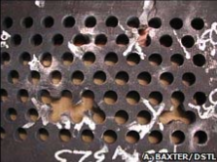
The Defence Science and Technology Laboratory in the UK is developing a new type of armor for vehicles that is cheaper and lighter to produce. It is made from ultra hard steel and covered in holes.
Picture 11-20
The armor.

The holes, or the edges of the holes, deflect bullets making them tumble so the “blunt” side hits the armor instead of the front. This spreads out the kinetic energy over the length of the bullet instead of it being concentrated at the front.

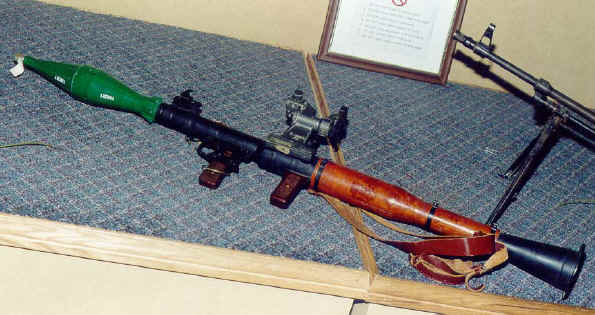
I don’t think this would have any effect on shaped charges, which are a mass of hot metal (usually copper), so this type of armor would probably be used in vehicles that would not be armored against shaped charges, such as RPG rounds, in the first place, for example VIP transport vehicles.
Rpg-7
RPG-7 launcher and grenade.

From the press release:

It may seem like a strange solution but introducing holes to vehicle armour can actually provide a ective advantage. The trick is to think of them as circular ‘edges’ rather than holes. When a bullet hits an edge, it gets deflected and turns from a sharp projectile into a blunt fragment which makes it much easier to stop. The introduction of holes also reduces weight. As a result perforated Super Bainite steel armour is ballistically very efficient.

Invented, designed and manufactured in the UK, Super Bainite is experimental high performance armour steel developed to save the lives of UK Armed Forces. Traditionally the MOD has utilised offshore suppliers to fulfil its specialist armour requirements. However, following successful industrial production trials, directed by Dstl in partnership with Corus and Bodycote, the UK is now well placed to develop a secure onshore supply of specialist, high hardness steel armour.

Hat Tip: Defense Talk and “null”.

Related Posts

Steve Jan 15th 2009 military Tags: , , , 9 Comments

9 Responses to ““Hole” vehicle armor being developed in UK”

  1. jdun1911on 15 Jan 2009 at 8:19 pm link comment

    I think the professor should go out and shoot some guns. It might work on non-AP light rounds like 5.56 and 7.62×39. I doubt it will be effect against larger caliber bullets.

  2. Bullet Boyon 15 Jan 2009 at 8:51 pm link comment

    Won’t the hole’s make for weaker metal also? Unless it is some type of cast system I doubt it will be much cheaper to produce. But then again the post says “covered in holes”. I’m gonna need to see pictures to fully comprehend or pass judgment.

  3. nullon 15 Jan 2009 at 11:55 pm link comment

    http://www.dstl.gov.uk/news_events/press/pr2009/7-1-09.pdf

    Here is the original press release the Defense Talk article is lifted from, and it includes a picture. After looking at the picture, it becomes obvious. It’s not the hole, it’s the edge of the hole. Since this Super Bainite stuff is stronger, it can be made thinner, and put on stuff like Humvees instead of just tanks…I think that is the angle they are going for.

    This super bainite stuff has been the topic of a lot of press releases over the last year or so. Looks to me like the UK is fishing for a customer.

  4. Steveon 15 Jan 2009 at 11:59 pm link comment

    null, thanks for the info.

  5. Lorion 16 Jan 2009 at 3:11 am link comment

    Buddy I am loving your blog, something I can actually read at work, great blog

    Lori

  6. Sven Ortmannon 16 Jan 2009 at 6:08 am link comment

    Steve, shaped charges don’t use “molten metal”.

    “It is universally agreed that conical liner collapse and target penetration both occur by hydrodynamic flow. However, it has been established by X-ray diffraction that the jet is solid metal and not molten. Additionally, best estimates of jet temperature by incandescence colour suggest a mean value of about 450°C, and copper melts at 1083°C at atmospheric pressure. So the following conundrum is the first confusion: The jet appears to behave like a fluid, and yet it is known to be a solid. One recent theory that would help explain this is that the jet has a molten core but with a solid outer sheath. “

    http://www.globalsecurity.org/military/systems/munitions/bullets2-shaped-charge.htm

  7. Steveon 16 Jan 2009 at 8:34 am link comment

    Sven, thanks for the correction

  8. EzGoingKevon 16 Jan 2009 at 8:57 am link comment

    I really don’t see it.

    What about a flechettes, claymore type weapon with smaller metal balls.

    Also there is huge reduction in liquid or gas type attacks.

  9. thekiton 15 Feb 2009 at 3:37 am link comment

    It’s probably designed as an up armor applique. If you space it far enough away from the very light armor skin of something like a conventional up-armor humvee, you might be able to predetonate the rpgs and ruin their focus, and also make all the ap bullets that strike the little holes keyhole and fail to be able to point their ap hard penetrator cores at the target.

    flechettes, might be able to pass through, provided the holes are greater than the diameter of the flechette or the flechette is long enough to stay on track when passing through the hard steel, and heavy enough to keep going after impact.

    on the other hand, I don’t know of any small arms that have successfully fired flechettes and have been fielded in any numbers. Even the .50 cal sabot round the marines use is actually a subcaliber projectile which is bullet shaped, rather than a long thin finned flechette.

    And I’m not sure what a blast wave would do after it goes through a whole bunch of little holes. Reinforce itself at antinodes and do more damage? need to do some physics there, or just study the damage after meeting an IED.

Leave a Comment

Comment Policy: I reserve the right to remove comments at my discretion. Think of comment threads like a dinner party at someone's house. If you make the party unpleasant for others or me, you won't be invited back. I am happy to tolerate a wide range of viewpoints, even extreme ones, but I'm not going to tolerate nastiness, rudeness, trolling, vitriol, or excessive snarkiness toward the author(s) or other commenters. You may make your case passionately, but civility is expected. Please stay on topic and respect the technical nature of this blog.
Spam Filtering: To avoid spam, comments are filtered using Akismet and then manually approved. Do not be alarmed if you comment does not appear instantly. I do not check the spam folder more than once per day.