
NASA’s hybrid air/gun powder gun

The latest Popular Mechanics (Jan 2009) has an article about the 12 foot long vertical gun NASA has at the Ames Research Center. The gun is used to simulate impacts from meteor and space debris.

What is very interesting is that it utilizes a hybrid air gun / gun powder system. It uses a gunpowder charge to accelerate a piston which compresses hydrogen gas to 100,000 psi (maximum pressure of a .338 Lapua Magnum is 60,916 psi). This propels a saboted projectile at 26,400 fps!

The piston system if very common. All spring air guns use it, even the simple springer airsoft guns use a simple piston system. The difference is they use a spring to propel the piston which compresses air.

Here is my attempt at explaining my understanding of how the NASA gun works:
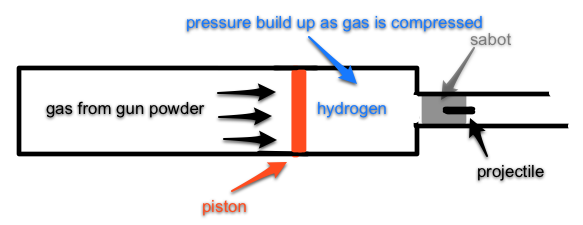
Nasa Gun
Excuse my drawing skills. Click to expand

UPDATE: A diagram by NASA of a Light Gas Gun (thanks to R.A.W and Billl):
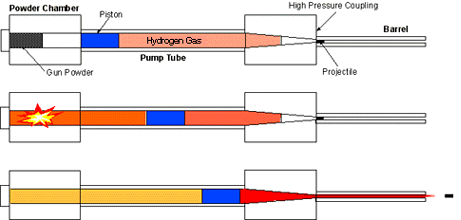
Gundraw1

I got it more or less correct :)

Related Posts

Steve Dec 17th 2008 air guns, strange guns Tags: , , 5 Comments

5 Responses to “NASA’s hybrid air/gun powder gun”

  1. jdun1911on 17 Dec 2008 at 1:26 pm link comment

    How small is the projectile and what is it made out off? It’s not lead because at that speed it will disintegrate once out of the barrel.

  2. Steveon 17 Dec 2008 at 1:31 pm link comment

    they don’t say. I wondered about that myself. It is saboted so there is no reason it could not be steel or iron.

  3. Billllon 17 Dec 2008 at 2:37 pm link comment

    The ones they have in Tennesee have a diaphragm between the big piston and the sabot, and the piston has a point on it to rupture the diaphragm when it gets all the way forward. The sabot can be anything that will support the weight of the device to be launched.It helps if you design the sabot and experiment in such a way as to prevent the experiment from sinking into the sabot, and failing to separate when launched.

    In Tenn. they were simulating things re-entering the atmosphere at 20+K Mph. The chamber they fired this into was pumped down to a near vacuum, and they took pictures of your experiment as it went by the small windows.

    The debris damage to the inside of the tunnel was fascinating to behold.

  4. R.A.W.on 17 Dec 2008 at 5:01 pm link comment

    It’s called a light gas gun:

    http://en.wikipedia.org/wiki/Light_gas_gun

    It works more or less like you’ve got drawn, although as Billl mentions, there usually is a diaphragm to prevent hydrogen leaking prematurely; a valve wouldn’t be fast enough, and hydrogen tends to leak through all but the very best-constructed of valves anyhow.

  5. Steveon 17 Dec 2008 at 5:03 pm link comment

    ah! thanks for the info. I have updated the post.

Leave a Comment

Comment Policy: I reserve the right to remove comments at my discretion. Think of comment threads like a dinner party at someone's house. If you make the party unpleasant for others or me, you won't be invited back. I am happy to tolerate a wide range of viewpoints, even extreme ones, but I'm not going to tolerate nastiness, rudeness, trolling, vitriol, or excessive snarkiness toward the author(s) or other commenters. You may make your case passionately, but civility is expected. Please stay on topic and respect the technical nature of this blog.
Spam Filtering: To avoid spam, comments are filtered using Akismet and then manually approved. Do not be alarmed if you comment does not appear instantly. I do not check the spam folder more than once per day.