
 Your Privacy Choices
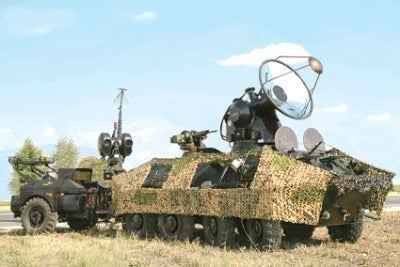
Greek company Soukos Robots S.A. have began to export their anti-RPG technology to Raytheon for use by the the US Army. From ΕΦΗΜΕΡΙΔΑ (Translated by enallos at MP.net):
In the context of a December 2006 deal, valued at 330 million USD with the US company Raytheon, Soukos Robots S.A. began to export products (kits) of special anti- RPG technology that is intended for the protection of combat vehicles and helicopters of the US Army. The effectiveness of the technology in question was confirmed after certified and successful trials were carried out in firing ranges in the USA. At this point it deserves to mark the continuous support of the hellenic MoD and more specifically the defence aquisitions directorate (ΓΔΑΕΕ).
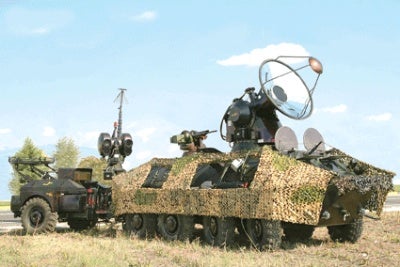
It appears to be be an evolution of slat/cage armor. The Patent has information on how it works:
It comprises of a protective grid (12) of special configuration and hardness. In the interspaces (19) of the grid (12) there exists a polyester foam (13) for its adequate electrical insulation. The grid (12) possesses a serrate conductive entrance (14) on the side of rocket impact (40) and a conductive cathode (15) on its other side. All the electrodes (23) are connected with an electronic control unit (16) in order for the data to be transferred from the impact surfaces to this unit. The unit (16) is programmed to terminate the electric energy produced by the piezoelectric crystal to an ignition head of the Rocket Propelled Grenade RPG when this rocket strikes against the conductive entrance (14) of the protective grid (12). It can be used for the protection against the lethal Rocket propelled grenades RPG.
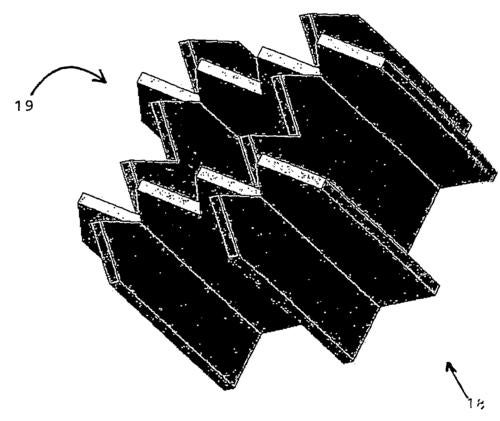
The saw-tooth armor design.
In summery: the saw-tooth armor carries a current sufficient enough to “shock” the piezoelectric transducer (the component which, when it hits something, causes the fuse to ignite) and so detonates the grenade early. The steel saw-tooth armor is designed in much away that it spreads out the explosion. Since it works against anti-armor grenades, I assume it disrupts the shaped charge. How it does this is beyond my understanding. If you have any ideas, please share them in the comments.
This technology has been talked about for some time, it is good to see it finally shipping.
More from the patent after the jump.
conductive cathode (15) at the other side of the net (11) , one at least appropriate connection plug (17) and a control unit (16) . Protection system against self- propelled grenades is characterized by the fact that it has the ability, during the impact of the rocket grenade at its first sensitive layer, which is the tooth shaped conductive entrance (14) , to destroy and interrupt the ■ electric power produced by the piezoelectric crystal that is placed at the firing head of the rocket grenade.
The system is characterized by the fact it protects all types of vehicles, public and private property, helicopters, airplanes in the ground of military use or not, various buildings, human’s transportation means, as well as radar units by terrorist and hostile action, where the risk of the launched rocket grenades is huge, for the human lives as well as for the material possessions .
In accordance with another feature of the invention, the layers (13, 14, 15) that it consists of contribute to the • high-speed destruction of the rest of the explosive hollow charge and of the rest mechanisms, due to the increased momentum of the rocket grenade during its impact to the mentioned system.
In accordance with a further feature of the invention, with its way of operation is prevented the creation of accumulated bulky detonation wave of enormous temperature (plasma) , so as not to procure the catastrophic and deadly results.
…
2. The protection system according to claim 1, wherein said protection net is of steel sufficiently harceled to protect against self-propelled grenades.
3. The -protection system according to claim 1, wherein said protection net substantially prevents passage of a self-propelled grenade through said front side to said rear side.
4. The protection system according to claim 1, wherein said protection net is of steel sufficiently harceled to protect against armor-piercing shells.
5. The Protection system according to claim 1, wherein said protection net substantially prevents passage of an armor-piercing shell through said front side- to said rear side
6. The protection system according, to claim 1, wherein said net is configured to prevent the passing of an accumulated detonation plasma wave through said front side to said rear side.
