Shot gunning from a tank: M1028

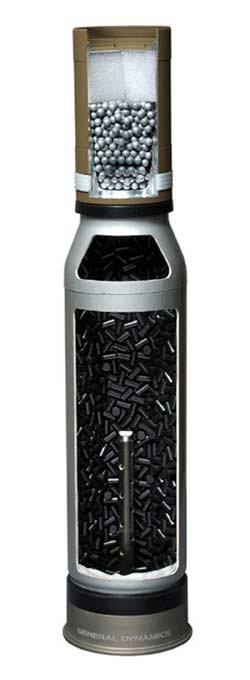
The M1028 is a 120mm shotgun shell for the M1 tank. The shell holds 1100 10mm tungsten balls. They are apparently lethal up to 700m (765 yards). Here is a video of the shell being fired in slow motion. It shows the shot breaking the sound barrier and the shot pattern (H/T to Sebastian).

I tried to calculate the weight of each ball. It depends on how pure the balls are. My calculations, based on a company that makes tungsten balls that weigh 18 grams per cm3, indicate that each ball will weigh about 145 grains. That is a combined weight of 159,500 grains / 10 kilograms / 22.8 pounds!

(4/3) x pie x 0.5cm ^ 3 = 0.52 cm3
0.52 * 18 = 9.42 grams (145 grains)

Please correct me if I am wrong.

The requirements of the round were:

  • Defeat >50% Advancing Squad w/ 1 Shot
  • Defeat >50% Advancing Platoon w/ 2 Shots
  • 200-500M (threshold)/100-700M (objective)
  • Muzzle Action (i.e. No Fuze)
  • No orientation of the projectile
  • Vulnerability no worse than current fielded
 Pics Soldiertech M1028-1
The M1028 cross section.

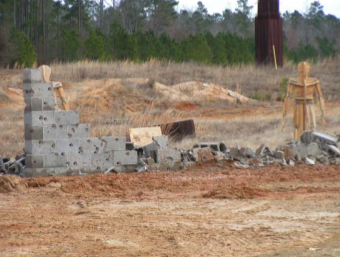
Here is a before and after shot taking during the testing of the round. I am not sure of the range.

Picture 15-12
Before

Picture 16-6
Two dummies survived, the wall did not.

The concept of shot is not new. Grape shot or loose stones, metal and glass have been used for as long as cannons have.

Grapeshot Treatise Closeup
American Revolution grapeshot

Sources of information:

M1028 - GARM Final (PDF)
Military.com
PSMVCC (PDF)
JinJu Powder Metallurgy

Related Posts

Steve Feb 29th 2008 ammunition, military, photos, video Tags: , , , , , , , , , , , , 14 Comments Trackback URI Comments RSS

Stumble    Bookmark    Digg    Reddit

14 Responses to “Shot gunning from a tank: M1028”

  1. Royson 29 Feb 2008 at 3:37 pm link comment

    I read about shotgun/canister rounds for the British Saladin armoured car a while back. Read somewhere that they were extremely useful for jungle warfare and counter-ambush work but can’t remember the exact source of this info.

  2. Steveon 01 Mar 2008 at 12:26 pm link comment

    Did you see the concertina wire test in the PDF? It looks like the shell has the opposite effect, as it restores damaged wire to a functional state.

  3. Steveon 01 Mar 2008 at 12:38 pm link comment

    Roys, thanks for that info, I will hunt around for it.

    Haha, Steve, yes I did see that. I think it is a pretty useful feature!

  4. Evil Punditon 01 Mar 2008 at 10:29 pm link comment

    I’m impressed by the grapeshot, but even more so by the way the high-speed camera can follow the cloud of balls all the way down the range. That’s some impressive target chasing capability.

  5. Evil Punditon 01 Mar 2008 at 10:42 pm link comment

    Also, I missed Roy’s comment. Some old tankers I know told me that the British [url=http://www.army-guide.com/eng/product903.html]Centurion[/url] also had canister ammunition for its 105mm gun.

    Elsewhere, I’ve read that some battleships could fire grapeshot from their 14- to 16-inch main guns — consisting of three- or four-inch balls, intended to discourage torpedo boats or destroyers. Unfortunately a quick Google search hasn’t turned up any examples of these.

  6. Daveon 06 Mar 2008 at 3:21 pm link comment

    How did a camera possibly track the shot like that? I’ve spent 6 years in the professional audio/video broadcasting industry, and never heard of anything capable of tracking like that. It’d need a *super* fast servo, and the left to right tracking would have to be predefined, based on a few previous test shots. Anybody know what was used to film? Other option is a special camera, with a *very* wide aperature that filmed the whole thing… all you see is a cut, moving segment of one solid video. Don’t know of anything capable of that either… last option is, CG hoax.

  7. Steveon 06 Mar 2008 at 3:26 pm link comment

    I remember reading something about the difficultly of recording shot patterns while they are in the air.

    Dave, if you figure this out please let us know!

  8. Nobodyon 11 Apr 2008 at 7:17 am link comment

    I would like to say, not much.

    1. The weight ratio to figure the weight of each ball is not correct. The final production payload weight is not the same as used in calaculations here.

    2. Camera? Most of these around here are capable of flight following projectiles at twice the speed of the CAN. Spark graphs measure in the 10 to the -9 range, (1 nanosecond) flight followers can capture at the 10 to the -12 range (1 picosecond). Slowed to human eye capabilities, one can off hand see the pause betwen a hummingbirds wing beat. If one were to be on break or pre-setup that is.

    3. Leave it to some powerpoint ranger to place the after shot under the word before, and before under after. Is good help still that hard to come by?

  9. Steveon 11 Apr 2008 at 9:48 am link comment

    Hi Nobody, are you able to tell us the correct weights?

    My weights were based on a commercially sold tungsten alloy.

    (Readers: Nobody hails from a .mil)

  10. Nobodyon 12 Apr 2008 at 1:56 am link comment

    Hey Steve, I’m not calling your ratio or equation; I’m calling the data used for the equation incorrect. The data that is widely available on the net and what is final production are not exactly the same. I can say that 10mm is not the actual size per tungsten ball. Additionally, the final production payload weight is different. The final snafu is what keeps our enemies and many times our allies as well, guessing. Did you know the parasitic weight of the aft body and the break away aluminum body is part of the payload weight? It is. The aft body can be clearly observed in the flight follower video. Further investigating on the web may produce another video taken from the muzzle angle. That video shows the break away panels, the dispersion of the payload, and the aft body. Take it however you like, but as a munitions technician, I commend you on a job well done with public release information.

  11. Frankon 24 Apr 2008 at 5:49 am link comment

    We had Beehive rounds for the 105mm and canister for the 152mm during Viet Nam. Both used flechettes (nails with fins). Beehive could be set to detonate at a range or at muzzle. The Cannister could only function at muzzle. Look up ‘Beehive’ and ‘Cannister’ on wikipedia for more details.

  12. Steveon 24 Apr 2008 at 8:42 am link comment

    Thanks for the info, Frank

  13. Nobodyon 02 Jul 2008 at 12:50 am link comment

    Found this link while conducting OPSEC on the net. Almost, almost!

    http://www.janes.com/extracts/extract/jah/jah_5345.html

  14. Nomen Nescioon 05 Sep 2008 at 3:58 am link comment

    i admit i don’t know how the footage was filmed, but i can see how it might have been. you wouldn’t need to track or pan the actual camera; use a rotating mirror instead to bounce the image into the camera lens.

Leave a Reply